



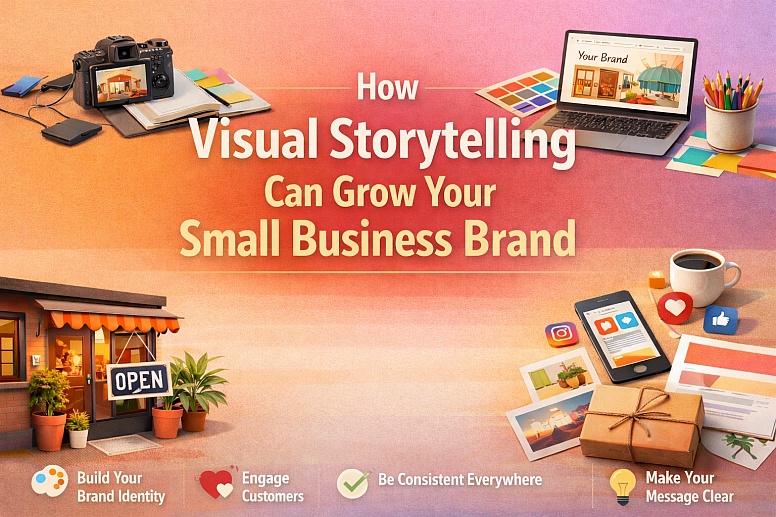
How Visual Storytelling Can Grow Your Small Business Brand
For local small business owners, solo entrepreneurs, and the web designers and developers supporting them, marketing often feels like a pile of disconnected posts, pages, and promotions.
The core tension is simple: brand identity challenges make it hard to look consistent and credible, and customer engagement struggles make it even harder to turn attention into trust. Those entrepreneur marketing pain points show up as mixed visuals, unclear messaging, and a website that doesn’t “feel like” the business behind it. Beginner digital branding gets easier when the brand starts telling one clear story.
Quick Summary: Visual Storytelling for Growth
- Use visual storytelling to strengthen brand identity with clear visuals that reflect your values and personality.
- Use story-led design to build customer engagement by guiding attention and creating an emotional connection.
- Use consistent brand visuals across touchpoints to improve recognition and trust as you grow.
- Use purposeful visual content to support marketing goals by making messages easier to understand and remember.
What Visual Storytelling Means for Your Brand
Worth clarifying the basics first.
Visual storytelling is using images, layout, color, and words together to tell a clear brand story. Your brand narrative is the message behind what you sell, and your visuals are how people feel and understand it in seconds. Because information processed by the human brain is largely visual, your design choices are part of your marketing communication.
This matters because “branding through visuals” is not just having a pretty logo. It is making every page and post say the same thing about who you help and why it matters. Strong visuals can also guide choices, since 63% of consumers are influenced by visual narratives.
Picture a service page for a home baker: warm photos, friendly headings, and simple icons for ordering steps. The story becomes “easy, comforting, and reliable” without extra paragraphs. A web designer can reinforce that story with consistent spacing, contrast, and clear buttons.
With the concept clear, you can pick one story moment and build visuals fast, then refine accessibility.
Use a 10-Minute Workflow to Generate On-Brand Visual Concepts
Visual storytelling works best when you treat it like a small, repeatable system: pick a story moment, lock in your brand cues, generate options fast, then refine. Use this 10-minute workflow whenever you need a new hero image, social post, product graphic, or landing page section.
- Pick one “story moment” (2 minutes): Choose a single beat your audience can see, the problem, the turning point, or the result. Examples: “before/after using the product,” “unboxing,” “behind-the-scenes prep,” or “customer win.” This keeps your visuals aligned with your brand narrative instead of becoming random “pretty graphics.”
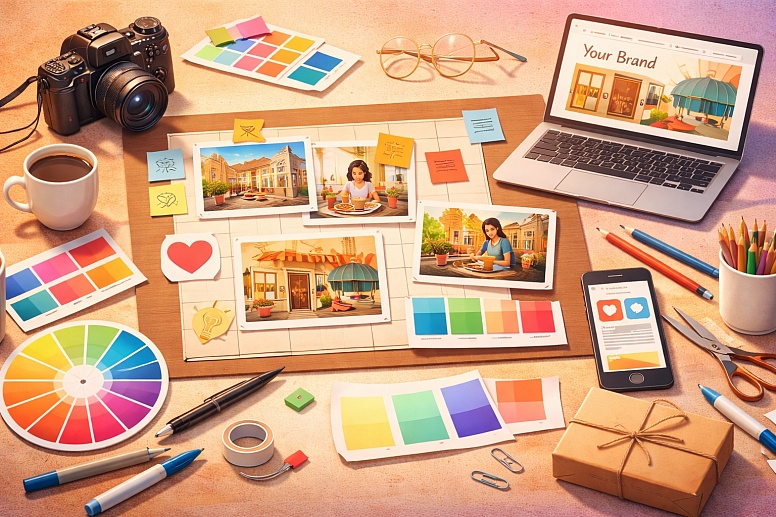
- Write a mini brand-cue checklist (2 minutes): On a sticky note or in your project doc, list 5 cues you’ll reuse every time: 2 brand colors, 1 font style (e.g., clean sans-serif), 1 texture/mood (e.g., airy, handmade, premium), and 1 subject rule (e.g., always show hands, always show the product in use). These cues turn brand imagery creation into assembly, not guesswork, and they help your site and social content feel like the same brand.
- Generate 10 options with plug-and-play storytelling prompts (3 minutes): Use visual content generation to create quick variations before you design anything, and this may help with generating AI art prompts for brand visuals. Paste your cues into prompts like:
- “Create a photo/illustration concept showing [story moment] with [mood], using [colors], minimal background, space for headline.”
- “Storyboard 3 frames: problem → process → result for [offer]. Keep props consistent with [brand cues].”
- “Create 5 thumbnail concepts featuring [product] in [setting], showing [benefit] without text.” Generate more than you need because branded content tends to earn a stronger audience response; one benchmark found that branded content drove a more positive reaction than traditional advertising.
- Choose a “best 2” using a simple filter (1 minute): Don’t pick the most complex concept, pick the clearest. Ask: (1) Can someone understand it in 2 seconds? (2) Does it match my brand cues? (3) Does it support the page goal (click, sign-up, purchase)? If it fails anyone, cut it.
- Iterate in an accessible design tool (2 minutes): Start from a template and make three quick edits: swap in brand colors, apply one consistent type style, and adjust spacing so the focal point is obvious. Beginners often over-design; instead, prioritize one subject, one headline, and plenty of breathing room. Visuals carry a lot of meaning fast; some sources note 90% of all information transmitted to the brain is visual.
- Save your “recipe,” not just the finished graphic (30 seconds): Store the winning prompt, the cue checklist, and the final export settings (size, margins, type scale) in a single doc. The next time you need a banner or post, you’ll be generating on-brand concepts in minutes, and you’ll have fewer “Is this consistent?” doubts to untangle.
Visual Storytelling FAQs for Small Business Brands
Quick clarifications to help you move forward confidently.
Q: What if my “brand visuals” are basically just a logo right now?
A: That is normal, and it is fixable fast. Build a simple kit you can reuse: two colors, one type style, and one photo or illustration vibe. A cohesive brand stays consistent across your website, social posts, and emails, so people recognize you even when the layout changes.
Q: How can I tell if a visual is telling a story or just looking nice?
A: If someone cannot tell what is happening in two seconds, it is decoration, not communication. Choose one moment your customer can picture, then add one clear focal point and a short headline. Test it by asking someone what they think you sell without explaining.
Q: Can visual storytelling work if I do not have pro photos or a big budget?
A: Yes. Use templates, phone photos in consistent lighting, and a repeatable layout system for speed. You can also collect user-generated content with a simple permission message and a shared hashtag.
Q: Should I prioritize accessibility even for marketing graphics?
A: Yes, because clarity is a conversion tool. Use strong contrast, large type, and avoid embedding key information only inside images. Add descriptive alt text for meaningful visuals and keep animations subtle.
Q: When should my visuals be “product-first” versus “lifestyle” or abstract?
A: Go product-first when visitors are close to buying and need proof, details, or a clear next step. Use lifestyle or conceptual visuals when you are building desire, explaining a problem, or introducing a new offer. Match the visual to the page goal, not your mood.
Keep it simple, keep it consistent, and let your visuals do the heavy lifting.
Ship One Consistent Visual Story to Strengthen Your Brand
Small business marketing gets messy fast when every post looks different and the message changes week to week. The fix isn’t more content; it’s applying visual storytelling with simple, repeatable choices that protect brand consistency. When those choices show up regularly, people recognize you faster, enjoy a more engaging customer experience, and small business growth becomes easier to measure and repeat.
Consistency turns scattered visuals into a story customers remember. Pick one story to share this week and ship it in the same visual style across the places you already show up. That steady rhythm builds marketing confidence and supports longer-term stability.



0.2445