



Top 10 Enterprise EDI Solutions for Modern B2B Integration
Electronic data interchange (EDI) remains the foundation of B2B commerce, supply chain management, and healthcare transactions. Organizations processing thousands of purchase orders, advance ship notices, and invoices each day need platforms that deliver reliability, speed, and compliance without adding operational complexity.
The right EDI solution transforms what could be a legacy burden into a competitive advantage. Modern platforms combine traditional EDI protocols like AS2 and EDIFACT with API-first architectures, real-time observability, and streamlined partner onboarding.
Whether you're connecting with retail giants, healthcare payers, or international logistics networks, selecting the right platform requires matching your specific requirements against vendor strengths in connectivity, mapping capabilities, and compliance features.
This roundup examines the top 10 enterprise EDI platforms based on their approach to partner connectivity, document transformation, monitoring depth, scalability, and industry-specific capabilities. Each platform offers distinct advantages depending on your ecosystem, operating model, and growth trajectory.
1. Cleo (Cleo Integration Cloud)

In a landscape where businesses often struggle to balance legacy stability with digital transformation, Cleo Integration Cloud offers a single, hybrid environment that natively supports traditional EDI standards alongside modern JSON APIs. By unifying these protocols into a true "Big EDI" strategy, organizations move beyond simple file transfers to achieve 100% visibility into their B2B lifecycles. This ecosystem approach seamlessly connects your EDI flows with ERP, WMS, and TMS systems through prebuilt connectors, providing end-to-end transparency across every order, shipment, and invoice.
By centralizing documents, acknowledgments, and business application data into a single interface, teams can eliminate disconnected silos and replace them with rapid partner onboarding and automated error resolution. Whether you are managing high-volume enterprise partner catalogs or extending connectivity through modern APIs, Cleo’s configurable dashboards provide the transaction-level insights needed to scale with confidence. Before committing to an enterprise deployment, organizations can validate their specific custom mapping complexity and pricing models to ensure a solution that turns integration from a technical requirement into a revenue-generating business outcome.
2. Orderful
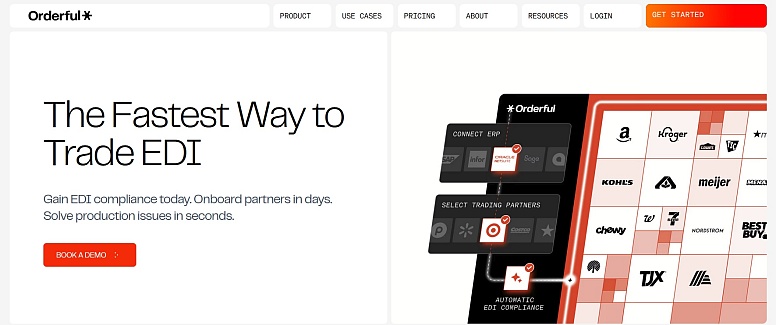
Orderful delivers cloud-native EDI with modern APIs and extensive prebuilt mappings for major retailers, 3PL providers, and healthcare payers. The platform's event-driven architecture publishes canonical events like OrderReceived and ShipmentConfirmed, enabling real-time workflows without tight coupling to legacy EDI protocols. Document-level and partner-level status visibility helps teams identify issues early, while collaborative validation tools reduce manual testing cycles.
Organizations evaluating enterprise EDI platforms appreciate Orderful's transparent pricing model and focus on reducing time-to-certify. The platform excels at standardizing partner onboarding through templated profiles and self-serve implementation guides. Teams in growth mode benefit from the combination of prebuilt mappings, REST APIs, and observability features that scale alongside business volume. The platform supports ANSI X12, UN/EDIFACT, and common healthcare transactions with strong compliance foundations.
3. IBM Sterling
IBM Sterling B2B Integrator provides enterprise-grade EDI capabilities with deployment flexibility across on-premises, cloud, and managed service models. The platform's extensive mapping library and robust transformation engine handle complex document requirements across industries. Large organizations value the deep compliance features, comprehensive partner kits, and integration with broader IBM infrastructure.
Sterling's architecture supports high-throughput scenarios with strong governance controls and audit trails. The platform handles AS2, AS4, OFTP2, and SFTP transports with mature security frameworks. Teams should plan for licensing complexity and align contracts carefully with expected document volumes and partner counts. IBM's managed services option can accelerate deployment and reduce internal operational burden.
4. OpenText Trading Grid
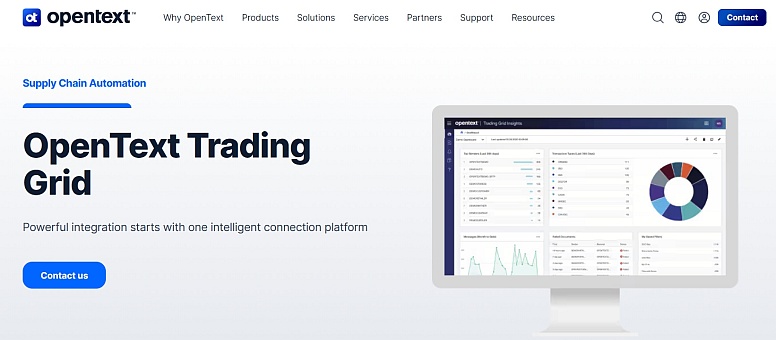
OpenText operates one of the largest B2B networks with an extensive global trading partner community. The platform combines EDI translation with managed services programs that handle partner testing, certification, and ongoing compliance updates. Rich partner kits and documented service levels provide predictability for complex supply chain programs.
Organizations benefit from OpenText's global operations footprint and experience managing retailer mandate changes. The platform's monitoring capabilities and exception handling support large-scale operations. Managed onboarding services compress implementation timelines while reducing internal resource requirements. The platform serves retail, manufacturing, healthcare, and logistics sectors with industry-specific compliance programs.
5. SAP Integration Suite
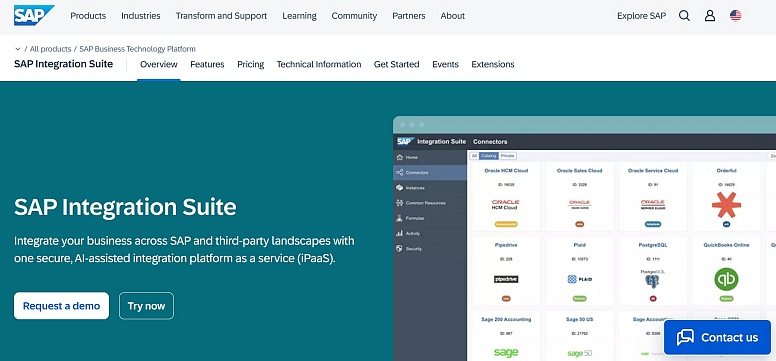
SAP Integration Suite provides cloud-native integration with B2B and EDI add-ons, while Microsoft Dynamics 365 Business Central development teams benefit from similar prebuilt content approaches for rapid onboarding. Prebuilt content accelerates integration with SAP S/4HANA, ECC, and other SAP applications. Unified governance across the SAP landscape reduces operational complexity for organizations already standardized on SAP infrastructure.
The platform supports common EDI standards and transports while maintaining consistency with SAP's integration patterns. Organizations should verify capabilities for non-SAP endpoints and confirm the breadth of AS2, AS4, and OFTP2 support for diverse partner requirements. The unified administration and monitoring experience benefits teams managing multiple integration patterns beyond just EDI.
6. SPS Commerce

SPS Commerce operates one of the largest retail-focused EDI and trading partner networks, enabling suppliers, brands, and logistics providers to connect with thousands of global retailers through prebuilt maps and standardized workflows. The platform emphasizes speed-to-compliance by handling partner onboarding, testing, certification, and ongoing mandate changes through managed service programs.
Following its acquisition of TIE Kinetix, SPS Commerce expanded its capabilities in global partner connectivity and e-invoicing, particularly across European markets. This strengthens the platform’s support for international compliance requirements while maintaining its core strength in retail supply chain integration.
Organizations benefit from SPS Commerce’s centralized network model, which reduces the operational burden of managing retailer-specific EDI requirements. The platform is well-suited for retail and consumer goods ecosystems, including drop-ship, omnichannel, and direct-to-consumer programs. Teams should evaluate flexibility for non-retail use cases, custom integration patterns, and API-driven workflows when considering SPS Commerce for broader enterprise integration needs.
7. Boomi B2B/EDI
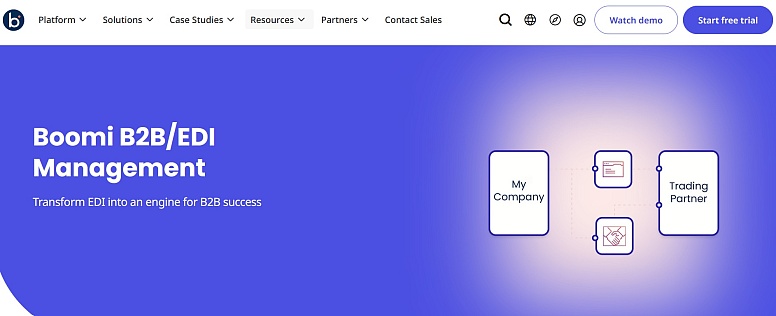
Boomi provides low-code integration with B2B and EDI packs built on the broader Boomi platform. Reusable library components and a large community knowledge base accelerate integration development. The platform connects EDI with SaaS applications and ERP systems through Boomi's extensive connector catalog.
Organizations already using Boomi for application integration can extend their investment to B2B scenarios with consistent tooling and governance. The low-code approach reduces technical barriers for mapping and transformation logic. Teams should validate AS2 and AS4 transport capabilities along with performance tuning options for high-volume scenarios before production deployment.
8. MuleSoft B2B
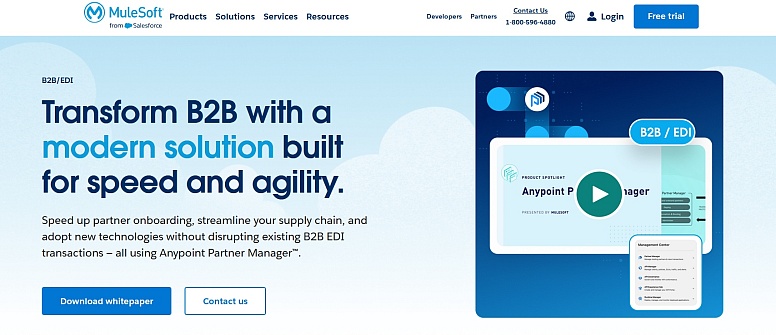
MuleSoft brings API-led connectivity patterns to EDI with bundles that combine traditional B2B protocols with MuleSoft's broader integration platform. Strong governance tooling and reusable assets support organizations standardizing on API-first architectures across multiple domains. The platform fits enterprises committed to decoupling legacy EDI from internal microservices through event-driven patterns.
MuleSoft's Anypoint Platform provides unified monitoring, security, and lifecycle management across EDI and API integrations. Organizations benefit from consistent development practices and operational tooling. Teams should assess the breadth of prebuilt mapping libraries and partner templates for their specific industry before committing to complex EDI programs.
9. TrueCommerce
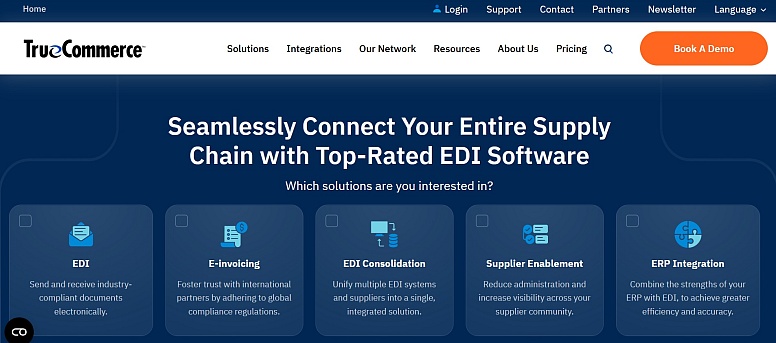
TrueCommerce operates a network model with managed onboarding services and a strong retail supply chain focus. Community connectivity and ongoing compliance updates help suppliers maintain alignment with evolving retailer mandates. The platform handles testing, certification, and production support through managed service programs.
Organizations value TrueCommerce's experience with retail programs and the operational relief provided by managed services. The network approach reduces individual implementation burden while maintaining flexibility for internal system integration. Teams should evaluate customization options and integration patterns to ensure alignment with internal architecture requirements and non-standard use cases.
10. E2open
E2open, now part of WiseTech Global, delivers enterprise-scale B2B connectivity through a global multi-enterprise supply chain network. The platform combines traditional EDI, API-based integrations, and region-specific compliance services to support complex, multi-tier supply chains across manufacturing, retail, and logistics.
As a WiseTech Global company, E2open benefits from deep logistics domain expertise and expanded investment in global trade, customs, and transportation ecosystems. The platform supports ANSI X12, UN/EDIFACT, and industry-specific message standards alongside country-level e-invoicing and regulatory requirements in Europe, Latin America, and Asia-Pacific.
Organizations with international operations value E2open’s ability to unify partner connectivity, document exchange, and supply chain visibility within a single network. Teams should evaluate how E2open’s network-centric model aligns with their ERP landscape, integration flexibility requirements, and desired balance between managed services and internal control.
Selecting the Right Platform for Your Organization

Choosing an enterprise EDI platform requires aligning your business requirements with vendor strengths across several dimensions. Start by documenting your priority document types, partner counts, transaction volumes, and compliance requirements. Map these against platform capabilities in partner connectivity, mapping libraries, monitoring depth, and industry-specific features.
Run a proof of concept with actual documents and real partners before making final commitments. Test your most complex mappings, validate acknowledgement flows, and verify observability features meet operational needs. Evaluate the total cost of ownership, including licensing models, professional services requirements, and ongoing support costs.
Consider your operating model and internal capabilities. Organizations with strong integration teams may prefer platforms offering maximum flexibility and customization. Teams seeking to minimize internal operational burden should evaluate managed service options that handle testing, certification, and ongoing partner changes.
Modern EDI platforms support both traditional batch patterns and near-real-time event-driven architectures. The right solution decouples legacy EDI protocols from internal applications through APIs and message brokers, enabling your architecture to evolve without disrupting partner connectivity. This approach transforms EDI from a technical constraint into a durable business capability that scales with your organization.
The enterprise EDI market continues to consolidate, with several platforms now operating as part of larger integration or supply chain software groups. Buyers should consider both current capabilities and long-term platform strategy when evaluating vendors.







0.276