




Tips & Tricks: Create Unique Content That Google Loves
Maybe you can’t woo the world’s largest search engine with a Christmas gift or with candy. But a bait that can actually work to make Google love you is the “content” of your website. It doesn’t matter which niche you’re working on; unique content can convince Google to rank it higher on the search engine results pages (SERPs).
But the problem is creating unique content that Google loves, and I know you are here to discover the secret hacks to make Google love your content.
If so, then I won’t keep it hidden from you. I’m going to share my personal experience about how to create unique and persuasive content that Google not just appreciates but also ranks high in SERPs.
What Google Loves in Content?
Google is an ocean of information and data. It is an interconnected way to utilize the internet and stay connected with the latest updates happening all over the world. The information on Google is primarily in the form of content (text) that people read and scroll through. This information on websites is ranked by Google based on two things:
- The first thing is how readers react to the content.
- The second is the authority of a website. High-authority websites will always outrank others. Forbes and the NY Times are the perfect examples.
In your content, Google’s reaction is based on how users will react to it. If your content follows certain things mentioned below, Google will recommend it to users. But if any of these factors go missing, you might not get the expected results.
The things are:
- Creators must focus on creating people-first content. Avoid creating content for search engines. This clearly means creating content that answers users’ queries, not the one that is keyword-stuffed and doesn’t provide a reliable solution.
- The content must cover almost every aspect related to the topic so that it can give a vast knowledge to your audience.
- Make sure your primary purpose is to provide valuable information, not to achieve a high ranking. If the content is valuable, Google will automatically rank it higher.
Content created with the intention to serve users with valuable and authentic information is always appreciated by Google.
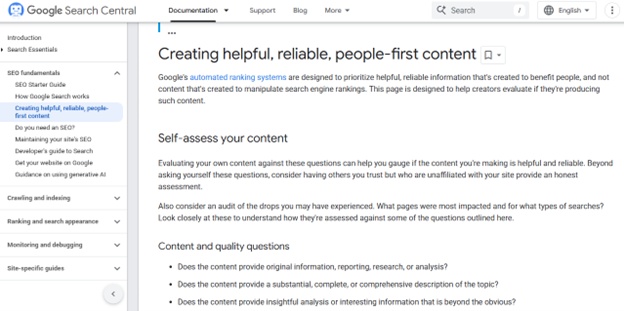
For more details, you can visit this link:
How to Write Unique & Captivating Content That Makes Google :) Happy?
Now that you have learned about what type of content Google loves the most, let’s talk about how you can write such content. The tips and tricks will give you a way to make your content both user-friendly and Google-friendly.
Your content should be plagiarism-free
First and foremost, the content you publish on your website must be plagiarism-free. The definition of plagiarism is:
“The act of using someone else’s written work as your own without giving any credit is called plagiarism.”
Google strictly prohibits plagiarism and doesn’t give any value to the content that is copied from any other online source. If it finds that your content matches any other online source, there will be consequences for that. You might get penalized for plagiarizing, or Google will simply de-rank your website without any warning, and it would take too much time to bring it to the top.
With plagiarism-free content, you show Google that you have brought something new and creative that no one else has talked about.
A critical thing to remember here is that you might also encounter accidental plagiarism that occurs when your own written piece gets matched with the information present on the internet. To avoid the penalty, one must remove plagiarism either by manually rewriting or with the aid of an online AI paraphraser. It can rephrase your content in a totally different style while keeping its main intent the same.
To save you time, using an AI paraphrasing tool is a great choice rather than manually rewriting. For a more natural and polished result, you can further use humanize AI text to ensure the rewritten content sounds authentic, engaging, and naturally written.
You must have experience & expertise in what you’re talking about
Google prefers content that is well-written, informative, and shows expertise of the person in the same field (circumstances). This is one of the most important factors in E-E-A-T (Experience, Expertise, Authoritativeness, and Trustworthiness).
Take an example. Suppose you’re writing an article on “How to lose 10 pounds in 143 days?” Now, what Google expects from such content is that it is written by a person who has worked hard to lose weight. This preferred experience, and the techniques and diets you followed to lose your 10KG weight, are the expertise (like how you did it).
Such content is more preferred by Google, and it can easily rank it higher in the search engine results page (SERP).
Your content must be useful and helpful for readers
Always write content that focuses on people-first, not search engines, and use Undetectable AI techniques whenever AI tools assist with drafting. Google loves content that gives users the answer to their question. They are either looking for information, news to read, or finding an answer to their question.
So, if you provide useful and helpful information to users, they won’t bounce back from your website. They will read it till the end, which will increase the dwell time. When Google notices such activity on your website, it will definitely rank it higher on the SERP, bringing more readers.
Besides, writing for humans also requires content to sound natural and human-written. Avoid utilizing AI content creation tools like ChatGPT or Claude AI to generate content and publish. Instead, humanize your text with an online text humanizer to give a more realistic and unique look to your content.
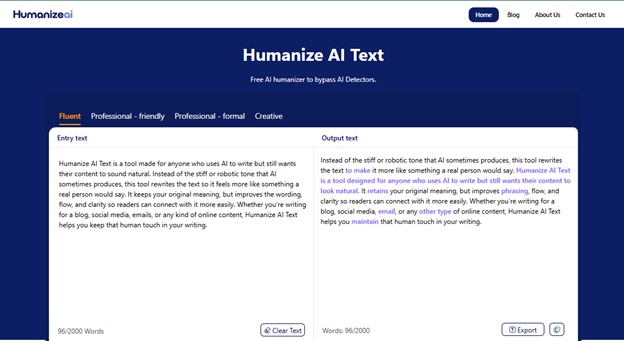
An AI text humanizer can add an emotional and personal touch to your content, making it feel more alive.
Your content should be perfectly structured and outlined
This is an on-page SEO factor, but Google prefers it very much. If your content is structured properly and provides an elaborate outline, it will help users understand each part of the topic. They can also easily navigate to a certain part they want to read if the content provides a detailed outline.
To structure your content, make sure it has proper headings (H1, H2, H3, H4, and H5). The least you can go for is H5, but if there is a need for more headings, then consider changing them to bullets or listings. That way, you will break down the pattern and add a captivating look to your content.
If you aren't sure how to structure headings, here’s a quick overview:
- There’s only one H1 in the whole content.
- H2s can be multiple, and they come after the H1.
- H3s are the subheadings of H2. Each H2 can have as many H3s as needed.
- H4s are the subheadings of H3, and you can’t rearrange them below H2 or H1.
- Bullets and lists can come under any heading since they are simple text.
With proper content structuring, you will be able to make your content well-structured and outlined for readers as well as Google.
Your content must cover all the relevant keywords
Keywords are the words or phrases that users search to find information regarding something. When you write descriptive content about a topic, covering the overall concept, you start to include relevant, focused keywords. This is also considered semantic SEO, in which you optimize your content not only for the meaning but also for the context. In simple words, you don’t just stick to the primary keyword and some of its relevant ones. You include all the relevant keywords, such as primary, secondary, and long-tail, to widen the reach of your content.
For example, if you’re writing about “weight loss,” then only sticking to weight loss isn’t semantic SEO. Also discuss how to maintain your weight if you achieve the target, and what to eat during your weight loss duration, etc. That way, you will be covering related entities regarding your topic, making it extensive and keyword-rich.
That way, you will also cover different keywords in your content so that it can rank higher in the search engines.
You must include an author bio
The ‘A’ and ‘T’ in E-E-A-T stand for authoritativeness and trustworthiness. If you want to show both of these factors in your content, one approach you can follow is to include an authentic author bio.
An author bio of a writer with the same niche experience is more authentic and reliable than one which isn’t belong there. For instance, if a person is experienced in finance management and you include their author bio under the SEO and content writing niche, it wouldn’t make any sense.
Include an author bio that shows similar expertise and experience. Besides, also include their social links such as LinkedIn, Instagram, Facebook, and X to showcase that the person is real and can be trusted.
Your content must be linked both internally and externally
Some people write content without adding links. There are two types of links in your content: internal linking and external linking.
Hyperlinking your content from one page to another on the same website using the same anchor text is called internal linking. If a user navigates to one of your content pages and starts reading it, the chances are that, with internal linking, they will navigate from one page to another, but will remain on the same website. This will boost the website’s stay time.
But that doesn’t mean you only internal link your content. Since you might also read the same information from another source, adding a link to that website shows credibility and builds loyalty. If you do not want to pass them authority but hyperlink the external websites, then add the “nofollow” tag. This will not pass the authority, but still, users can navigate to it.
These were some tips and tricks that, if you implement in your content, can help you achieve a high ranking in SERP.
Creating unique and valuable content that Google loves requires a focus on user needs, expertise, and proper structure. Avoid plagiarism, prioritize people-first content, and cover a broad range of relevant topics to boost your SEO.
Ensure your content is well-organized with clear headings and internal/external links. By implementing these tips and tricks, you can improve your chances of ranking higher in SERPs and providing meaningful content that engages both users and search engines.







0.2843