




Shopify vs Custom App: The Best Choice for US Merchants
In San Francisco’s fast-moving retail landscape, the question isn’t simply “Shopify or a custom app?” anymore. The real question is:
“Where is your business right now—and what stage of growth are you preparing for?”
Merchants in the USA operate in one of the most competitive environments in the world. That means your digital platform needs to evolve as quickly as the market does. Shopify and custom apps both have strengths, but they support different business phases, priorities, and goals.
So instead of treating them as direct competitors, let’s break the decision down by growth stage: Launch → Validate → Scale → Dominate
Stage 1: Launch: Shopify Wins Here
If your priority is getting online fast without tech complexity, Shopify is the natural first step.
What makes Shopify ideal for early-stage merchants:
- Launch in days using prebuilt themes
- No developers required
- Predictable monthly costs
- Built-in hosting, security, and PCI compliance
- Access to thousands of plug-and-play apps
For new or unproven concepts, the speed-to-market advantage is huge. Shopify lets you test offers and validate demand before investing heavily.
But the Limitations Show Up Quickly:
- You are locked into template layouts
- Heavy dependence on third-party apps
- Custom features require additional development
- Not suited for unique workflows or niche business models
Shopify is a great starting point, but it’s not always a great forever solution.
Stage 2: Validate: Shopify Still Works—With Caveats
Once the business is running and transactions are happening, merchants often start to feel boxed in by Shopify’s structure.
At this stage, typical challenges appear:
- You need features that require paid apps
- Monthly subscriptions start stacking up
- Custom logic or workflows aren’t supported
- Integrations with ERP/CRM systems become complicated
Shopify can still work here, but most merchants start paying more in add-ons than they expected.
This is the stage where many businesses begin exploring custom development for features Shopify can’t natively support.
Stage 3: Scale: Custom App Becomes the Advantage
When traffic grows, operations mature, or the business model becomes more complex, Shopify’s constraints become more apparent.
A custom app—built around your processes—lets you scale without depending on patches, plugins, or workarounds.
Why custom apps shine during scaling:
- Unlimited customization
- Ability to streamline internal workflows
- Built for high performance and high traffic
- Tailored user journeys
- Integrates deeply with backend systems
Instead of bending your business to fit Shopify, you build technology around your business.
This is also where partnering with a development company makes a difference—they understand local market expectations, user behavior, and tech trends specific to their local Area.
Stage 4: Dominate: Custom App Is Essential for Differentiation
When your goal shifts from simply “operating” to “owning your space,” Shopify becomes a limiting factor, not a growth enabler.
A custom app gives you:
- Complete control over branding
- Advanced personalization
- Faster performance
- Unique features that no competitor has
- Freedom from monthly plugin dependencies
This is how local brands develop experiences like:
- bespoke subscription systems
- on-demand delivery apps
- loyalty and rewards engines
- AR/VR try-on shopping
- marketplace platforms
You move beyond a store into a full digital ecosystem.
Cost Perspective: The Investment Curve
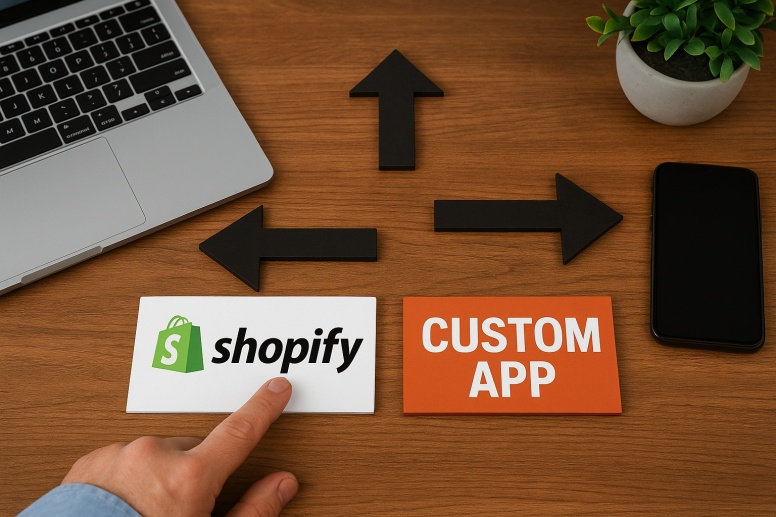
Instead of comparing Shopify and custom apps dollar-for-dollar, think in terms of timing:
| Growth Stage | Shopify Cost | Custom App Cost |
|---|---|---|
| Launch | Low | High (overkill) |
| Validate | Low–Medium | High (not needed yet) |
| Scale | Medium–High | Medium (investment makes sense) |
| Dominate | High (limitations force upgrades) | High upfront, high ROI |
Shopify is cheaper early. Custom wins later—because it eliminates restrictions and recurring plugin expenses.
How to Decide Based on Your Stage
Choose Shopify if you are:
- launching your first online store
- testing a business model
- operating on a limited budget
- not needing custom logic or integrations
- wanting a managed, no-maintenance platform
Choose a Custom App if you are:
- scaling operations
- needing full control over UX and features
- running a unique business model
- integrating with internal systems
- planning long-term digital investment
- competing in a saturated market
Why Local Developers Add Value
A local development partner understands:
- local consumer behavior
- design expectations
- speed and performance requirements
- local competition standards
They help with:
- user-centric UI/UX
- prototyping and MVP development
- ongoing updates and optimization
- tailoring integrations and architecture
- building future-proof digital systems
They’re not just coding—they’re creating a market-fit product.
Match the Platform to Your Stage
There’s no universal “best” choice. There’s only the best fit for where you are right now.
- Shopify → the fastest way to get started
- Custom App → the strongest path to long-term differentiation
If your goal is to grow beyond templates, plugins, and limitations, a custom solution becomes not just an upgrade—but a necessity.




0.3137