



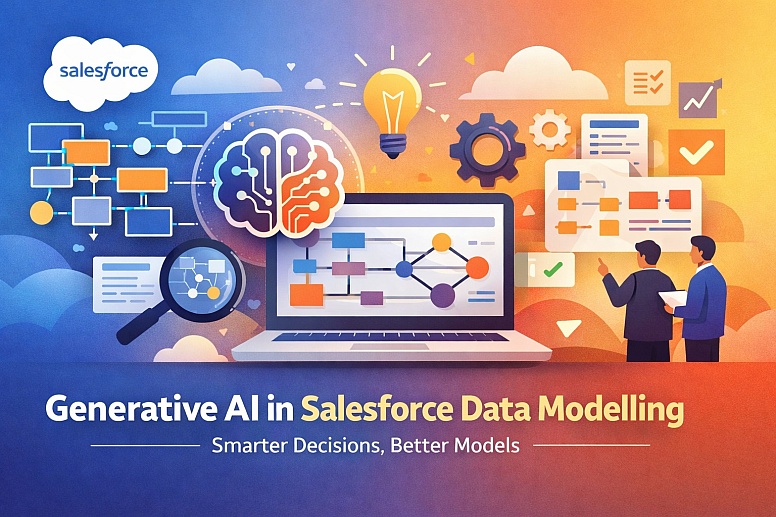
Role of Generative AI in Salesforce Data Modeling & Design
Salesforce helps organizations to store, process, and analyze essential information to maintain an efficient business process and improve customer experience. However, it depends on how the data is being modeled. Because if the structure is clear, teams operate faster and more confidently to adapt to change. When it's not clear, even minor changes can feel risky.
Especially, when traditionally, architects depend on personal experience and foresight to translate shifting business requirements into objects, fields, and relationships. Some choices gave results, some didn't. Generative AI is beginning to redefine this process; however, rather than replacing architectural thinking, it’s augmenting it.
How? Well, the GenAI in Salesforce is changing how design decisions are evaluated, tested, and refined before they turn into long-term constraints. We’ll discuss how GenAI informs Salesforce data modeling, reduces guesswork, and helps teams design with greater clarity and confidence.
What does Generative AI in Salesforce Data Modelling mean?
In the context of Salesforce, generative AI is more about interpretation than creation. It studies patterns across data models, organisational behaviour, usage trends, and known platform limits, then connects the dots that are difficult to track manually. So, instead of relying only on what has worked before, teams can assess design choices against broader evidence.
Therefore, guessing how a model might scale, or how similar structures behave in real environments, becomes easier and faster. This makes early-stage design conversations more informed and far less speculative, and the value shows not in speed alone, but in confidence. In addition, seeking generative AI development services ensures those insights bring in practical Salesforce models that scale reliably.
7 Ways Generative AI Shapes Better Salesforce Data Models
Let’s explore the impact of generative AI in creating better and more reliable Salesforce data models:
Design Objects Smarter
The decision on whether some item should be an independent object, a related record or an aggregate set of fields is not a linear process. These decisions have a huge impact when it comes to reporting, sharing, automation, and flexibility in the long run.
Generative AI simplifies it by checking similar Salesforce projects and spotting trends that remain relevant over time. It can surface when certain relationships tend to complicate reporting or when object sprawl leads to maintenance overhead. This does not eliminate debate, but it makes it an observable outcome rather than assumptions. Thus, design decisions become clearer, even when they remain complex.
Scale Without Complexity
Many Salesforce organizations begin life with overly complex data models as teams try to account for every possible future scenario, often before the current one is stable. The result is a structure that feels heavy and intimidating from day one.
Generative AI encourages restraint. By analyzing likely growth paths instead of imagined ones, it supports models that are simpler at launch while still extensible. So critical elements like fields, objects, and relationships are added when there is evidence they are needed, not just when they are conceivable. This reduces clutter without sacrificing long-term adaptability.
Early Visibility into Structural Risks
Some data model issues only surface after months of real usage, leading to queries slowing down; reports require workarounds, and automations become brittle as data volumes grow. But with generative AI, you can identify these risks much earlier by simulating usage patterns and assessing data access paths, an approach often strengthened with expert generative AI consulting services. Doing so highlights where performance or maintainability may degrade over time. Such an ability to spot weak points during design is far less costly than coming to them later, and, in addition, quite difficult to get through manual review alone.
Well-Aligned with Business Needs
Even a technically sound data model may fail if it doesn't align well with the way people work. Moreover, when the system doesn't represent real processes or objects that are abstract, users avoid using them. However, Generative AI fills this gap by matching data structures to business language and behavior. It helps demonstrate the models of how a team considers the accounts, opportunities, cases, or custom processes. It avoids compelling them to adopt strict technical abstractions, thus leading to increased adoption, cleaner data, and fewer downstream corrections.
Refine Models Continuously
Salesforce organizations are continuously changing because of new workflows, changes in responsibilities, and changes in reporting. But too often, data models that are deployed remain fixed. But using Generative AI, it can be more adaptive. The technology can propose improvements to the model and maintain consistency with the current use by analyzing each update, query, and creation of data. It leads to multiple benefits, such as retiring unused fields, restructuring objects with large loads, and simplifying relationships between them. This eventually makes data modelling a living practice and not a one-time task.
Embedded Governance Seamlessly
Governance is essential for Salesforce's scale, but it often arrives late and feels restrictive. Reviews catch issues after they have already spread across the org. Generative AI brings governance into the design phase itself. It flags inconsistencies, duplication risks, and deviations from established standards as models are created. This reduces rework and helps teams stay aligned without slowing delivery. Good governance feels invisible when it works.
Clearer Collaboration Across Teams
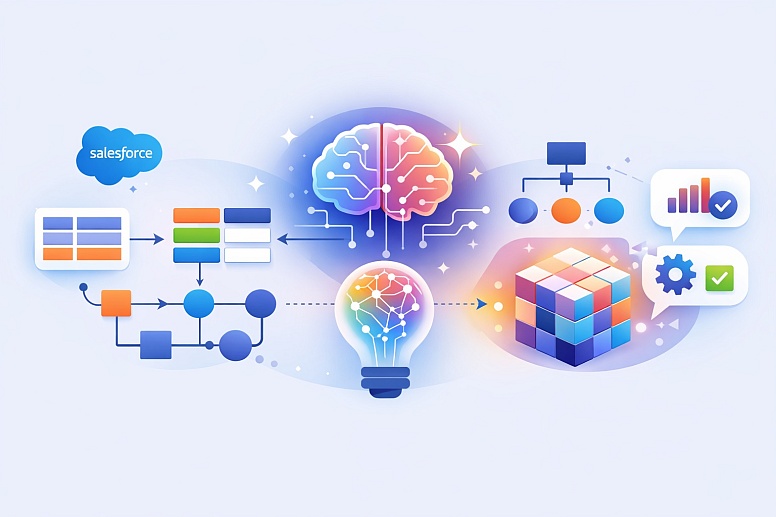
Salesforce data modelling rarely belongs to a single role; architects, admins, developers, and business stakeholders all shape it in different ways. Misalignment between these groups is common and costly, but not with Generative AI. As GenAI technology provides shared context, design options are accompanied by reasoning and potential consequences, making discussions more concrete. When conversations shift from personal preference to practical evaluation, this shared understanding improves outcomes more than any individual recommendation.
The Limits of Automation
Despite the benefits of Generative AI technology in Salesforce, one thing is very clear: it’s not without some challenges. One of the primaries being the way GenAI technology is unable to understand organizational politics, regulatory nuance, or strategic concerns. In addition, it cannot decide when a technically imperfect choice is the right one for the business or not. Therefore, Salesforce organizations as they continue to scale with Salesforce AI services, must ensure human judgment remains central.
It’s not just about eliminating the fear of technology replacing human resources, but it’s more about delivering decisions with greater clarity and understanding of their implications. When organizations use both AI and human oversight together, they can create designs that are both technically and ethically sound and are business‑relevant.
Salesforce data modelling has always been anticipating change, and by using Generative AI in the process, it adds scale, pattern recognition, and evidence. In addition, organizations also can also automate the process, make it accurate, and faster. But to make this possible, an organization must use it responsibly.
Your team should build data models that are easier to understand, maintain, and better align with how the business actually operates. To fully optimize the real value of generative AI in Salesforce, we recommend consulting certified Salesforce consultants. These experts possess know-how of GenAI and can help you simplify the process to make informed, agile, and accurate decisions.





0.1825