



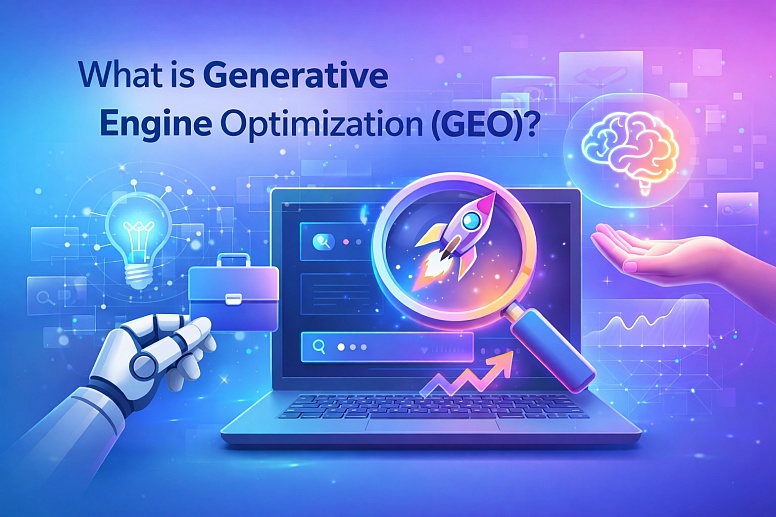
What is Generative Engine Optimization (GEO)?
Generative Engine Optimization (GEO) is a set of methods to help AI search tools pick your content when they generate answers. Regular SEO helps you rank in Google links. GEO helps you become the source an AI uses to write its response.
AI search tools like Google’s AI Overviews, Perplexity, or Bing Chat do not just list links. They read many pages and write one answer. If your content is clear and useful, the AI might use your facts. If your content is messy or hard to read, the AI will use someone else’s. This also connects to voice search optimization, because voice assistants like Siri and Google Assistant rely on the same kind of clear, structured content when selecting answers to read aloud.
GEO matters because more people now get answers directly from AI. They never click on your website. But if the AI cites your content, people still see your brand. They also trust you more. Over time, this drives traffic even without clicks.
What GEO Changes Compared to Traditional SEO
| Area | Traditional SEO | Generative Engine Optimization |
|---|---|---|
| Target | Search engine crawlers | AI language models |
| Output | Link position on page | Citation inside the written answer |
| Content need | Keywords, backlinks | Clarity, structure, factual density |
| Ranking signal | Domain authority, links | How often AI chooses your facts |
| User action | Click through to the site | Read the answer, maybe click the source |
Core Mechanics of Generative Engine Optimization
AI search tools work in three steps. First, they find relevant pages. Second, they read those pages. Third, they write a new answer by combining facts from multiple sources.
GEO focuses on steps two and three. You cannot force the AI to pick you. But you can make your content easier for the AI to read and use.
How AI models extract facts
Large language models (LLMs) break your text into small pieces called tokens. The model then predicts which tokens should come next. When an AI writes an answer, it pulls tokens from its training data. But for live search answers, it also pulls from web pages it just read.
The model looks for:
- Clear statements of fact (not opinions phrased as facts)
- Consistent numbers and dates
- Information that matches what multiple other sources say
- Text that is easy to parse (short sentences, active voice, simple words)
If your page buries the main point in a long paragraph, the AI may miss it. If you use passive voice or vague language, the AI may not trust it.
The difference between indexing and extraction
Indexing means the search engine knows your page exists. Extraction means the AI pulls a specific fact from your page to use in an answer. Many pages get indexed. Few pages get extracted from.
Extraction depends on:
- Fact density (how many verifiable claims per 100 words)
- Redundancy (stating the same fact in slightly different ways)
- Position of key information (put facts early in paragraphs)
- Absence of contradictions (do not say one thing then later say another)
What GEO is not
GEO is not about tricking AI. You cannot hide keywords in white text or stuff pages with invisible facts. Modern models detect those patterns. They also penalize sites that try to game the system.
GEO is also not about writing for robots instead of humans. The same clear writing that helps AI also helps people. Short sentences, active voice, and specific facts work for both.
Use Case Analysis
Use Case 1: Product Specification Pages
Companies that sell technical products need AI search tools to pull accurate specs. A buyer asks, “What is the maximum load for steel shelving unit X?” The AI should find your spec sheet and give the exact number.

Specific constraints
- Specs must match across all pages (product page, datasheet, manual)
- Numbers need units (pounds, kilograms, inches)
- Older products may have conflicting documentation
Common mistakes
- Writing specs inside paragraphs instead of tables or lists
- Using vague phrases like “supports heavy loads” without numbers
- Changing spec formats across different products
Practical selection advice: If you sell more than 50 products, build a template. Each product page must have a “Technical Specifications” section with the same structure. Use metric and imperial units together. Place the most searched specs at the top of the section.
Use Case 2: Medical Information Pages
Hospitals, clinics, and health websites want AI to use their symptoms or treatment information. A user asks, “What are the signs of dehydration in elderly adults?” The AI should pull from your verified medical content.

Specific constraints
- Must cite medical sources (studies, official guidelines)
- Cannot make claims without disclaimers
- Symptoms vary by age group, so specify the group
Common mistakes
- Writing long narratives about patient cases instead of direct symptom lists
- Forgetting to date the information (AI needs recency signals)
- Mixing treatment advice with basic information
Practical selection advice: Start every symptom or condition page with a bullet list of key facts. Put the list right after the first paragraph. Date each page at the top. Link directly to primary sources (CDC, WHO, peer-reviewed studies) so the AI can verify.
Use Case 3: Legal and Regulatory Summaries
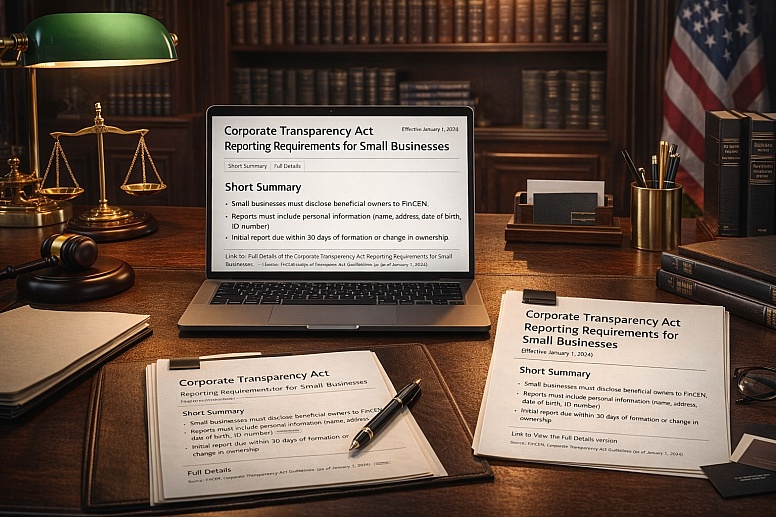
Law firms and compliance platforms want AI to cite their explanations of rules. A user asks, “What are the reporting requirements for small businesses under the Corporate Transparency Act?” Your summary should become the AI’s source.
Specific constraints
- Laws change, so pages need clear version dates
- Must distinguish between federal, state, and local rules
- Cannot simplify to the point of inaccuracy
Common mistakes
- Writing dense paragraphs with multiple clauses per sentence
- Burying the effective date in the footer
- Using “may” or “might” without explaining conditions
Practical selection advice: Create two versions of each regulation summary. One long version with all exceptions and conditions. One short version with only the most common scenario. Link them together. The AI will pull from the short version, but can check the long version for details.
Use Case 4: How-To Tutorials
Educational sites and software companies want AI to use their step-by-step instructions. A user asks, “How do I remove background from an image in Photoshop?” Your tutorial should be the AI’s source.

Specific constraints
- Steps must work in the current software version
- Must account for different operating systems (Windows vs Mac)
- Keyboard shortcuts and menu names change over time
Common mistakes
- Writing paragraphs that combine multiple steps
- Using “click here” or “then” without clear sequencing
- Forgetting to mention which version or platform the steps apply to
Practical selection advice: Number every step. Start each step with an action verb. Put each step on a new line. After the steps, add a short “What to expect” sentence. AIs use that confirmation sentence to check if the user succeeded.
Use Case 5: Comparison Articles
Review sites want AI to use their product or service comparisons. A user asks, “Which is better for small teams, Slack or Microsoft Teams?” Your comparison should provide the pros and cons that the AI lists.

Specific constraints
- Must compare the same features across all options
- Price, storage, user limits, and integrations must have current numbers
- Updates to one product require updating the whole comparison
Common mistakes
- Writing opinion statements without supporting facts (“Slack feels more intuitive”)
- Comparing different versions of products (free vs paid)
- Leaving out negative points, which makes the AI distrust the source
Practical selection advice: Use a table for the main comparison. Put features as rows. Put products as columns. Fill every cell. Below the table, add a “Best for” section that matches each product to a specific use case. AIs use that section to make recommendations.
Use Case 6: Financial Data Pages
Investment sites and banks want AI to pull their market data or fee schedules. A user asks, “What is the expense ratio for Vanguard Total Stock Market ETF?” Your page should provide the exact number.

Specific constraints
- Data must be updated daily or weekly
- Must distinguish between historical and current rates
- Fees often have conditions (minimum balance, transaction limits)
Common mistakes
- Writing rates inside narrative text instead of tables
- Forgetting to include the effective date for each rate
- Mixing different types of fees in one list without labels
Practical selection advice: Put all current rates in a single table at the top of the page. Below the table, add a “Historical rates” section with dates. If rates have conditions, put those conditions in a separate column, not in a paragraph.
Comparative Evaluation: GEO vs. Traditional SEO Methods
Most organizations already invest in SEO. GEO requires different tactics. The table below shows where they overlap and where they diverge.
| Tactic | Works for SEO? | Works for GEO? | Notes |
|---|---|---|---|
| Keyword in title tag | Yes | Yes | AI still uses the title for topic identification |
| Keyword density (2-3%) | Yes | No | AI does not count keyword frequency |
| Internal linking | Yes | Partially | AI follows links but does not use anchor text heavily |
| Backlinks from high-authority sites | Yes | No | AI does not check backlinks for live search answers |
| Clear headings (H1, H2, H3) | Yes | Yes | AI uses headings to find section boundaries |
| Bullet points and tables | No direct effect | Yes | AI extracts structured data more reliably |
| Long-form content (2000+ words) | Yes | No | AI prefers concise, fact-dense pages |
| Schema markup | Yes | Yes | AI reads schema but also reads plain text |
| Page load speed | Yes | No | AI reads cached text, not live pages |
| Mobile formatting | Yes | No | AI does not render pages visually |
Key differences to act on
First, stop assuming more words are better. A 5000-word page may rank well in Google. But an AI reading that page will miss key facts buried in the middle. Shorter pages with higher fact density perform better for GEO.
Second, backlinks do not help you get cited by AI search tools. The AI does not check who links to you. It only checks if your facts match other credible sources. Focus on consistency across your own pages, not on earning links.
Third, tables and lists are not just nice formatting. They are how AIs find structured information. A spec buried in a paragraph has a lower chance of extraction than the same spec in a two-column table.
When to prioritize GEO over SEO
Prioritize GEO if your audience uses AI search tools. That includes:
- Technical professionals (engineers, developers, data scientists)
- Students and academics
- Early adopters in any industry
- People searching for step-by-step instructions
Prioritise SEO if your audience has not yet adopted AI. That includes:
- Local service customers (plumbers, electricians, roofers)
- Older demographics
- People searching for physical products to buy immediately
Most sites need both. But if you have limited resources, choose based on your user data.
Expert-Level Considerations
Experienced practitioners know that GEO changes how you measure success. Standard SEO uses rankings, clicks, and time on site. GEO uses different metrics that most analytics tools do not show by default.
Measuring AI citations
You cannot see every time an AI cites your content. But you can see some signals. Set up brand mention alerts for your domain name. When an AI cites you, the answer often includes your brand name or URL. Monitor Perplexity, Bing Chat, and Google AI Overviews manually once per week. Search for your core topics. See if your content appears.
Another method is to track referrer traffic from “ai.google.com” or similar domains. Some AI tools send clicks when users ask to see sources. This traffic is small but valuable. It means the user actively wanted to verify the AI’s answer.
Handling contradictory information across your site
AIs penalize inconsistency. If one page says “Product X weighs 5 pounds” and another says “Product X weighs 5.2 pounds,” the AI may use neither. It may also mark your domain as unreliable.
Fix this by creating a single source of truth page for each product or topic. Every other page must link to that page or pull data from it dynamically. Use a content management system that centralizes key facts. Do not let different authors write different numbers.
The role of date freshness
AIs check publication dates and modification dates. If your page has no date, the AI assumes it is old. If your page has a date from three years ago, the AI may still use it for evergreen topics. But for news or changing information, recency matters more.
Add a “Last updated” date at the top of every page. Update that date even for small changes. Do not backdate pages to make them look older. Do not fake future dates. AIs can detect date manipulation through multiple signals, including sitemap frequency and crawl history.
How AIs handle disclaimers and uncertainty
If your page uses phrases like “may,” “might,” “could,” or “it depends,” the AI will note that uncertainty. For topics where certainty matters (medical dosage, legal requirements, safety instructions), avoid hedging language. State the fact directly. Add a separate section for exceptions or conditions.
For example, do not write: “The maximum dose may be 500mg depending on patient weight.” Write: “The maximum dose is 500mg for patients under 70kg. For patients over 70kg, the maximum dose is 750mg.” The AI can extract both facts cleanly.
Structuring for multilingual AI answers
If your site serves multiple languages, do not assume the AI will translate. Many AI search tools answer in the user’s language by reading pages in that language. They rarely translate from English to Spanish. You need separate pages in each target language.
But do not just machine translate. AIs detect low-quality translation through unnatural phrasing and token patterns. Pay for human translation of key pages. Keep the same structure (tables, lists, headings) across all languages so the AI finds facts in the same positions.
Failure Modes & Misconceptions

Failure Mode: The AI picks your competitor even though your facts are correct
This happens when your competitor states the same facts more clearly. The AI does not know who is “right.” It knows who is easiest to read. If your page has long sentences, passive voice, and no bullet points, the AI will struggle. Your competitor with short sentences and tables will win even with identical information.
Fix this by rewriting your key pages using the GEO checklist:
- Average sentence length under 15 words
- Active voice for every verb
- At least one bullet list or table per 300 words
- The key fact appears in the first 100 words of the page
Failure Mode: The AI cites your page but gets the fact wrong
This happens when your page states the fact confusingly. For example: “The battery lasts 8 hours, but if you use the screen at full brightness, it lasts 4 hours.” The AI may extract “battery lasts 8 hours” and ignore the condition.
Fix this by putting conditions in a separate sentence or bullet point. Write: “The battery lasts 8 hours at 50% screen brightness. At 100% screen brightness, the battery lasts 4 hours.” The AI now has two clean facts instead of one confusing fact.
Failure Mode: Your page disappears from AI answers after an update
AIs update their models and their crawling patterns. A page that worked last month may stop working. This is not a penalty. It just means the AI changed how it extracts facts.
Monitor your brand mentions in AI answers weekly. When you see a drop, check your page structure. Did you add new content that buried the key facts? Did you remove a table that the AI relied on? Reverse those changes first.
Misconception: GEO is the same as optimizing for featured snippets
Featured snippets are the boxes at the top of Google search results. They come from Google’s traditional search algorithm. GEO applies to AI-generated answers that are not snippets. The two systems work differently. A page can rank for a featured snippet but never appear in an AI answer. The reverse is also true.
Misconception: You need special code or schema for GEO
Schema markup helps, but it is not required. AIs read plain text well. In fact, overly complex schema with nested properties can confuse some models. Start with clean, well-structured HTML. Add schema only after you have fixed your text structure.
Misconception: More pages mean more chances to be cited
More pages can hurt you if they contain duplicate or contradictory information. A single well-structured page outperforms ten messy pages. Focus on quality and consistency over quantity.
Decision Framework for GEO Implementation
Use this four-step method to decide what to optimize first.
Step 1: Audit your current AI visibility
Search for your five most important topics using Perplexity, Google AI Overviews (enable SGE in Google Labs), and Bing Chat. Write down:
- Does any AI answer include your content?
- If yes, which pages get cited?
- If no, which competitors get cited instead?
Do this audit once per month for three months. You need a baseline before you change anything.
Step 2: Score your key pages for GEO readiness
Rate each important page on four criteria (1 to 5 points each):
| Criterion | 1 point | 3 points | 5 points |
|---|---|---|---|
| Fact density | Fewer than 5 facts per 300 words | 5 to 10 facts per 300 words | More than 10 facts per 300 words |
| Structure | All paragraphs, no lists or tables | Some lists, no tables | Lists and tables in every section |
| Sentence length | Average over 20 words | Average 15 to 20 words | Average under 15 words |
| Date freshness | No date or date over 2 years old | Date within 1 year | Date within 3 months |
Pages scoring 15 or higher are GEO-ready. Pages scoring 10 to 14 need moderate changes. Pages scoring below 10 need a full rewrite.
Step 3: Choose your first optimization target
Pick the page that meets all three conditions:
- It covers a topic where users ask fact-based questions
- It currently scores below 15 on GEO readiness
- It gets at least 1000 monthly visits from any source
Do not start with your most popular page. Start with a medium-traffic page where you can measure changes easily.
Step 4: Apply the GEO rewrite protocol
For your chosen page, do these changes in order:
- Move the most important fact to the first paragraph
- Break every paragraph longer than 3 sentences into shorter paragraphs
- Convert every list of items into a bullet list
- Convert every set of comparisons or specifications into a table
- Add a “Last updated” date at the top
- Remove every sentence that does not add a fact or instruction
- Change every passive verb to active voice (“The button is pressed by the user” becomes “The user presses the button”)
- Add a short “Summary of key facts” section at the end with 3 to 5 bullet points
After rewriting, wait two weeks. Then repeat the audit from Step 1. If you see your page appearing in AI answers, apply the same protocol to your next page.
Frequently Asked Questions
Does GEO work for local businesses?
Yes, but only for location-specific facts. A pizza shop will not get cited for “best pizza recipes” but can get cited for “what time does pizza shop X close?” Put your hours, address, and phone number in a table at the top of your contact page. Use the same format as competitors.
How long does it take to see results from GEO changes?
Most sites see changes within 2 to 4 weeks. AI crawlers revisit pages on different schedules. Some models update weekly. Others update monthly. Make your changes and then wait a full month before judging.
Can I pay to get my content cited by AI search tools?
No. No major AI search tool accepts payment for citations. Any company offering “GEO guarantees” is lying. You can pay for sponsored answers in some tools, but those are labeled as ads. Users ignore them.
Do I need to stop doing regular SEO to do GEO?
No. Most pages need both. But if you have limited time, do GEO for pages that answer specific fact-based questions. Do SEO for pages that target broad topic categories or local searches.
What happens if the AI cites my page but gets the fact wrong?
Check your page wording first. Likely, your page was unclear. Fix the wording. Then add a small note at the top of the page: “Updated [date] to clarify [specific fact].” The AI will re-crawl and correct within a few weeks.
Does using AI to write my content hurt my chances for GEO?
Not if you edit the AI output. Raw AI writing often repeats phrases and uses passive voice. But you can take AI-generated text and rewrite it into short sentences, active voice, and clear lists. The source does not matter. The final clarity does.
How do I know if my industry is early or late for GEO?
Search for five common questions in your industry using an AI search tool. If the answers are good (specific, correct, sourced), GEO already matters. If the answers are bad (vague, wrong, no sources), you have time. Start optimizing now to get ahead.
LEAVE A COMMENT






0.3181