



The One-Idea Rule: How to Write Paragraphs That Make Sense
A strong paragraph should feel easy to follow. The reader should understand where it begins, where it is going, and why each sentence belongs. Yet many paragraphs become confusing because they try to do too much at once. A writer starts with one point, adds another related thought, jumps to an example, introduces a new claim, and ends somewhere else. The result may contain useful material, but the paragraph itself does not make sense.
The one-idea rule is simple: each paragraph should develop one main idea. Not two, not five, and not a cluster of half-connected observations. One paragraph should give the reader one clear unit of meaning. That idea can be explained, supported, questioned, compared, or expanded, but the paragraph should not lose sight of it.
For students, this rule is especially useful because academic writing often involves complex material. Whether the task is an essay, research paper, literary analysis, or discussion post, the reader needs structure. Clear paragraphs make thinking visible. They show how ideas connect instead of forcing the reader to guess.
Some students look for outside guidance when they feel stuck organizing research or shaping paragraphs, and resources such as research paper writing support from https://paperwriter.com/pay-for-research-paper can help them understand how focused academic writing is structured. Still, the basic skill is one every writer can practice: give each paragraph one job, then make every sentence serve that job.
Why Paragraphs Fall Apart
Paragraphs usually become unclear for three main reasons. First, the paragraph lacks a controlling idea. The writer may know the general topic but has not decided what the paragraph is actually saying about that topic. A paragraph about online learning might mention flexibility, motivation, technology problems, teacher feedback, and student isolation. Those points are all related to online learning, but they are not one idea.
Second, the paragraph includes sentences that belong somewhere else. A sentence may be interesting, accurate, or well written, but if it does not support the main point, it weakens the paragraph. Good writing often requires moving sentences, not deleting them. A sentence that feels out of place may become the topic sentence of a new paragraph.
Third, the paragraph has weak transitions. Sometimes the ideas are related, but the writer does not show the relationship. The reader sees separate statements instead of a logical chain. Transition words help, but transitions are not only words. A strong transition also depends on order. The paragraph must move step by step.
What Counts as One Idea?
A paragraph can include several pieces of evidence, examples, or explanations as long as they all support the same claim. For instance, a paragraph about group projects could focus on how they help students develop communication skills. That paragraph might discuss planning, dividing responsibilities, resolving disagreements, and presenting shared work. These details are different, but they all support the same main idea.
A paragraph loses focus when it tries to cover several claims at once. A discussion of group projects might start with communication skills, then shift to unfair workloads, and then move to grading convenience for teachers. Each part could become its own paragraph. One paragraph could focus on communication skills. Another could discuss unequal participation. A third could examine why instructors assign group work. Combining them into one paragraph creates confusion because the reader does not know which point matters most.
A useful test is to ask whether the paragraph can be summarized in one sentence. If the answer requires several unrelated clauses, the paragraph probably needs to be divided.
The Basic Structure of a Clear Paragraph
Most clear academic paragraphs follow a simple pattern:
- A topic sentence that states the main idea
- Explanation that clarifies what the topic sentence means
- Evidence or examples that support the idea
- Analysis that explains why the evidence matters
- A closing or linking sentence that connects to the next point
This structure does not have to be mechanical. Not every paragraph needs to look identical. Still, the pattern helps writers avoid random collections of sentences.
Consider a weak paragraph about student sleep. It might mention that sleep is important, that students stay up late because of homework, that phones are distracting, that some students drink coffee at night, and that sleep affects memory. The paragraph has a general topic, but it does not have a clear direction. Is the paragraph about homework, phone use, caffeine, teacher responsibility, or memory? The ideas are connected to sleep, but they are not organized around one main claim.
A focused version would build around one idea: lack of sleep weakens students’ ability to remember what they study. From there, the paragraph could explain that sleep gives the brain time to process and store new information. It could then show why late-night studying may be less effective than students expect. Every sentence would support the same point: sleep is part of learning, not a break from it.
How to Use the One-Idea Rule While Drafting
The best time to apply the one-idea rule is before the paragraph becomes messy. Start with a topic sentence that makes a claim, not just an announcement.
A weak topic sentence only names a subject. A stronger topic sentence makes a point about that subject. For example, a general paragraph about social media should not merely state that teenagers use it often. A clearer paragraph might focus on how social media increases awareness of social issues or how it exposes students to shallow information. Those are related ideas, but each one deserves focused development.
Before writing the rest of the paragraph, identify the paragraph’s job. This makes it easier to decide what belongs and what should move elsewhere.
A paragraph may have one of several jobs:
- Explain a cause
- Give an example
- Present an opposing view
- Analyze evidence
- Show a consequence
Once the job is clear, the paragraph becomes easier to control. If the paragraph’s job is to explain a cause, then a sentence about long-term effects may need to wait. If the paragraph’s job is to analyze evidence, then adding another statistic may not help. The writer’s goal is not to include everything, but to include what the paragraph needs.
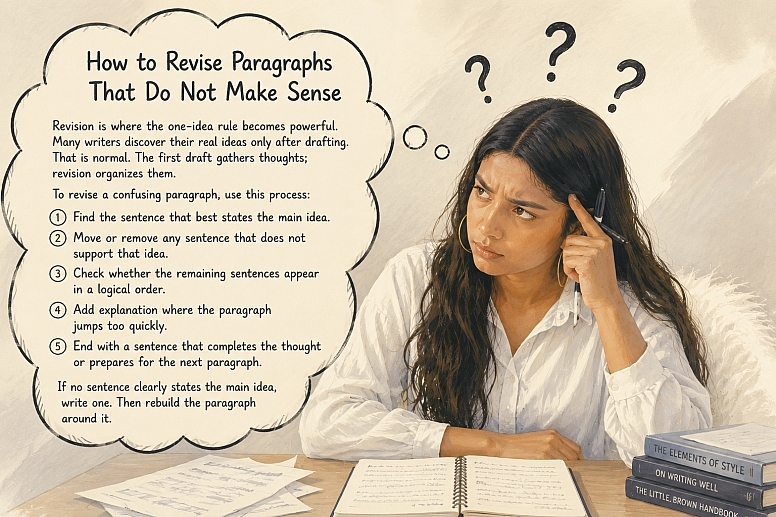
How to Revise Paragraphs That Do Not Make Sense
Revision is where the one-idea rule becomes powerful. Many writers discover their real ideas only after drafting. That is normal. The first draft gathers thoughts; revision organizes them.
To revise a confusing paragraph, use this process:
- Find the sentence that best states the main idea.
- Move or remove any sentence that does not support that idea.
- Check whether the remaining sentences appear in a logical order.
- Add an explanation where the paragraph jumps too quickly.
- End with a sentence that completes the thought or prepares for the next paragraph.
If no sentence clearly states the main idea, write one. Then rebuild the paragraph around it.
For example, a paragraph about college students with part-time jobs could go in several directions. It might focus on financial pressure, time-management challenges, stress, or career experience. All of these ideas are connected, but they should not be crowded into one paragraph without a clear center.
A revised version might focus only on financial pressure. It could explain that many college students work because tuition, rent, food, transportation, and textbooks create serious costs. It could then show that employment is not always optional but may be necessary for staying enrolled. Even if work reduces study time, it can also make college possible. The paragraph would then have one main idea and a logical flow.
The Difference Between Focus and Simplicity
The one-idea rule does not make writing basic or shallow. In fact, it allows complex thinking to become clearer. A paragraph can handle a sophisticated idea as long as it develops that idea carefully.
A paragraph in a history paper might argue that an economic policy helped one group while harming another. That is still one idea if the central point is about the policy’s uneven effects. A paragraph in a literature essay might argue that a character’s silence shows both fear and resistance. That is still one idea if both details support the same interpretation.
Good paragraphs can contain contrast, nuance, and tension. They simply need a center. The reader should feel that each sentence belongs to the same line of thought.
When to Start a New Paragraph
A new paragraph signals a shift. Writers should begin a new paragraph when they introduce a new claim, example, stage of reasoning, time period, or counterargument.
Start a new paragraph when
- The writing moves from one main idea to another
- The discussion shifts from evidence to analysis
- An opposing viewpoint appears
- A different case or example begins
- The paragraph has become too long to follow comfortably
Paragraph breaks are not just visual pauses. They are thinking pauses. They tell the reader that one unit of meaning has ended and another has begun.
Final Thoughts
The one-idea rule is one of the simplest ways to improve academic writing. It helps paragraphs become focused, organized, and readable. Instead of asking the reader to sort through scattered thoughts, the writer presents one clear idea at a time.
A good paragraph does not need to be fancy. It needs to be purposeful. The topic sentence should point the way, the supporting sentences should stay on track, and the final sentence should leave the reader with a completed thought.
When every paragraph has one job, the whole essay becomes easier to understand. Ideas connect more naturally. Arguments become stronger. Evidence becomes more meaningful. Most importantly, the reader can follow the writer’s thinking from beginning to end.







0.262