




Cisco Router vs. Cisco Firewall: Which One is Better & Why?
When building modern web platforms, performance and security go hand in hand. Whether you're running an eCommerce store, SaaS platform, or enterprise application, your network infrastructure plays a critical role in uptime, speed, and data protection.
One of the most common questions businesses and developers face is whether a router alone is enough or if a dedicated firewall is necessary. While these devices may seem similar at a glance, they serve very different purposes in a production environment.
Understanding how they differ is essential for designing scalable, secure systems.
Whether you need a Cisco router or a firewall depends on several factors, including traffic volume, application exposure, and the level of security your platform requires.
Why Network Infrastructure Matters for Web Applications
From a development perspective, network infrastructure is not just a backend concern; it directly impacts user experience. Slow routing, poor traffic handling, or weak security can lead to latency issues, downtime, or even data breaches.
For example, high-traffic web applications require efficient routing to maintain performance under load, while platforms handling user data must enforce strict security policies to prevent unauthorized access.
This is where routers and firewalls play complementary roles.
What Does a Router Do?
A router’s primary role is to move traffic between networks efficiently. It determines the best path for data packets, ensuring users can access your website or application without delay.
In web infrastructure, routers are essential for:
- Connecting servers to the internet
- Managing traffic between microservices or internal networks
- Supporting load balancing and failover strategies
- Maintaining stable connectivity for cloud and hybrid environments
Cisco routers are widely used in enterprise environments due to their reliability and performance. They support WAN connectivity, VPN tunnels, and dynamic routing protocols that are critical for distributed systems.
Modern routers also include basic security features such as Access Control Lists (ACLs) and Zone-Based Firewalls. These allow developers and network engineers to apply simple filtering rules.
However, these features are not designed for deep security inspection.
The Working Mechanism of a Firewall
A firewall is designed specifically to protect systems and applications. While a router focuses on directing traffic, a firewall evaluates that traffic in detail before allowing it through.
For web applications, this is crucial. Firewalls can:
- Block malicious requests before they reach your servers
- Prevent unauthorized API access
- Filter traffic based on application-level rules
- Protect against common attack vectors such as intrusion attempts
Advanced firewalls perform deep packet inspection and can analyze traffic across multiple layers. This enables them to detect threats in real time.
They also provide detailed logging and monitoring, which is essential for debugging, auditing, and maintaining compliance with standards like ISO 27001.
Dedicated firewall hardware ensures that these intensive processes do not affect overall network performance.
Router vs Firewall in Modern Web Architecture
In modern architectures, especially those involving cloud services, APIs, and distributed systems, the line between routers and firewalls has become less distinct.
Cisco routers now include basic security features, while firewalls can handle routing, NAT, and VPN termination. This overlap can create confusion when designing infrastructure.
However, in practice, their roles remain different:
- A router ensures your application is reachable and performs efficiently
- A firewall ensures that only safe and authorized traffic gets through
For developers, this distinction is important when designing secure deployment pipelines and production environments.
When Do You Need Only a Router?
There are scenarios where a router alone may be sufficient, particularly in low-risk or internal environments.
Examples include:
- Internal development environments with no public exposure
- Routing traffic between trusted services or VLANs
- Small applications with minimal user data and limited access points
In these cases, basic filtering through ACLs may be enough to maintain acceptable security.
When Do You Need a Dedicated Firewall?
For most production-grade web applications, a dedicated firewall is essential.
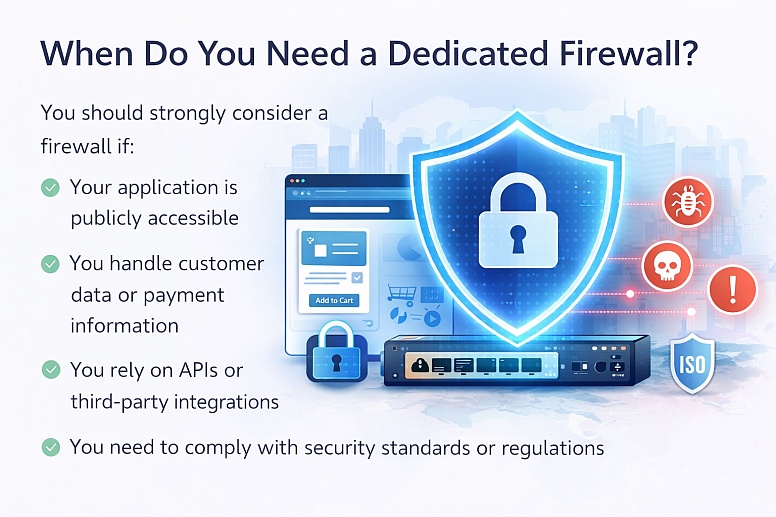
You should strongly consider a firewall if:
- Your application is publicly accessible
- You handle customer data or payment information
- You rely on APIs or third-party integrations
- You need to comply with security standards or regulations
Firewalls act as a protective barrier between your application and external threats, reducing the risk of breaches and downtime.
Router vs Firewall: Key Differences
Here’s a simplified comparison to clarify their roles:
| Feature | Router | Firewall |
|---|---|---|
| Primary Role | Traffic routing | Security and threat prevention |
| Inspection Level | Basic (IP/port level) | Deep packet inspection |
| Impact on Web Apps | Performance and connectivity | Security and data protection |
| Best Use Case | Network communication | Application and perimeter security |
Best Practice: Using Both Together
In modern web infrastructure, the best approach is not choosing between a router and a firewall, but using both strategically.
A typical setup looks like this:
- The router handles connectivity, routing, and traffic distribution
- The firewall inspects traffic and enforces security policies
This layered approach ensures your application is both fast and secure.
Summing It Up
If you're running a small project or internal system, a router with basic security features may be sufficient.
However, as your application scales and handles more users and data, security becomes a critical concern. At that point, relying solely on a router is not enough.
A dedicated firewall becomes an essential part of your infrastructure, protecting your application, your users, and your business.
Ultimately, routers and firewalls are not competitors. They are complementary tools that, when used together, create a strong foundation for modern web applications.







0.179