



AI Music Video Generators: How a Prompt Becomes a Studio
When Creativity No Longer Has to Wait
A new kind of creative experience is reshaping how people make content. What once demanded days or even weeks can now begin with a single sentence. Someone enters a prompt such as “emotional synthwave track with rainy neon city visuals,” and only moments later, they're watching a polished music video that feels like the result of an experienced production team.
No filming schedule. No large crew. No lengthy editing process. No endless rounds of revisions.
Just a simple concept transformed into a finished piece.
AI music video generators haven't simply accelerated production—they've changed how creativity unfolds. Instead of waiting for the right resources, creators can move from inspiration to execution almost instantly.
That shift changes far more than production speed. It changes the way ideas are explored.
The Traditional Workflow Was Built Around Delays
Before AI entered creative production, making a music video involved a sequence of interconnected stages where every step depended on the successful completion of the one before it.
A familiar workflow looked something like this:
concept → songwriting → production → recording → mixing → visual planning → filming → editing → revisions → approvals → publishing
Every phase introduced new dependencies—people, software, schedules, budgets, and approvals. Any delay could interrupt momentum.
By the time everything was complete, the excitement that sparked the original idea had often faded.
The obstacle wasn't a lack of imagination.
It was the amount of friction built into the process.
And friction is often what prevents promising ideas from ever becoming reality.
Why AI Music Creation Spread So Quickly
The rapid adoption of AI-powered music and video tools wasn't accidental. It reflected growing pressure throughout the digital content landscape.
Content platforms increasingly reward creators who publish consistently rather than occasionally. Extended gaps between uploads often reduce visibility.
At the same time, audiences consume content faster than ever. Videos have only a few seconds to capture attention before viewers move on.
Traditional creative pipelines simply couldn't keep pace. Too many production stages meant too many opportunities for ideas to lose momentum.
AI didn't invent creativity.
It dramatically reduced the time spent waiting.
When delays disappear, experimentation naturally becomes much easier.
Creating Music Through Language Instead of Technical Skills
One of the most significant changes in AI-assisted creativity is the ability to describe music rather than manually compose it.
An AI Song Generator enables users to transform written descriptions into complete songs without requiring instruments, production software, or formal musical training.
Instead of focusing on technical terminology, creators describe feelings and atmospheres:
- "uplifting electronic track that feels like sunrise over a futuristic ocean city"
- "nostalgic indie pop with soft emotional warmth and rainy-night memories"
- "cinematic ambient soundscape for exploring abandoned digital worlds"
The AI interprets those descriptions to generate rhythm, melody, harmony, structure, pacing, and emotional character.
Perhaps the bigger transformation is how people work.
Rather than settling for a single version, users quickly create alternatives, compare moods, refine prompts, and continue improving results. Tools such as a random music generator can add another layer of experimentation by helping users discover unexpected musical directions. Creative judgment develops through repeated experimentation instead of years of technical training.
Creating music becomes an exercise in expressing ideas clearly rather than mastering complicated production tools.
When Music Naturally Leads to Visual Storytelling
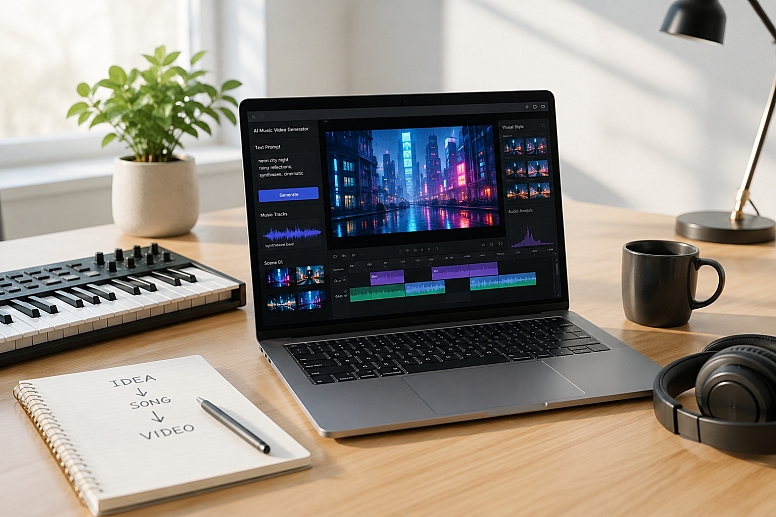
Modern digital content rarely separates audio from visuals. On today's social platforms, music often feels incomplete without accompanying imagery.
As a result, every soundtrack naturally invites visual interpretation.
AI makes that connection almost immediate.
Instead of manually assembling footage or designing scenes from scratch, creators allow algorithms to interpret the music visually.
Rhythm influences movement.
Emotional tone shapes color palettes.
Song structure guides narrative progression.
A gentle opening might produce slower cinematic movement, while energetic sections create faster transitions and increasingly dynamic effects.
Tools such as the AI Music Video Generator are valuable because they do more than automate editing—they convert musical characteristics into visual storytelling.
The outcome isn't simply a video paired with a song.
It's a visual experience generated directly from the music itself.
The Creative Feedback Loop That Keeps Going
Anyone who spends time using AI creative tools quickly notices a familiar cycle.
You generate a result, make a small adjustment, generate another version, compare several options, refine again, and before long, you've explored dozens of creative directions.
This happens because AI dramatically lowers the cost of iteration.
Traditional production treats revisions as expensive and time-consuming. Every adjustment demands additional work.
With AI, those barriers largely disappear.
The workflow becomes:
generate → review → refine → generate again → repeat
Since experimenting carries very little cost, creators naturally test more possibilities.
Interestingly, those extra iterations often produce the strongest ideas.
Who Uses AI Music Video Generators?
Although the technology may seem cutting-edge, AI music video generators have already become part of everyday creative workflows.
Independent artists use them to prototype songs and publish visuals without expensive production costs. Content creators rely on them to maintain consistent publishing schedules. Marketing teams rapidly create campaign assets that adapt to emerging trends. Indie game developers build cinematic previews before final game assets are completed. Casual users simply enjoy experimenting because the process feels accessible and engaging.
Across all of these groups, one pattern appears repeatedly.
Lower friction leads to greater creative output.
More importantly, it encourages broader exploration.
People don't just produce more; they investigate more creative possibilities.
Creative Success Is Becoming About Direction Rather Than Execution
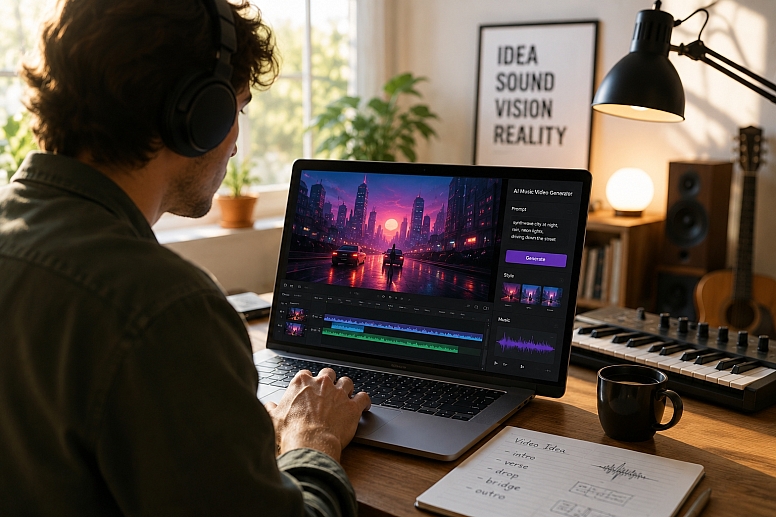
For many years, creative advantage belonged to those with deep technical expertise. Mastering complex software and production workflows largely determined the quality of finished work.
AI-assisted creation is gradually shifting that balance.
Today, creative strength increasingly depends on taste, decision-making, prompt refinement, and the ability to evaluate many variations efficiently.
Someone who explores dozens of concepts may discover stronger outcomes than someone who spends days polishing only one version.
Craftsmanship hasn't disappeared.
Its role has evolved.
Instead of focusing entirely on manual execution, creators increasingly shape quality through selection, refinement, and creative direction.
More Than a Productivity Tool
It's tempting to describe AI music and video generation as another efficiency upgrade, but the shift is more fundamental.
Traditional creative systems filtered ideas through the effort required to produce them. Many concepts never moved beyond the planning stage because they demanded too much time or complexity.
AI changes that equation.
Ideas can now be tested immediately. They may evolve, improve, or be replaced—but they're no longer stopped by production barriers.
This creates a very different creative environment:
- more experimentation
- more alternatives
- more partially explored concepts
- more unexpected discoveries
Creativity becomes less about committing to one path and more about discovering new possibilities.
That naturally expands creative diversity.
Ideas Move at the Speed of Imagination
The biggest change brought by AI isn't simply faster production.
It's the removal of the delay between imagining something and seeing it take shape.
The creative process is no longer strictly linear:
idea → plan → execute → complete
Instead, it has become an ongoing cycle:
idea → generate → evaluate → refine → repeat
Within that cycle, creativity feels less like managing a production pipeline and more like exploring an interactive creative system.
AI music and video generators don't replace human imagination.
They dramatically shorten the distance between inspiration and expression.
And when that gap becomes small enough, many creators discover that they never lacked ideas; they simply lacked a fast enough way to bring those ideas to life.






0.3111