


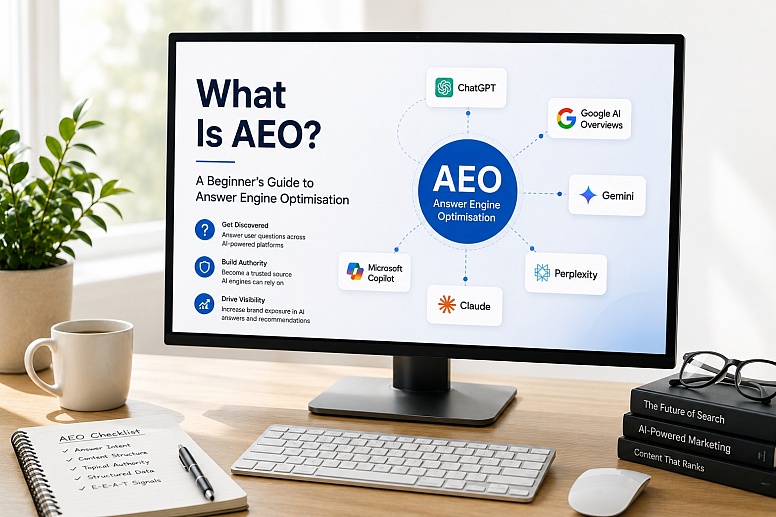
What Is AEO? A Beginner's Guide to Answer Engine Optimisation
Search is changing.
For years, businesses focused on ranking in Google's traditional search results through Search Engine Optimisation (SEO). Today, people increasingly get answers directly from AI-powered platforms such as ChatGPT, Google AI Overviews, Gemini, Perplexity, and Microsoft's Copilot.
This shift has created a new discipline known as Answer Engine Optimisation (AEO).
Join us as we are about to explain what AEO is, how it differs from traditional SEO, why it matters for businesses, and how you can optimise your website to appear in AI-generated answers.
What Is AEO?
Answer Engine Optimisation (AEO) is the process of improving your content so that AI-powered search tools and answer engines can easily understand, trust, and cite it when responding to user questions.
Rather than focusing solely on ranking web pages in search results, AEO aims to position your content as a trusted source that AI systems use when generating answers.
Examples of answer engines include:
- ChatGPT
- Google AI Overviews
- Google Gemini
- Perplexity AI
- Microsoft Copilot
- Claude
When someone asks:
"What is the best CRM for small businesses?"
An AI answer engine may generate a response using information gathered from multiple trusted websites. AEO helps increase the chances that your content becomes one of those sources.
How Is AEO Different From SEO?
While SEO and AEO share many principles, their goals differ.
| SEO | AEO |
|---|---|
| Focuses on rankings in search results | Focuses on being cited in AI-generated answers |
| Optimises webpages for search engines | Optimises content for AI understanding |
| Relies heavily on clicks and traffic | Focuses on visibility within AI responses |
| Targets keywords | Targets questions, topics, and user intent |
| Success measured by rankings and traffic | Success is measured by citations, mentions, and AI visibility |
The good news is that strong SEO often provides the foundation for successful AEO.
Why Is AEO Becoming Important?
AI-powered search experiences are growing rapidly.
Google now displays AI-generated summaries for many searches. Meanwhile, millions of users rely on ChatGPT, Gemini, and Perplexity to research products, services, and local businesses.
Instead of reviewing ten blue links, users increasingly receive a direct answer.
For businesses, this creates both an opportunity and a challenge:
Opportunity
If your website is referenced by AI systems, your brand can appear directly in answers delivered to potential customers.
Challenge
If your competitors become the sources AI tools trust, they may receive the visibility that traditional search traffic once provided.
Businesses that invest in AEO early are positioning themselves for the future of search.
How Do AI Answer Engines Find Information?

Although each platform works differently, most answer engines evaluate factors such as:
- Content quality
- Topical authority
- Website trustworthiness
- Structured data
- Brand mentions across the web
- Freshness of information
- Expertise and credibility signals
They often pull information from websites that clearly answer user questions and demonstrate authority within a specific topic.
Key Elements of Answer Engine Optimisation
Create Question-Based Content
AI systems frequently respond to questions.
Instead of only targeting keywords like:
Create content around questions such as:
Question-focused content aligns naturally with how people interact with AI tools.
Build Topical Authority
Answer engines prefer sources that demonstrate expertise across an entire subject area.
Rather than publishing one article about local SEO, create a content hub covering:
- Local SEO basics
- Google Business Profile optimisation
- Local citations
- Reviews and reputation management
- Local link building
- AEO strategies
Comprehensive coverage signals expertise.
Use Clear Structure
AI models find it easier to understand content that uses:
- Clear headings
- Short paragraphs
- Bullet points
- Tables
- FAQs
Well-structured content increases the likelihood of being extracted and referenced.
Add Structured Data
Schema markup helps search engines understand the meaning of your content.
Useful schema types include:
- FAQ Schema
- Article Schema
- Organization Schema
- Local Business Schema
- How-To Schema
Structured data provides additional context that can improve visibility in both search engines and AI systems.
Demonstrate Expertise
Content should showcase genuine expertise.
Include:
- Author information
- Original insights
- Industry experience
- Real examples
- Statistics and supporting evidence
AI systems increasingly favour trustworthy sources over generic content.
What Is Local AEO?
Local AEO focuses on helping businesses appear in AI-generated responses related to local searches.
For example, a user may ask:
- "Who is the best accountant in Manchester?"
- "Which local SEO agency should I hire in London?"
- "What are the top-rated plumbers near me?"
Answer engines often use signals from:
- Google Business Profile
- Reviews
- Local citations
- Business websites
- Industry directories
Businesses with strong local SEO foundations are often better positioned for local AEO success.
How Can You Measure AEO Success?
Unlike traditional SEO, AEO measurement is still evolving.
Businesses commonly track:
- AI citations
- Brand mentions in AI tools
- Referral traffic from AI platforms
- Visibility in Google AI Overviews
- Share of voice across answer engines
- Branded search growth
Many SEO platforms are beginning to introduce AI visibility tracking features as demand grows.
Is AEO Replacing SEO?
No.
AEO is best viewed as an extension of SEO rather than a replacement.
Traditional search remains a major source of traffic and leads. However, as AI-driven search experiences continue to expand, businesses need strategies that address both search engines and answer engines.
The most effective approach combines:
- Technical SEO
- Content marketing
- Local SEO
- Digital PR
- Answer Engine Optimisation
Together, these disciplines help maximise visibility across the modern search landscape.
Answer Engine Optimisation is rapidly becoming an essential part of digital marketing.
As users increasingly rely on ChatGPT, Google AI Overviews, Gemini, Perplexity, and other AI-powered platforms for answers, businesses must adapt their content strategies to remain visible.
The organisations that create trustworthy, well-structured, expert content today will be best positioned to earn citations, mentions, and visibility in tomorrow's AI-driven search environment.
AEO may be new, but its foundations remain familiar: provide the best answers, demonstrate expertise, and make your content easy to understand. Do that consistently, and you'll be well placed to succeed in both traditional search and the emerging world of AI answer engines.
LEAVE A COMMENT






0.2671