



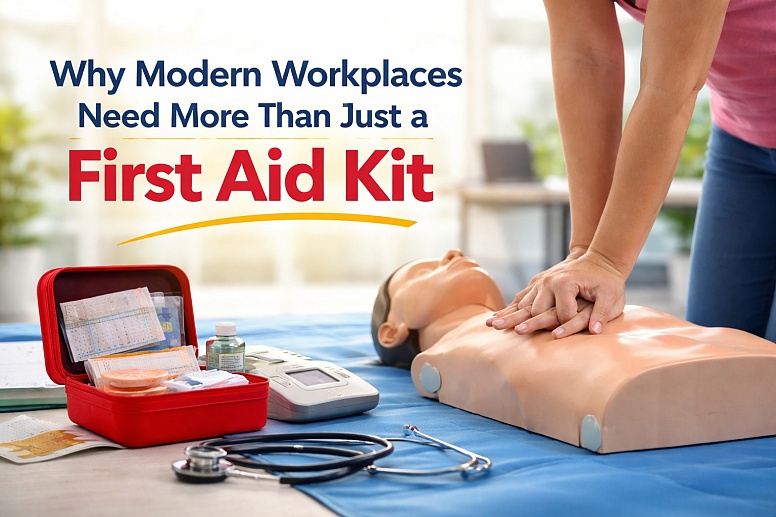
Why Hamilton Startups Prioritize First Aid Training
Hamilton’s business sector is rapidly shifting from heavy industry to modern startups and tech hubs. As office environments evolve, so do workplace health risks. Forward-thinking founders are prioritizing CPR certification to stay WSIB compliant and protect their teams during sudden medical emergencies when every single second counts.
Hamilton is completely reinventing itself right now. We are no longer just a traditional steel town. Today, we have a booming tech ecosystem, massive investments in digital health, and a vibrant creative sector rapidly expanding around James Street North. But as we enthusiastically swap heavy hard hats for ergonomic standing desks, a highly dangerous new mindset is taking over.
Modern office managers assume a quiet, carpeted floor is entirely safe from severe physical harm. They are completely wrong. This harsh, ignored reality is exactly why local founders are suddenly prioritizing first aid courses Hamilton for their core teams. We are finally realizing that hoping an ambulance arrives in time is not a valid operational strategy.
Why Is Hamilton's Business Shift Changing Office Risks?
If you run a heavy manufacturing plant down by the industrial sector, safety protocols are physically drilled into your workforce on day one. You wear steel-toed boots, you use safety harnesses, and you know exactly where the trauma kits are located. In a modern tech office or a marketing agency, that intense physical safety culture is often entirely absent.
Professionals are waking up to the fact that sitting in an air-conditioned room all day doesn't magically make you immune to sudden cardiac arrest or severe allergic reactions. In fact, modern hustle culture carries very specific, hidden health risks. We deal with immense mental stress, incredibly tight project deadlines, and chronic sleep deprivation. These exact lifestyle factors drastically increase the statistical risk of sudden cardiovascular events. A sleek co-working space might feel safer than a factory floor, but the invisible risks are quietly climbing higher every single year.
What Happens When a Health Crisis Disrupts Your Startup?
Let's break down a very realistic, terrifying office scenario. It is a busy Tuesday morning. Your core team is huddled in a glass boardroom, rushing to finalize a massive client pitch. The stress levels are incredibly high, and everyone is running on sheer adrenaline and too much espresso. Suddenly, a senior developer slumps out of their chair and hits the floor, completely unresponsive.
If nobody on that floor is trained to help, the resulting panic is absolute. People will stand around, screaming and debating whether to move the person or wait for a professional. Those wasted minutes are deadly. The human brain begins taking irreversible damage within just four to six minutes of oxygen deprivation.
By the time Hamilton paramedics navigate through the downtown core, find parking, and get up the elevator to your floor, it might be too late. When your staff is properly trained, that chaotic delay simply doesn't happen.
Why Can't We Just Rely on Emergency Medical Services?
We have phenomenal emergency responders here in Ontario. But you have to look at the logistical realities of our city. Have you tried driving down Main Street or King Street during the afternoon rush hour lately? Traffic congestion is serious and directly impacts ambulance response times.
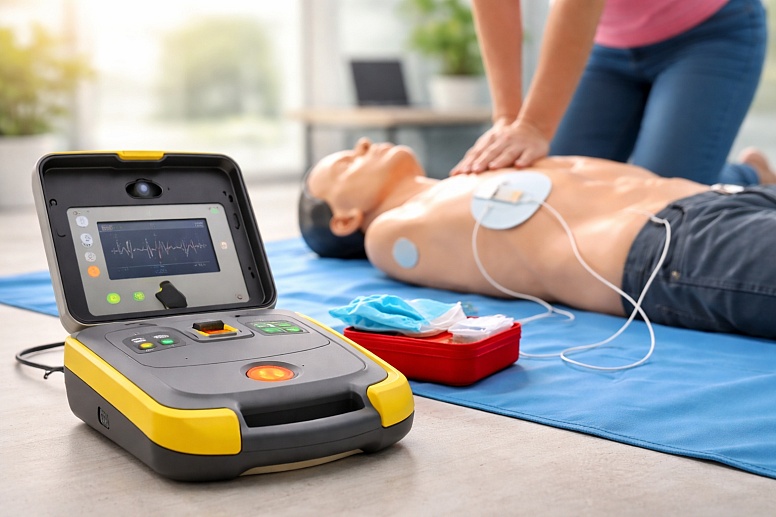
When someone suffers a sudden cardiac arrest, the heart completely stops beating out of nowhere. At this exact second, their body is rapidly starving of oxygen. You simply cannot afford to stand by and wait for sirens. By learning CPR, you become the vital physical bridge between the moment a crisis strikes and the moment professional help takes over. Performing chest compressions isn't about fully restarting the heart; it is about manually acting as a human pump to force residual oxygenated blood up into the brain. You are keeping them alive until the heavy gear arrives.
How Does WSIB Compliance Fit Into Startup Growth?
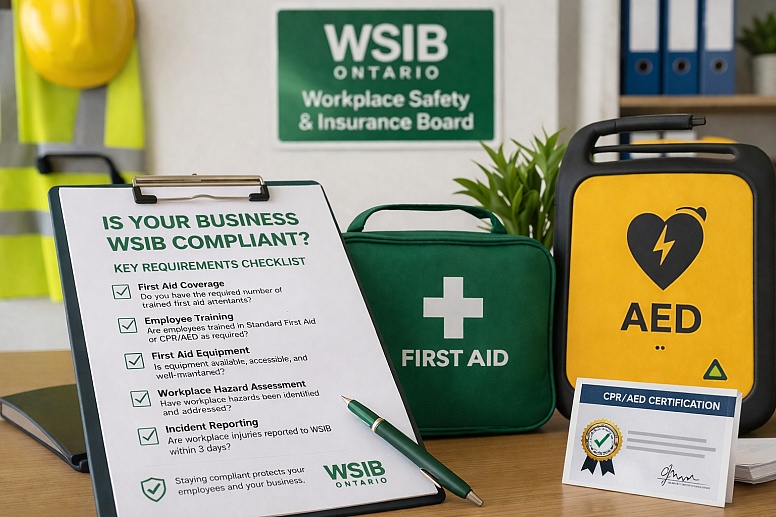
Beyond the moral obligation to keep your team alive, there is a very sharp financial and legal angle to consider. The Workplace Safety and Insurance Board (WSIB) in Ontario does not view first aid as an optional perk for startups. It is a strict, legally mandated requirement regardless of your industry.
If your startup office falls out of compliance by not having enough certified staff on shift, you are operating entirely illegally. Failing a random safety audit leads to massive financial fines that can cripple a young business. But the hidden costs are honestly even worse.
If an emergency is handled poorly on your office floor, the psychological trauma ripples through your entire workforce. Your absolute best employees will start looking for the exit, realizing that their founders view them as disposable assets rather than human beings worth protecting.
Why Is Emergency Preparedness the Ultimate Soft Skill?
In the business world, we strictly divide talents into hard skills like coding and soft skills like empathy and communication. First aid training perfectly bridges that gap. The physical act of pushing down on a chest is a hard, learnable skill. But the situational awareness required to successfully execute it in a crowded room is purely a soft skill.
When you learn how to treat a severe wound or assist a coworker having a panic attack, you develop massive amounts of raw empathy. You learn how to speak calmly to someone who is terrified. You learn how to take charge of a chaotic scene and delegate tasks under extreme pressure. These are the exact same leadership skills that make someone a phenomenal project manager or a trusted executive. You are basically cross-training your brain to handle high-stakes human interaction.
Can Blended Learning Fit a Brutal Startup Schedule?
One of the biggest excuses founders use to avoid safety training is a total lack of time. They argue that pulling their top performers out of the office for two full days to sit in a dull classroom will destroy their weekly production metrics. A decade ago, that was a valid complaint. Today, it is just a lazy excuse.
The training industry has completely evolved to match the speed of modern business. Blended learning is now the absolute standard for corporate certifications. Your employees can complete all the heavy reading, instructional videos, and theoretical quizzes online through a dedicated portal. They can knock it out on their laptops during a slow afternoon or while working from home. After the online theory is done, they just visit the training facility for a brief, hands-on skills session to prove their physical competency. It minimizes office disruption while completely maximizing retention.
Do Office Workers Actually Need to Know How to Use an AED?
You have probably noticed those Automated External Defibrillator (AED) boxes mounted near the elevators in modern office buildings or at McMaster Innovation Park. A shocking number of highly educated professionals are terrified to even touch them. They assume you need a medical degree to press the buttons without accidentally electrocuting someone.
This is a massive misconception. AEDs are essentially smart devices designed for completely untrained, panicked bystanders to use. They are entirely foolproof. Once you open the lid, a calm digital voice literally talks you through the entire process. It tells you exactly where to place the sticky pads on the person's bare chest. The machine reads the heart rhythm entirely on its own and will actively refuse to deliver a shock unless the patient is in genuine cardiac arrest. Training just gives you the mental permission to pull the machine off the wall when things go wrong.
How Does CPR Training Build Better Corporate Teams?
We waste a lot of corporate budget on highly ineffective team-building exercises. Trust falls and awkward Friday afternoon escape rooms rarely build actual, lasting camaraderie. If you want to see your team bond on a deep, meaningful level, send them to get certified in life-saving skills together.
When coworkers practice chest compressions on mannequins side-by-side, it changes the dynamic of the room. They learn how to communicate under simulated pressure. They quickly figure out who naturally steps up to lead and who excels at following clear directions. It builds a very raw, genuine level of trust. Knowing that the person sitting in the cubicle next to you actually knows how to save your life creates a modern workplace culture that a fancy ping-pong table simply cannot match.
What Practical Skills Will Your Team Bring Back to the Desk?
When your staff returns from certification, they aren't just bringing back textbook theories. They are bringing back highly practical, hands-on skills that apply directly to office accidents. They learn how to safely approach a scene to ensure they don't become a second victim.
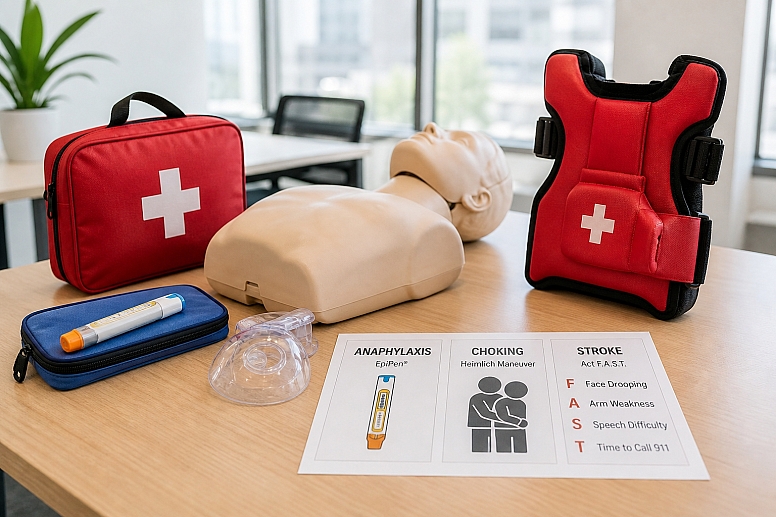
They learn how to quickly administer an EpiPen if a client goes into anaphylactic shock during a catered lunch meeting. They learn the proper Heimlich maneuver for a coworker choking in the breakroom. Perhaps most importantly, they learn how to recognize the sneaky, subtle signs of a stroke. Rapid hospital treatment for a stroke can completely save a person's long-term mobility and speech. These are tangible skills that translate directly to the daily hazards of modern office work.
Why Should Founders and CEOs Lead the Charge?
A true culture of safety has to start directly from the top down. If the executive team treats first aid training as an annoying chore that is beneath them, the entire office will treat it the exact same way. Employees take their cues from leadership.
When you, the founder, get down on the floor and practice chest compressions right alongside a new intern, it breaks down corporate barriers. It visually proves that in a life-or-death situation, job titles do not matter at all. It builds a highly resilient team culture. You stop being just a group of people clocking in to hit a quarterly revenue target, and you start being a unified team that actively watches out for each other.
If you are looking for first aid training near Downtown Hamilton, the major intersection of Hughson Street and King Street East, or other areas close to our facility, then you may reach out to Coast2Coast First Aid/CPR - Hamilton in that area. For more info and articles like this, visit: https://www.c2cfirstaidaquatics.com/
Frequently Asked Questions
Question 1: How many certified first aid employees does my Hamilton business actually need?
Answer: WSIB regulations in Ontario clearly dictate that if your workplace has 1 to 5 workers on a given shift, you need at least one person certified with Emergency First Aid. If you have 6 or more workers on a shift, you must have at least one person equipped with a Standard First Aid certificate.
Question 2: Does the employer have to pay for the employee's first aid training course?
Answer: Yes. Under strict Ontario health and safety laws, the employer is entirely responsible for covering the cost of the mandated training course. You must also pay the employee their regular hourly wages while they are physically attending the class.
Question 3: Are 100% online CPR certificates legally accepted for professional compliance?
Answer: No, they are not. The WSIB does not recognize safety certifications that are earned entirely online without a physical component. To be legally compliant and protect your business, your staff must complete a blended course or an in-person class that includes a physical skills assessment with a qualified instructor.
Question 4: Will my employees be held legally liable if they make a mistake during CPR?
Answer: No. Ontario has a powerful Good Samaritan Act that legally protects individuals who voluntarily step in to help during a medical emergency. As long as they are acting in good faith without expecting a financial reward and are not acting with gross negligence, they are fully protected.
Question 5: How often must my office team renew their workplace safety certifications?
Answer: In Ontario, first aid and CPR certifications are valid for exactly three years from the date of completion. To remain legally compliant and keep their physical skills sharp, employees must successfully take a recognized recertification course before their current three-year certificate expires.






0.2645