


How Startups Can Launch an Uber-Like App in Under 30 Days
Building an Uber-like application was once a multi-month, multi-million-dollar effort, if not for a few well-funded startups. However, today, with mature application frameworks, white-label solutions, and scalable cloud infrastructure, even early-stage startups can build and launch a functional ride-hailing app in under 30 days-if they follow the right approach, that is.
We will explain how it is realistically possible for a startup to launch in 30 days, which decisions really matter, which shortcuts are safe to take, and which Uber clone providers can seriously shorten the development time.
Why It's Now Possible to Launch an Uber-Like App in 30 Days
The idea of ride-hailing itself is no longer new. The basic elements that include real-time GPS tracking, matching of drivers and riders, digital payments, and push notifications are now standard components. What used to require bespoke engineering from scratch can now be implemented using:
- Pre-built frameworks for ride-hailing applications
- Uber clone Scripts and SDKs
- Cloud-native backends
- Cross-platform mobile development: Flutter / React Native
- Ready integrations for maps, payments, and notifications
With startups, it's not about reinventing the wheel but putting together proven components into a lean MVP focused on one market and one use case.
The Right Mindset: MVP First, Scale Later
A 30-day launch doesn't mean to launch a perfect competitor of Uber. It means launching a market-ready MVP with:
- This is in contrast to one city or one region.
- One category of vehicle
- Core ride-booking functionality
- Stable payments and tracking
- Basic administration controls
Most startups that fail overbuild early by adding in advanced pricing logic, multi-city operations, loyalty programs, or AI features before having any kind of validated demand. Speed comes from focus, not volume of features.
What an Uber-Like MVP Should Include (and Nothing More)
Your app should support, at a minimum, three key users to be usable and commercially viable: riders, drivers, and admins.
Basics of the Rider App
The experience for the rider must be instinctive, straightforward:
- Phone-based sign-up and log-in
- Pickup and drop-off location selection
- Visibility of nearby drivers
- Ride request and confirmation
- Live tracking of drivers
- Fare estimation and payment
- Trip history and receipts
- Push notifications
Driver App Essentials
Drivers should be able to operate with minimal friction:
- Driver registration and document upload
- Online/offline availability toggle
- Trip request accept/decline
- Navigation assistance
- Earnings summary
- Ride history and ratings
Admin Panel Essentials
The admin dashboard keeps the system under control:
- Rider and driver management
- Trip monitoring
- Driver approval workflows
- Payment and payout tracking
- Basic reports and dispute handling
Anything beyond this can wait until post-launch iterations.
How Startups Actually Build It in 30 Days
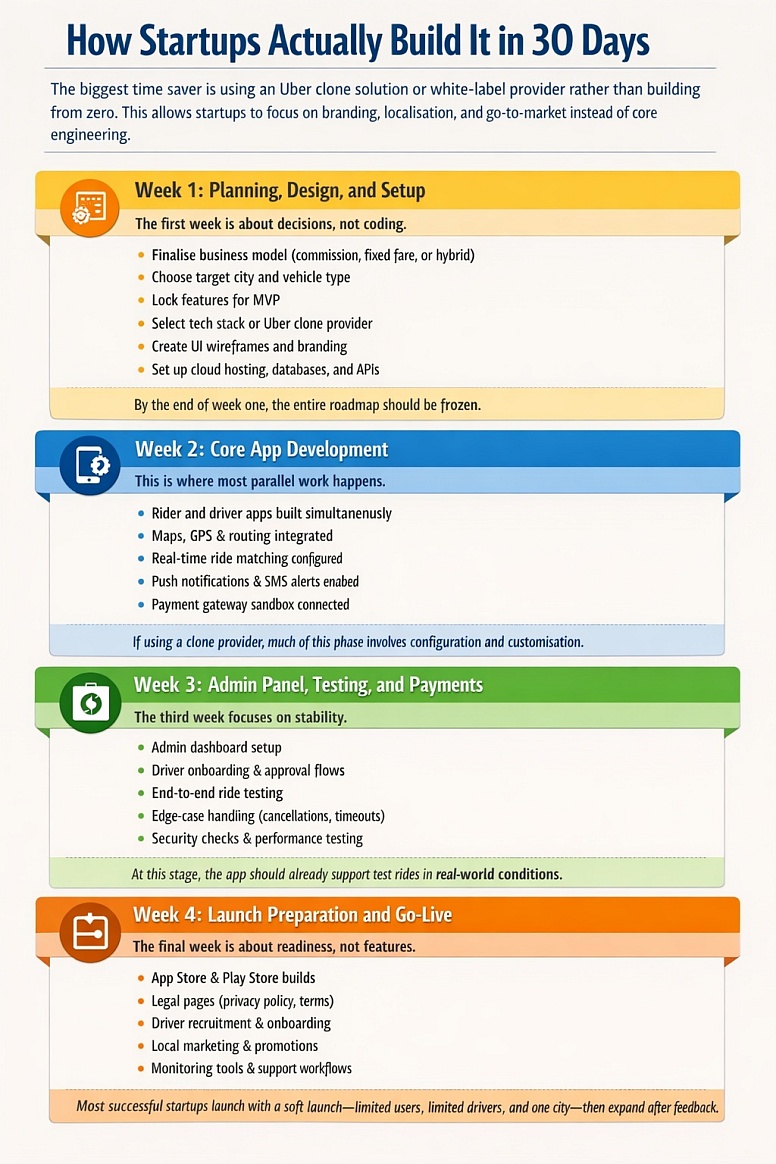
The biggest time saver is using an Uber clone solution or white-label provider rather than building from zero. This allows startups to focus on branding, localisation, and go-to-market instead of core engineering.
Week 1: Planning, Design, and Setup
The first week is about decisions, not coding.
- Finalise business model (commission, fixed fare, or hybrid)
- Choose the target city and vehicle type
- Lock features for MVP (no changes after this point)
- Select tech stack or Uber clone provider
- Create UI wireframes and branding
- Set up cloud hosting, databases, and APIs
By the end of week one, the entire roadmap should be frozen.
Week 2: Core App Development
This is where most parallel work happens.
- Rider and driver apps are built simultaneously
- Maps, GPS tracking, and routing are integrated
- Real-time ride matching is configured
- Push notifications and SMS alerts are enabled
- The payment gateway sandbox is connected
If using a clone provider, much of this phase involves configuration and customisation, not raw development.
Week 3: Admin Panel, Testing, and Payments
The third week focuses on stability.
- Admin dashboard setup
- Driver onboarding and approval flows
- End-to-end ride testing (request → completion → payment)
- Edge-case handling (cancellations, timeouts)
- Security checks and performance testing
At this stage, the app should already support test rides in real-world conditions.
Week 4: Launch Preparation and Go-Live
The final week is about readiness, not features.
- App Store and Play Store builds
- Legal pages (privacy policy, terms)
- Driver recruitment and onboarding
- Local marketing and promotions
- Monitoring tools and support workflows
Most successful startups launch with a soft launch—limited users, limited drivers, and one city—then expand after feedback.
Why Uber Clone Providers Matter for Speed
Real-time matching, routing, and payments are some of the most complex parts of the solution, and that is exactly what the Uber clone providers do: provide a pre-built system that solves these problems, dramatically reducing development time. The following are some of the commonly used providers of Uber clone solutions.
Uberclone.co
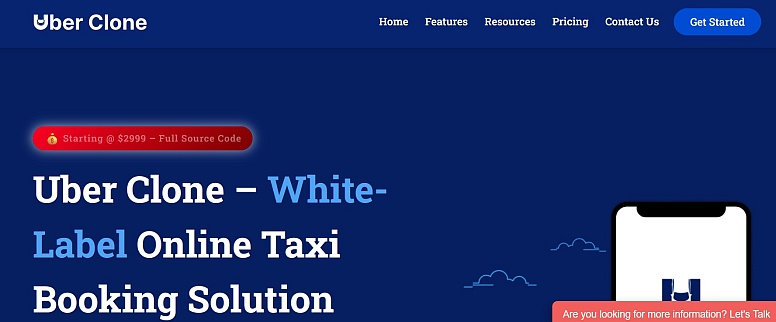
Known for ready-to-launch Uber-like scripts, Uberclone.co is all about speedy deployment. It's a popular choice among startups where the need is minimal customisation and quick entry into the market.
Elluminati
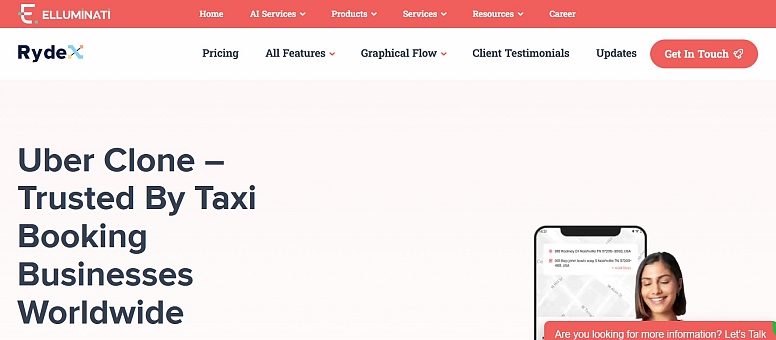
Elluminati provides customised Uber clone solutions supported by a full-cycle development team for startups that want more advanced personalisation and long-term scalability.
V3Cube

V3Cube generally provides white-label ride-hailing platforms with extensive modules like fleet management, multiservice expansion, and often finds a place in the list of startups that have plans for scaling up beyond a single city.
Trioangle
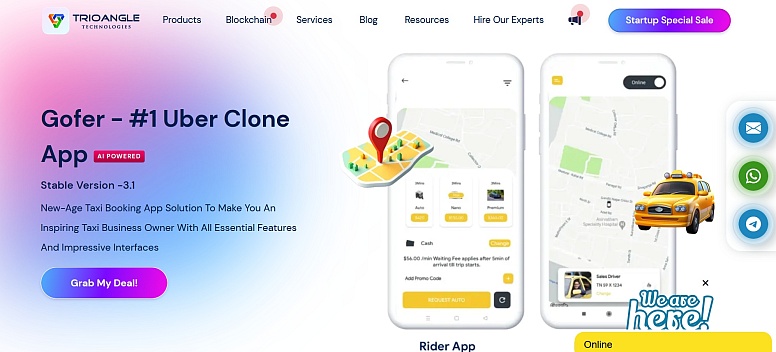
Trioangle will provide Uber-like app solutions that can be availed with SaaS and on-premise deployment options, which will be useful for startups seeking ownership of source code and regional flexibility.
AppDupe

AppDupe specialises in rapid MVP launches across multiple on-demand verticals, including taxi, delivery, and logistics. It’s a popular choice for fast prototyping and multi-app strategies.
Tip: Always request a live demo, source-code clarity, post-launch support terms, and update policies before selecting a provider.
Common Mistakes That Kill 30-Day Launches
Startups often miss the 30-day window because of:
- Changing features mid-development
- Trying to support multiple cities at launch
- Over-customising UI too early
- Delaying driver onboarding
- Ignoring payment gateway approvals
- Underestimating testing time
Discipline is what enables speed.
What Happens After the 30-Day Launch
Once the MVP is live and validated, startups can gradually add:
- Surge pricing and dynamic fares
- Multi-city expansion
- Wallets and subscriptions
- Loyalty and referral programs
- Fleet management
- AI-driven pricing or matching
The first 30 days are about entering the market, not winning it.
Launching an Uber-like app in under 30 days is no longer unrealistic; it’s a strategic execution challenge. With a tightly scoped MVP, the right Uber clone provider, and a disciplined rollout plan, startups can move from idea to live app in a single month.
The real competition doesn’t start at launch—it starts with how fast you learn from real users and improve after day 30.













0.0536