




Voice Search Optimization: Preparing for the Next SEO Shift
Internet search habits have evolved more in the last few years, much like everything around us, due to the rapid rise of technology and artificial intelligence. Now, the goal is to replace the usual short, choppy sentences that people type into search engines with people talking into their devices.
This has made search engine tools faster, easier and more natural, particularly due to voice assistants such as Siri, Alexa and Google Assistant. This also means that businesses have to re-evaluate their approach to search engine optimization.
Voice search is now in the spotlight, and businesses must recognize this to remain competitive. Voice search has become a critical factor in how business content is found, ranked, and used by their target audiences and customers.
It's not only about staying trendy with the latest trends, but also about being prepared to meet the demands of a new era! You don't want to be left behind the curve when the change comes in 2026. Companies that align their plans with users' actual speech will have a clear edge over those that continue using antiquated SEO methods.
The Evolution of Search Behavior
Searching methods have become more conversational. For example, instead of searching keywords like ’software company UAE', users are now asking questions such as, “Which company provides reliable custom software development services in the UAE?” This shift is suited to the natural way people communicate, with search engines evolving to better understand and respond to the conversational language humans use daily.
Therefore, it’s only fair that companies that provide the best custom software development should reconsider the way they market their content. The days of keywords are over; now, content must satisfy actual questions naturally and straightforwardly. Search engines have increasingly focused on meaning and intent, not just exact keyword matches, so it's vital to write content that isn't robotic.
This also signifies how crucial context is for users utilizing search engines. Voice search queries will also include more information, such as location, urgency, and specific needs. One might ask, "Who offers custom software solutions near me?" as opposed to just "custom software”. This level of detail provides opportunities for businesses that plan to respond effectively.
Why Voice Search Matters More Than Ever
The reason voice search is becoming increasingly significant is largely due to voice-activated devices. Voice activation has become common and is embedded in smartphones, smart speakers, and even on some wearable devices, making searching on the go a breeze.
This change in visibility is something that needs attention, especially for enterprises operating in a digital environment. Rather than providing results for a full range of options, voice assistants tend to return only the top one or two results. This indicates how ranking isn’t a mere advantage of companies any longer, but is also beneficial.
Companies offering custom software development can greatly leverage this by tailoring their offerings to market trends. Imagine this: a voice assistant selects your content or service as the top answer in search results and recommends it, and your business is perceived as credible in your industry. This is the kind of exposure you can gain to a potential customer that helps you build trust rapidly and can sway decision-making in mere seconds, without costing you much or any money.
Understanding Conversational Intent
The first step to optimizing for voice search is to understand how users ask their questions. Users are looking for rapid, clear and accurate answers. They don't want to scroll through long pages or read long, irrelevant information.
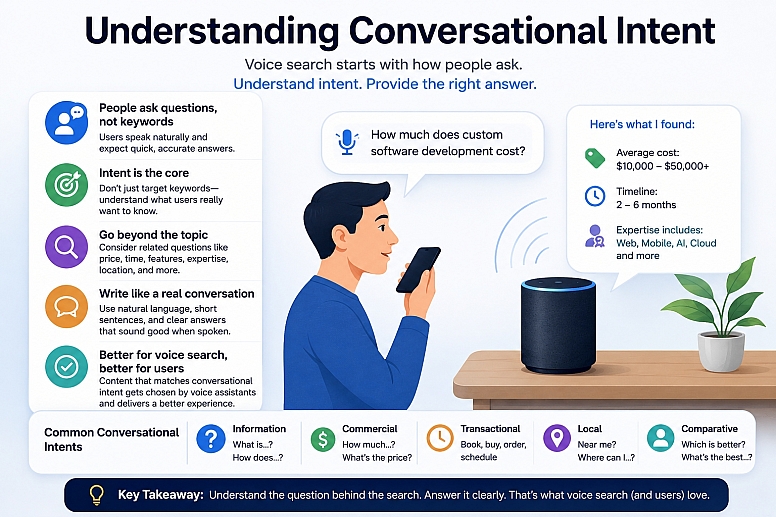
This is where intent becomes the core of contemporary SEO. Businesses cannot simply look at a list of individual keywords; they need to consider what consumers are likely to search for. For instance, when someone is looking for software services, they may ask for the price, time or other expertise.
Any content that directly addresses these questions is much more likely to be picked up by voice assistants. The best approach is to write the material so it sounds like a real conversation. Sentences must be fluent, and answers should be easily understood when spoken. This will not only make it easier to use voice search, but it will also enhance the user experience.
Content Structure in the Voice Search Era
The way in which content is structured is an important element in voice search optimization. Easy-to-scan, easy-to-understand content is preferred by search engines. In contrast to conventional SEO, which focuses on keyword density in content, voice SEO involves making content both clear and relevant, tailored to answer the query.
Clear paragraphs answering particular questions are better than information in free-flowing paragraphs. Every piece of information should have one message and one point. This ensures that search engines can pick up more information and boost the chances of appearing in voice search results. It is also important to have answers that are short and to the point. Content generally needs to be concise with voice assistants, with some "fluff" around the edges. It should be meaningful, but also give enough context.
The Role of Local Optimization
One of the important factors in how voice search results are provided is local optimization. Most voice searches are location-based, such as users asking for goods and services “near me” or specifying a city or region. This is why the business cannot afford to ignore local SEO: search engines will prioritize results that are locally and geographically relevant.
For those companies that provide excellent custom software development services, having positive local reviews can be a big help in boosting visibility. Having clear and standardized business information, such as name, address, and contact information, displayed on every platform encourages trust in search engines and increases the chances of being found in the best voice search results.
Content must also conform to the local intent. Rather than using a generic page, companies should develop pages for specific locations that align with users' local requirements. For instance, a specific page for the UAE, or another location where the business operates, supports content optimization based on people's actual voice search queries.
At the end of the day, local optimization is all about providing the right and relevant information to the right user. It can be used to boost visibility and drive more targeted traffic, including those who are ready to take action.
Writing for Voice Search in 2026
In 2026, expect the art of content writing to be more user-focused than ever before. The objective is to design and curate material that feels natural when spoken and easy to understand when heard. This means avoiding language that is too formal and technical. Content writers need to consider the tone of their work. Sentences need to be simple and direct. This makes it more accessible for voice assistants to understand and provide information.
Another most significant factor is relevance. Content should answer the user's questions without requiring them to seek the answer elsewhere. This indicates looking ahead for questions and incorporating the complete answers in the content itself. Consistency is also relevant. It keeps content up to date and in line with current trends. New and timely information is a treasure trove for the search engines in competitive fields such as software development.
Voice search is not yet a distant dream; it is already a reality that is impacting how people locate information, compare services, and make purchasing decisions. In this search landscape that is moving toward more conversational and intent-driven searches, businesses need to let go of traditional SEO techniques and focus on providing answers that are clear, natural, and relevant.
At the same time, AI is greatly shaping the future of voice search. AI-powered algorithms have become better at understanding context, intent, and how users will interact with content, so the content must be truly helpful rather than simply stuffed with keywords.
Search engines are now ranking content that is natural and answers real questions, and is more valuable. This change is a great opportunity for companies providing the best custom software development services. Companies can differentiate themselves in a crowded marketplace by providing content tailored to how users speak, optimizing for local intent, and structuring information so voice assistants can easily understand it. It's not as complicated as it seems: you just need to know what they want to ask you, and how you can answer it humanly and naturally.
Today, in an era dominated by voice, AI, and all things digital, visibility isn't just about ranking; it's about being the top answer your users hear.
Author Bio: Myrah Abrar is a Computer Science graduate passionate about web development & digital marketing. She writes insightful blog articles for Dynamologic Solutions, focusing on SEO, technology, and online business growth.







0.2772