



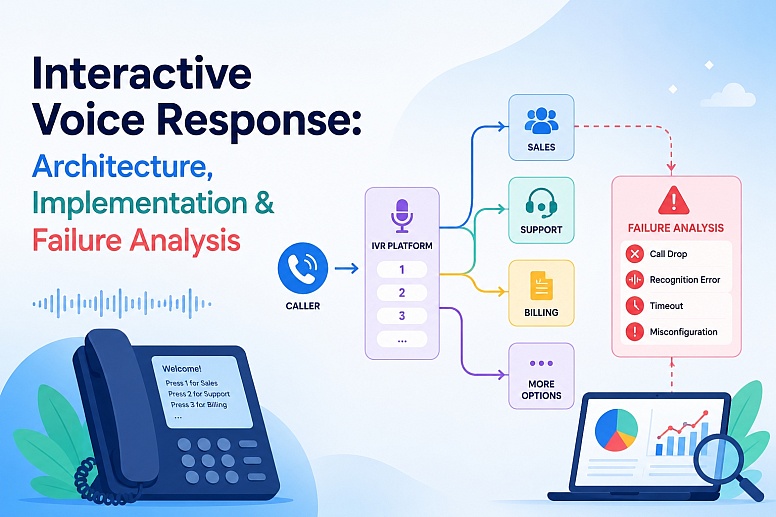
Interactive Voice Response: Architecture, Implementation & Failure Analysis
A caller spends ninety seconds navigating menu options, enters an account number twice, and finally reaches an agent who asks for the same information again. This scenario represents the failure mode that IVR exists to prevent and frequently creates. Interactive Voice Response systems automate telephone-based interactions by processing keypad inputs and voice commands.
These systems handle routine inquiries, route calls to appropriate departments, and provide self-service options without live agent intervention. The technical foundation of IVR combines computer-telephony integration with speech processing technologies to create scalable, automated service delivery. Understanding why these systems fail requires examining the physical layer, where voice signals degrade, the software layer, where interpretation errors compound, and the integration layer, where data handoff breaks down.
- Core technology: Computer-telephony integration (CTI) combined with speech recognition and synthesis
- Input methods: Dual-tone multi-frequency (DTMF) keypad signals and automated speech recognition (ASR)
- Primary output: Pre-recorded audio or text-to-speech (TTS) generated responses.
- Business value: 24/7 availability, reduced operational costs, and consistent service delivery
- Failure impact: Misrouted calls, customer frustration, abandoned interactions, and increased agent workload
- Primary failure mechanisms: Acoustic distortion, packet loss, grammars that do not match the caller's language, and incomplete integration handoff
System Architecture and Core Components

IVR architecture has evolved from proprietary, hardware-dependent systems to software-defined, cloud-native deployments. Understanding the layered architecture helps identify failure points and optimization opportunities.
Hardware and Media Processing Layer

Traditional IVR systems relied on specialized hardware, including telephone exchange equipment for signal routing, voice board cards for DTMF decoding and voice compression, and server clusters for application logic. Modern architectures abstract these functions into software layers running on commodity infrastructure.
Media servers handle real-time voice stream processing, managing codec conversion, packetization, and media session control. These servers interface with telephony networks through SIP trunks and use RTP or SRTP for media transport. The MRCP (Media Resource Control Protocol) governs communication between media servers and speech processing engines, enabling centralized control of ASR and TTS resources.
The physical layer introduces the first failure mechanisms. DTMF tones consist of two simultaneous frequencies: one from a low-frequency group (697 Hz, 770 Hz, 852 Hz, 941 Hz) and one from a high-frequency group (1209 Hz, 1336 Hz, 1477 Hz, 1633 Hz). Each key press generates a unique frequency pair. When callers use speakerphones or hands-free devices, acoustic echo cancellation (AEC) must separate the outgoing tone from the incoming audio stream.
Poor AEC implementation can clip the tone, causing the receiver to register no input or an incorrect key. Network compression codecs such as G.729 or G.723.1, designed to reduce bandwidth consumption, also degrade DTMF detection reliability. The solution requires transporting DTMF out-of-band using RFC 2833, which transmits key events as separate RTP payloads, bypassing audio-path degradation entirely.
Speech Processing Subsystem
Automated Speech Recognition (ASR) converts spoken input into text for interpretation. ASR systems operate with grammars, defined sets of valid phrases or patterns that constrain recognition possibilities. Fixed grammars limit recognition to specific commands, while dynamic grammars adapt based on context. Natural Language Understanding (NLU) extends ASR by interpreting whole-sentence inputs and extracting intent.
ASR failure occurs through multiple mechanisms. Acoustic models trained on clean, high-bandwidth audio fail when presented with GSM-compressed telephony audio sampled at 8 kHz. Background noise from call centers, traffic, or household environments introduces spectral interference that reduces recognition confidence. The fundamental problem is that telephone networks introduce frequency response limitations from 300 Hz to 3.4 kHz, discarding acoustic information above and below these thresholds. Speech recognition engines optimized for wideband audio (50 Hz to 7 kHz) must be specifically retrained for narrowband telephony or deployed with models designed for this constrained channel.
Language models and grammars introduce another failure class. Grammar-based systems require callers to use precise vocabulary. When a grammar expects "yes" but the caller says "yeah" or "sure," recognition fails. Creating grammars that cover all plausible caller responses while maintaining recognition accuracy across diverse accents, age groups, and speaking rates requires extensive testing and iterative refinement. NLU-based systems reduce this constraint but introduce new failure modes through intent misclassification and entity extraction errors.
Text-to-Speech (TTS) synthesis generates spoken output from text. TTS quality has improved substantially, but unnatural or overly robotic voices remain a significant source of caller frustration. Professional voice recordings remain preferable for frequently used prompts due to superior naturalness.
Dialog Management and Business Logic
The dialog flow interpreter executes the IVR application logic. VoiceXML, an XML-based standard, provides a declarative language for defining IVR call flows. A VoiceXML document defines forms and fields, each representing a discrete interaction:
<form id="balance_query">
  <block>
    <prompt>Please enter the last four digits of your account number</prompt>
  </block>
  <field name="account_suffix" type="digits" length="4">
    <prompt>Enter the four digits now</prompt>
  </field>
  <filled>
    <submit next="https://api.example.com/balance" method="post"/>
  </filled>
</form>
Dialog management failures occur when the flow logic cannot handle caller deviations. If a caller responds with unexpected information, for example, providing the full account number instead of the requested suffix, the system may reject the input and repeat the prompt, creating frustration. Sophisticated systems implement barge-in handling, allowing callers to interrupt prompts, but this introduces new failure modes when speech detection thresholds misclassify background noise as an interruption.
Modern systems increasingly use visual flow builders and microservices architectures to replace monolithic VoiceXML applications. Business logic servers integrate with databases, CRM systems, and third-party APIs to retrieve and update customer data during calls.
Integration Layer
IVR systems connect to broader enterprise infrastructure through:
- CRM integration: Customer identification, history, and preference retrieval
- Payment processing: Secure transaction handling for bill payments
- Workforce management: Queue prioritization and agent skill-based routing
- Analytics platforms: Call detail recording, abandonment tracking, and performance monitoring
Integration failures represent the most visible failure class from the caller's perspective. When an IVR collects account numbers, issue descriptions, or authentication credentials but fails to pass this data to the receiving agent, the caller must repeat the information. This handoff failure typically occurs at one of several boundaries: IVR to ACD (Automatic Call Distribution), ACD to CRM, or CRM to agent desktop interface.
Each handoff introduces a point where data structure mismatches, timeout conditions, or API failures can drop the information. Implementing end-to-end data persistence with unique session identifiers that accompany the call through all routing stages prevents this failure mode.
Use Cases and Implementation Patterns
Financial Services and Banking IVR
IVR systems in banking handle account balance inquiries, transaction history, funds transfers, and card reporting. Security constraints dominate the design: authentication must be robust while maintaining acceptable call duration.
Specific Constraints: Regulatory compliance (PCI-DSS for payment data, GLBA for financial privacy) requires encrypted transmission, secure storage, and authentication mechanisms. Voice biometrics for speaker verification is increasingly deployed but requires careful implementation to avoid false rejection rates. The physical constraints of DTMF transmission become critical in payment scenarios; a misdetected digit in a sixteen-digit card number can reject the entire transaction and require the caller to re-enter all information.
Common Mistakes: Requiring callers to re-enter account numbers that the system has already collected via caller ID or prior authentication. This redundancy frustrates callers and extends call duration. Another frequent error is failing to provide a fallback to live agents when authentication fails, creating dead ends for legitimate callers. Banks often implement authentication escalation chains that lock callers out after three failed PIN attempts with no agent fallback, forcing callers to hang up and redial.
Practical Advice: Implement tiered authentication; low-risk queries require minimal verification, while high-risk transactions escalate authentication requirements. Always provide a "zero-out" option to reach a live agent. Deploy voice biometrics as a passive authentication layer that doesn't add caller friction. For DTMF-based data entry, implement confirmation prompts where the system reads back entered digits and allows correction before submission.
Healthcare Appointment Scheduling
Healthcare providers use IVR for appointment booking, confirmation, cancellation, prescription refill requests, and basic health information. These systems reduce administrative overhead and provide patients with after-hours access.
Specific Constraints: HIPAA compliance requires PHI protection throughout the interaction. Appointment availability data must reflect real-time scheduling system state. Medication refill requests require accurate patient and prescription identification. The physical layer constraints affect appointment scheduling when DTMF tones must be transmitted through complex healthcare phone systems with numerous PBX hops, increasing the probability of tone distortion.
Common Mistakes: Maintaining separate appointment confirmation and scheduling flows that create duplicate data entry requirements. Failing to provide callback options for complex scheduling scenarios. Using inflexible menu structures that cannot accommodate schedule changes. Many healthcare IVR systems fail to integrate with the scheduling system's open slots, resulting in callers booking appointments that the system later cancels due to provider availability changes.
Practical Advice: Build IVR flows that sync directly with the scheduling system's API to reflect real-time availability. Include the confirmation number for delivery via SMS for patient reference. Design fallback options that escalate complex scheduling requests to scheduling coordinators. Implement explicit confirmation where the system reads the appointment date, time, and provider before committing the booking.
Logistics and Shipping IVR
Shipping companies and logistics providers deploy IVR for package tracking, delivery status updates, and service disruption reporting. These systems must process high call volumes with low latency.
Specific Constraints: Integration with real-time tracking APIs. Handling various package identification formats (tracking numbers, order numbers, reference numbers). Managing high-volume seasonal peaks. The primary failure mode in logistics IVR involves tracking numbers that include alphanumeric characters. Callers must spell these characters, which ASR systems frequently misinterpret; "B" and "D" are acoustically similar, and the NATO phonetic alphabet (Bravo, Delta) is not widely known by general consumers.
Common Mistakes: Failing to integrate tracking status updates in real-time, resulting in inaccurate information delivery. Presenting delivery information without clarity on what action the caller should take. Logistics IVR systems often provide tracking status but do not offer next-step options such as "deliver to alternate address," "hold for pickup," or "reschedule delivery," requiring callers to wait for an agent for these actions.
Practical Advice: Design IVR to offer proactive status information before requesting tracking numbers. Implement tracking number parsing that accepts various formats and auto-detects the number type. Provide clear action options after delivering status information. Consider integrating SMS notifications as a primary tracking channel with IVR as a fallback, reducing the number of tracking inquiries handled by voice.
Customer Support and Account Management
IVR systems in customer support handle password resets, account updates, order status inquiries, and technical support routing. These are the most common IVR deployments and face the broadest range of caller needs.
Specific Constraints: Supporting diverse customer needs while keeping menu options limited. Integrating with knowledge bases for self-service resolution. Maintaining consistent service across different support categories. Password reset flows present particular challenges: callers must authenticate before resetting credentials, but authentication often requires the very credentials they cannot provide.
Common Mistakes: Creating menus with more than five top-level options. Using industry jargon that callers don't understand. Failing to offer self-service options for common inquiries like password resets or order status forcing callers to wait for agents. Many support IVR systems treat all calls identically, regardless of caller status, failing to offer higher-tier support to premium customers.
Practical Advice: Structure menus around the most frequent call reasons first. Place less-common options in second-level menus or behind a "more options" selection. Offer SMS follow-up with resolution summaries for self-service transactions. Integrate with CRM to recognize returning callers and personalize menu options. Implement escalation thresholds that move callers to priority queues based on tenure, purchase history, or issue severity.
Multi-level IVR for Complex Organizations
Large organizations with multiple departments and services use nested IVR structures where selection at one level routes to another IVR node with new options.
Specific Constraints: Limiting navigation depth to prevent caller confusion. Maintaining consistent user experience across levels. Managing option grouping that makes intuitive sense to callers. The primary failure mechanism in multi-level systems is caller disorientation; after three levels of nested menus, most callers cannot accurately describe where they are in the structure.
Common Mistakes: Nesting more than three levels deep; callers lose context and become disoriented. Grouping options in ways that don't reflect the caller's mental models. Failing to provide "repeat options" or "return to main menu" at every level. Organizations frequently structure menus around internal organizational charts rather than caller needs, placing departments under labels that have no meaning to external callers.
Practical Advice: Place highest-value or most critical menu options at the top level with shortest paths to resolution. Group related options together at each level. For example, a top-level menu might include billing, technical support, and general inquiries, with technical support branching into specific product lines. Maintain consistent option numbering across levels where possible. Implement a "menu map" announcement for the second and third levels that briefly states the path taken: "You are in technical support, product line A."
Comparative Analysis of IVR Implementation Approaches
| Approach | Architecture | Input Processing | Integration | Scalability | Primary Failure Risks |
|---|---|---|---|---|---|
| Traditional On-Premise | Proprietary hardware + software | DTMF only or basic ASR | Hard-coded, manual configuration | Limited by hardware capacity, expansion requires new equipment | Hardware failure, codec incompatibility, vendor lock-in |
| VoiceXML-based | Software-defined on standard servers | DTMF + grammar-constrained ASR | HTTP/XML APIs | Moderate; scales with server resources | Grammar mismatch, ASR model obsolescence, integration timeouts |
| Cloud-based Visual Flow | Fully software, multi-tenant | DTMF + ASR + basic NLU | Native connectors to cloud services | High, elastic scaling | API rate limits, network latency, service provider outages |
| AI-powered Conversational | Microservices + NLP engines | Natural language understanding + dialogue management | API-first with CRM/CDP integration | High; can handle massive scale with AI resources | Intent misclassification, confidence threshold misconfiguration, training data bias |
Traditional on-premise systems offered reliability but at the cost of agility. Changes required professional services engagement and had extended cycle times. Hardware failure remains a risk, as does codec incompatibility when telecommunications carriers change their network configurations. VoiceXML introduced standardization and HTTP-based integration, reducing vendor lock-in but still requiring significant development expertise.
Grammar-based ASR in VoiceXML systems becomes brittle as caller populations diversify and regional dialects evolve without corresponding grammar updates.
Cloud-based visual flow builders now dominate new deployments, offering business users the ability to modify IVR flows without development resources. These platforms support drag-and-drop flow design, native cloud service integration, and elastic scaling. However, they can introduce dependency on specific cloud providers and may have less flexibility for highly custom requirements. Service outages at the provider level can render the entire IVR system unavailable.
AI-powered conversational IVR represents the most advanced tier, employing NLU to interpret natural language inputs rather than constraining callers to fixed grammars. These systems can understand full-sentence inputs like "I need to check my account balance" and extract intent, reducing caller effort. They also enable dialogue management for multi-turn conversations where context is maintained across exchanges. The primary risk with these systems is overreliance on NLU in low-confidence scenarios; when the system's confidence score falls below the threshold, it must either request clarification or escalate to an agent. Both outcomes create friction.
Advanced Considerations and Expert Nuances
Voice Biometrics Implementation
Voice biometrics for caller authentication uses the unique spectral characteristics of an individual's voice to verify identity. Unlike knowledge-based authentication (PINs, passwords), voice biometrics operates passively during normal conversation. Implementation requires enrollment sessions where callers repeat specific phrases to create a voiceprint model. During subsequent calls, the system compares the live voice against the enrolled model.
The failure modes for voice biometrics include environmental noise contamination, channel variation, and temporal changes in the caller's voice. A call made from a mobile phone in a moving car produces a different signal than a call made from a landline in a quiet office. The biometric engine must normalize for these variations, but normalization reduces accuracy. False acceptance rates and false rejection rates trade off inversely; lowering the acceptance threshold reduces false rejections but increases false acceptances. Deployment requires statistical analysis of the caller population to set thresholds that balance security requirements with usability.
MRCP Protocol and Speech Resource Management
Media Resource Control Protocol (MRCP) governs communication between IVR application servers and speech processing resources. MRCPv2 introduced session management capabilities for ASR and TTS resources, allowing dynamic resource allocation across multiple concurrent calls. The protocol operates over SIP or RTSP, enabling distributed architectures where speech processing engines reside on separate servers from the application logic.
Failure in MRCP-based architectures occurs through network latency, resource exhaustion, and protocol version mismatches. When the ASR resource fails to return a result within the configured timeout, the dialog manager must handle the error condition, typically by reprompting or escalating. Network latency between the media server and ASR engine affects recognition quality because audio packets may arrive out of order or with jitter that degrades the acoustic feature extraction process.
Dynamic Grammar Generation
Static grammars define every possible caller response at design time. Dynamic grammars are generated at runtime based on context, retrieving valid options from external systems. For example, an IVR that asks "Which store location are you calling about?" can generate a grammar from the list of stores in the caller's geographic region rather than all stores nationally.
Dynamic grammar generation introduces complex performance considerations. Grammar compilation time affects response latency. Large grammars (hundreds or thousands of options) increase recognition processing time and reduce accuracy. Optimization strategies include pre-compiled grammar fragments that can be assembled dynamically, pruning unlikely options based on context, and implementing multi-tier recognition where the system first classifies the call type before applying domain-specific grammars.
Caller Intent Prediction
Advanced IVR systems predict caller intent before the caller speaks. These predictions are based on the caller's identity (recognized from ANI), recent interaction history, and time-of-day patterns. Prediction reduces menu choices by presenting the most likely intent first. For example, a caller who has previously authenticated to check account balances and calls during business hours is most likely making the same inquiry.
Implementation requires historical call analytics with classification of past intents. The machine learning model must be retrained periodically as caller behavior evolves. Prediction failures occur when the model's assumptions break; a caller who always checks balances might be calling about fraud detection, but the system presents the balance inquiry option first, forcing the caller to navigate away. Successful implementations combine prediction with clear "something else" options to accommodate deviation.
Common Pitfalls and Correcting False Beliefs
Pitfall: "More options provide better service"
Adding options seems to expand self-service capabilities, but each additional option degrades caller experience. Psychological research indicates that three to four options are the optimal number per menu level. Exceeding this creates cognitive overload and increases "zero-out" behavior (callers pressing 0 to reach an agent). The correct approach is to prioritize the most frequent call reasons and push less-common options to secondary menus or self-service automation.
Pitfall: "Text-to-speech is good enough for all prompts"
While TTS has improved significantly, it still introduces friction. Callers prefer human voice recordings and have lower patience for TTS interactions. One study found that callers who hear a robotic voice can switch to a negative mindset. Record frequently-used prompts with professional voice talent using a consistent voice across all messages. Reserve TTS for dynamic content that cannot be pre-recorded, such as account-specific information.
Pitfall: "Callers should navigate the entire menu before getting an agent"
Businesses often try to force self-service to reduce agent costs. However, a significant majority of callers prefer to wait in a queue rather than navigate an IVR menu. A "zero-out" option (typically pressing 0) placed early in the call respects caller preference and reduces abandonment. The goal is to offer self-service, not to mandate it.
Pitfall: "Once built, IVR requires minimal maintenance"
IVR systems degrade over time without active maintenance. Business hours change, products evolve, and customer needs shift. One leading cause of IVR failure is outdated announcements that provide incorrect information. Regular review and testing are essential. Call your own IVR from an external line periodically to verify the experience matches expectations.
Pitfall: "Information gathered by IVR reaches the agent"
Systems that fail to pass caller-entered data to agents force callers to repeat information, a source of significant frustration. This failure often occurs at integration boundaries: IVR to ACD (Automatic Call Distribution), IVR to CRM, or CRM to agent desktop. Verify data handoff thoroughly during implementation and test it periodically with actual call flows that simulate the full agent handoff sequence.
Pitfall: "Long greetings create a professional impression"
Extended welcome messages with apologies and politeness phrases actually generate caller annoyance, particularly when callers have urgent needs. Keep initial greetings brief and get to menu options quickly. When callers already know their destination, unnecessary verbiage is perceived as wasted time.
Pitfall: "ASR accuracy improves with more training data"
While ASR models benefit from diverse training data, more data does not always improve accuracy. Training data must match the actual deployment environment: calls from mobile networks, with various background noise profiles, and with the demographic distribution of the caller population. Training on clean, studio-recorded speech for a system deployed to mobile callers with significant ambient noise produces models that fail in production.
Decision Framework for IVR Implementation

Step 1: Define the self-service objective
Identify which call types are candidates for IVR automation. Analyze call data to determine the most frequent inquiry types and current handling costs. Not all call types are suitable for automation; complex, highly personalized inquiries should remain agent-handled. Establish clear success metrics: self-service completion rate target, abandonment rate threshold, and average handling time reduction goals.
Step 2: Map the caller journey
Document the flow from inbound connection through resolution. Identify all decision points, data input requirements, and system integrations. For each step, determine:
- What information must the caller provide
- What information can the system infer (from ANI, authentication, or history)
- What external systems must be accessed
- What error recovery options exist
- What does the fallback to the agent look like at each failure point
Step 3: Design menu structure
Create menus with three to five options per level and no more than three levels. Order options by frequency of use, placing the most common selections first. Test the menu structure with sample callers who are unfamiliar with the system to identify confusing options. For each menu, define the grammar set for voice input and the DTMF mapping for keypad input.
Step 4: Select technology and deployment, model
Evaluate options based on:
- Integration requirements (CRM, payment processing, scheduling systems)
- Call volume and scalability needs
- Development and maintenance resources available
- Speech recognition requirements (DTMF-only, basic ASR, or NLU)
- Capital vs. operational expenditure preferences
For organizations with under 50,000 calls per month and limited development staff, cloud-based visual flow builders provide the fastest time-to-value. For operations exceeding 500,000 calls per month with complex NLU requirements, evaluating on-premise VoiceXML or hybrid deployments may be cost-justified based on per-minute cost models. Organizations with specialized security or compliance requirements should prioritize on-premise or private cloud deployments over public multi-tenant options.
Step 5: Implement voice and tone standards
Record all messages with a single, consistent voice talent using professional equipment. Keep prompt messages brief; under 20 seconds for menu prompts. Structure prompts with the option number after the description: "For support, press 1" rather than "Press 1 for support," as this improves comprehension. Maintain consistent prompt phrasing across all flows to reduce caller learning time.
Step 6: Deploy with monitoring and fallback
During launch, maintain lower automation expectations and ensure agents are available to handle escalations. Deploy detailed analytics to track drop-off points and self-service completion rates. Collect post-call survey feedback to identify caller pain points. Implement gradual rollout strategies where new flows are deployed to a subset of inbound calls before full production.
Step 7: Implement ongoing optimization
Regularly review analytics to identify underperforming flows. Experience the IVR yourself from an external line regularly. Gather agent feedback about caller frustrations. Set up a formal change management process to document all modifications, allowing assessment of whether changes achieved desired outcomes. Consider engaging external consultants for periodic IVR audits, as they bring fresh perspective from cross-industry experience.
Implementation-Specific Questions
How do I handle callers who consistently "zero out" (press 0 to reach an agent)?
High zero-out rates indicate callers cannot find the correct option in your menu. Analyze which menu levels or prompts cause the highest zero-out rates and redesign those sections. If zero-out remains high after menu optimization, consider that some callers simply prefer live agents and design your staffing models accordingly rather than fighting this behavior. Implementation of zero-out should route callers to appropriate agent queues with priority that reflects the time spent in the IVR.
What is the optimal wait time before repeating menu options?
Callers need sufficient time to move the phone away from their ear to press keypad buttons. Three to five seconds per option is appropriate. The optimum duration depends on your caller demographics and typical device usage patterns. Monitor abandonment during prompt playback to fine-tune this timing. Consider that repeated prompt playback should occur after a silent period of at least five seconds; calling out "I'm sorry, I didn't catch that" immediately after a short silence creates an aggressive, impatient user experience.
How do I test a new IVR flow before full deployment?
Use staged deployment with a subset of inbound calls routed to the new flow. Provide agents with enhanced escalation procedures during testing. Deploy A/B testing where feasible, comparing performance metrics between old and new flows. Automated testing should include simulated calls that exercise all paths through the flow, including error recovery and fallback handling. Load testing with simulated concurrent call volumes verifies that media processing resources can handle expected loads without degradation.
How often should I update IVR recordings?
Review all prompts quarterly and after any business process change. Change management processes should include IVR updates as part of any system change that impacts customer interactions. Schedule periodic external testing to verify accuracy from the caller's perspective. Establish a version control system for prompts that tracks changes and facilitates rollback if new recordings negatively impact caller behavior.
How do I handle callers in multiple languages?
Deploy language selection early in the call flow, generally the first prompt after the greeting. Each language option then routes to a separately maintained IVR flow. Ensure all voice talent and grammar resources are available for each supported language. Recognize that caller populations may default to a preferred language even if they speak multiple languages; the initial language selection prompt should be presented in multiple languages with corresponding keypad options.
LEAVE A COMMENT








0.2566