




The Skill Schools Rarely Teach: How to Evaluate Information
For generations, schools have focused on helping students acquire knowledge. They learn mathematics, science, literature, history, and these days even programming languages. They memorize formulas, analyze novels, and study historical events. These subjects remain essential, but the way we interact with information has changed far more rapidly than the way we teach students to evaluate it.
Today's students and professionals live in a world where information is available almost instantly. A single search produces thousands of results. News breaks first on social media. Artificial intelligence can generate convincing articles in seconds. Opinions travel as quickly as facts, and misinformation often spreads faster than corrections.
Ironically, the challenge is no longer finding information. It is deciding which information deserves our trust.
That is why one of the most valuable skills a person can develop today is not simply learning more. It is learning how to evaluate what they read before accepting it as true.
Information Is Everywhere, but Quality Is Not
The internet solved one problem while creating another.
Twenty years ago, people struggled to access information. Today, they struggle to process it. Every day, we encounter headlines, videos, podcasts, blog posts, newsletters, AI-generated summaries, social media updates, and endless streams of commentary. Each piece competes for our attention, often using emotional language or eye-catching claims to stand out.
This abundance creates an important misconception. Because information is easy to access, it can feel equally reliable. In reality, information varies enormously in quality, accuracy, context, and intent.
Some content is produced by experienced journalists following rigorous editorial standards. Some is written by experts sharing specialized knowledge. Some is created primarily to entertain, persuade, or generate clicks. Increasingly, some is generated automatically with little or no human oversight.
Without the ability to distinguish between these sources, people risk confusing popularity with credibility and confidence with evidence.
Simply knowing where to find information is no longer enough.
Intelligence Alone Does Not Protect Us
Many people assume that misinformation mainly affects those who lack education or critical thinking skills. Research tells a more complicated story.
Highly educated individuals are just as capable of falling into cognitive traps as everyone else. Intelligence often helps people defend their existing beliefs more effectively rather than question them more honestly.
Psychologists have identified several mental shortcuts that influence how people process information. Confirmation bias encourages us to accept information that supports our existing views while scrutinizing information that challenges them. Familiarity can make repeated claims feel true even when the evidence is weak. Emotion can shape judgment before logic has a chance to intervene.
These tendencies are not signs of poor reasoning. They are normal features of human cognition.
That is why evaluating information is a skill rather than an instinct. Like writing, research, or public speaking, it improves with deliberate practice.
The Questions Every Information Consumer Should Learn to Ask
One of the biggest differences between passive readers and media-literate readers is not intelligence. It is curiosity.
People who evaluate information effectively develop the habit of asking questions before forming conclusions. Rather than accepting every article, video, or post at face value, they pause long enough to examine how the information was created.
Some of the most useful questions include:
|
Question |
Why It Matters |
|
Who created this information? |
Helps identify expertise, incentives, and accountability. |
|
What evidence supports the claims? |
Separates assertions from verifiable facts. |
|
What information might be missing? |
Reveals omissions that may affect understanding. |
|
Are multiple perspectives represented? |
Provides a broader context and reduces one-sided interpretation. |
|
Is this reporting, analysis, opinion, or advertising? |
Clarifies the purpose and expectations of the content. |
These questions are valuable well beyond journalism. They apply to viral social media posts, marketing campaigns, AI-generated responses, political speeches, online reviews, and even workplace communications.
Learning to ask better questions often produces better decisions.
Evaluating Information Is No Longer Just an Academic Skill
The ability to judge information influences far more than classroom performance.
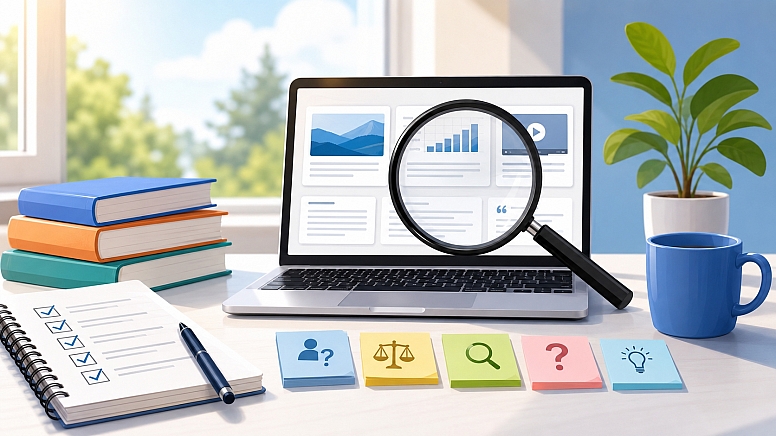
People evaluate information every time they compare medical advice, research financial products, vote in elections, assess public policies, or decide whether to share an article with friends. Employers expect professionals to distinguish credible sources from unreliable ones. Communities depend on informed citizens who can participate thoughtfully in public discussions.
In other words, information evaluation has become a practical life skill.
A person who can recognize weak evidence, identify missing context, or compare competing claims is better equipped to make decisions in almost every area of life. These abilities strengthen independent thinking without requiring agreement on political views or social issues.
That broader perspective is why many educators now view information evaluation as one of the defining competencies of modern citizenship.
Why Media Literacy Education Matters
Developing these habits does not happen automatically. They are learned through practice, repetition, and thoughtful instruction.
This is where media literacy education plays an essential role.
Contrary to a common misconception, media literacy is not about telling students which news organizations to trust or what political opinions to adopt. Its purpose is much broader. It teaches people how information is produced, how narratives are constructed, how bias can appear through framing or omission, and how evidence should be evaluated before reaching conclusions.
Students learn to distinguish reporting from opinion, recognize persuasive techniques, evaluate sources, compare multiple viewpoints, and understand how algorithms influence the information they see.
These skills encourage intellectual independence rather than ideological conformity.
The strongest media literacy programs do not provide students with answers to memorize. They provide questions that students learn to ask for themselves.
Learning Should Continue Long After Graduation
One reason information evaluation deserves greater attention is that the information landscape never stops changing.
A student graduating today will encounter technologies that may not exist yet. Artificial intelligence is already reshaping search engines, news production, education, and online communication. Deepfakes continue to improve. Social media platforms regularly introduce new algorithms that determine which content receives visibility.
The habits people developed ten years ago may not be enough to navigate the next decade.
That reality makes lifelong learning increasingly important. Evaluating information is not a skill that is mastered once and then forgotten. It requires continuous adaptation as technology, media platforms, and communication methods evolve.
The strongest learners remain curious long after formal education ends.
Why Structured Learning Makes a Difference
Many people improve their information habits simply by reading widely and comparing different perspectives. Curiosity is an excellent starting point.
Structured instruction, however, often accelerates that process by introducing concepts people might never discover on their own.
A well-designed media literacy course helps learners recognize recurring patterns across different forms of media. Rather than examining individual articles in isolation, participants learn to identify framing techniques, source quality, emotional language, visual persuasion, confirmation bias, and the broader systems that shape public understanding.
Biasly's Media Literacy Education Platform is built around this philosophy. It provides structured learning experiences for students, teachers, researchers, and professionals who want to strengthen their ability to evaluate information critically.
Rather than encouraging skepticism for its own sake, the platform emphasizes evidence-based analysis, responsible media consumption, and practical critical thinking skills that can be applied across news, social media, and digital communication.
The objective is not to create more cynical readers. It is to create more capable ones.
The Future Will Belong to People Who Can Evaluate Information
Reading and writing transformed societies because they allowed people to exchange ideas across generations.
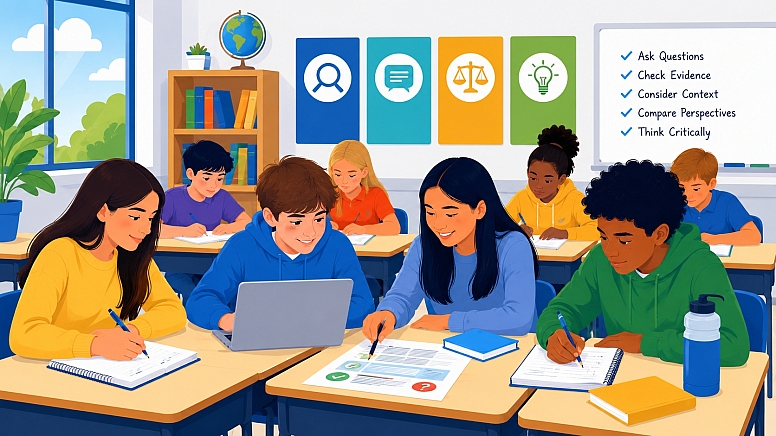
Today, the next essential skill is not simply accessing information. It is evaluating it.
Artificial intelligence will continue producing content at unprecedented speed. Social platforms will continue rewarding engagement. News cycles will continue accelerating. Information itself will become increasingly abundant.
Judgment, however, will remain scarce.
The people who thrive in this environment will not necessarily be those who consume the most information. They will be the ones who know how to ask thoughtful questions, compare competing claims, recognize persuasive techniques, and distinguish evidence from assumptions.
These are skills that strengthen every profession, every academic discipline, and every informed decision.
The Classroom Skill That Lasts a Lifetime
Schools have always prepared students for the future, but the future has changed.
Success today depends on more than remembering facts or mastering technical subjects. It also depends on understanding where information comes from, how it is presented, and why different sources may tell the same story in different ways.
That does not mean every student must become a journalist or media expert. It means every student should have the tools to evaluate information with confidence and care.
Because facts alone do not create understanding.
The ability to question, verify, compare, and think critically is what transforms information into knowledge.
It is a skill that strengthens every other subject, supports better decisions throughout life, and may ultimately become one of the most valuable forms of education any school can provide.


0.3248