



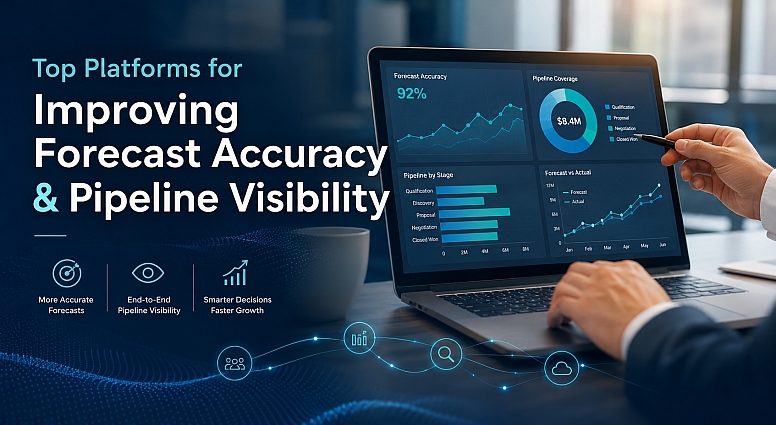
Platforms to Improve Forecast Accuracy & Pipeline Visibility
Business Intelligence tools have long been used by businesses of all sizes to gauge performance and productivity. But most go-to software tools either have a steep learning curve, are prohibitively expensive at scale, or require highly specialized development expertise to set up.
Fortunately, with the quick development of AI and Big Data technologies, businesses today have a wider range of options. For instance, when companies want to fix broken forecasts and get an honest look at their sales pipeline, they generally look at three distinct software categories: revenue intelligence, revenue AI & operations, and activity & relationship intelligence.
While they all aim to improve accuracy, they approach the problem from different angles. One focuses on analyzing conversations, one on financial modeling, and one on raw sales activity. Let’s learn more about each and how they can help businesses of all sizes.
Revenue Intelligence Platforms
A revenue intelligence platform connects directly to communication tools such as email, calendars, and video conferencing software, automatically capturing customer interactions across the sales process. It then uses AI to analyze that data, helping teams understand deal progress, pipeline health, and revenue risks.
Not all revenue intelligence solutions offer the same level of forecasting precision, analytics depth, or integration flexibility, making platform evaluation an important part of the buying process.
The best revenue intelligence platforms distinguish themselves through forecasting accuracy, conversation intelligence capabilities, CRM integrations, reporting depth, and the ability to surface actionable insights from customer interactions.
For example, the platform can alert a manager if a competitor's name was mentioned on a call or if the client stopped responding to pricing questions. Also, by comparing current sales activity with historical patterns, these platforms can predict exactly how much revenue the company will generate at the end of the quarter.
Revenue AI and Operations Platforms
These platforms care less about coaching reps on calls and more about complex mathematical forecasting. They pull data from every corner of the business to build finance-grade roll-ups that a CFO and VP of Sales can use to commit to a quarterly number.
Let’s take marketing spend as an example because it’s a notorious black hole for budgets of all sizes. Operations platforms track whether marketing spend is converting to cash, predict which big contracts are actually safe, and warn leadership months if the company is going to miss its financial targets.
This way, your team will know whether to invest more in tools to boost the marketing strategy or take a break and refocus their efforts.
Here are a few examples of such platforms to consider:
- Clari: The gold standard for enterprise forecasting math
- Aviso: Excels at multi-method forecast roll-ups and deal-level risk inspection
- Outreach: Blends pipeline visibility and AI-guided forecasting with the tools reps use
Activity Capture & Relationship Intelligence Platforms

You can’t have forecast accuracy if your data isn’t healthy and well-organized. But given that data just pours in at every moment of the day and night, no human-only team can handle this task.
This is where activity and relationship intelligence platforms step in. They run in the background automatically capturing 100% of those customer interactions and filing them into the system without human effort. Their job is to eliminate the "garbage in, garbage out" problem that is usually a symptom of manual data entry.
Once the data is captured, the relationship intelligence side kicks in. The AI maps out the invisible web of connections within a client company. It analyzes exactly who is talking to whom, flags if a key decision-maker has gone cold, and alerts managers if a deal is stalling because the team is talking to the wrong person.
Here are a few examples of such platforms to consider:
- AI: Captures and maps stakeholder interactions to the right enterprise account
- Revenue Grid: Focuses on Salesforce activity capture and pipeline visibility
- Oliv AI: Uses AI to process meetings and auto-populate pipeline criteria
Why Having the Right Tools Matters
Without accurate forecasting and clear pipeline visibility, high-level decisions become more guesswork than strategy. Companies that lack these capabilities often struggle to capitalize on growth opportunities because rising demand catches them off guard, leaving teams scrambling to manage an influx of orders, projects, and customer requests.
Limited pipeline visibility also creates deal blindness. Sales managers may not recognize which opportunities are progressing as expected and which are at risk until it's too late to intervene. With clear, reliable data, businesses can make smarter financial decisions, allocate resources effectively, hire with confidence, and scale their operations more predictably and sustainably.





0.3615