



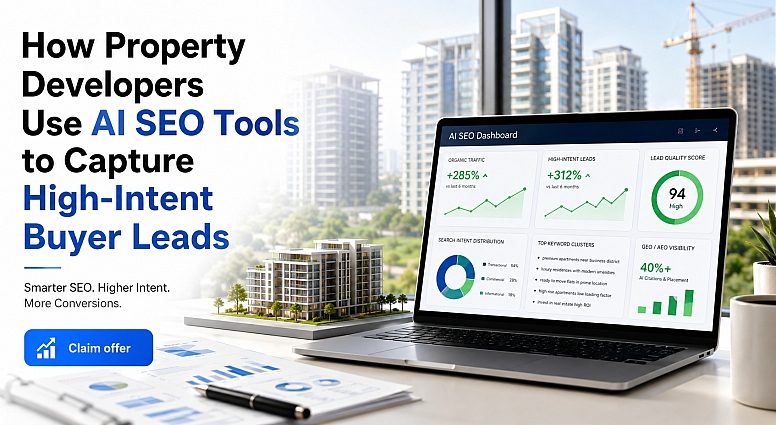
How Property Developers Use AI SEO Tools to Capture Leads
The real estate landscape has evolved past the point where simple location and broad visibility are enough to guarantee a sell-out launch. Today, property developers face a highly fragmented digital marketplace where high-net-worth investors and first-time homebuyers rarely look past the first few results on search engines or AI discovery platforms.
To break through this noise, forward-thinking brands no longer rely on traditional, manual search engine optimization strategies. Instead, a specialized real estate digital marketing agency leveraging modern AI SEO tools has become the baseline requirement for constructing data-driven lead generation funnels. By shifting from gut-feeling content creation to algorithmic precision, developers can identify, target, and capture high-intent buyers exactly when they are ready to make a transactional decision.
Here is a comprehensive breakdown of how modern property developers are deploying AI SEO tools to engineer high-converting digital pipelines.
Algorithmic Keyword Mapping: Moving Beyond
High-Volume Fluff
Historically, real estate SEO relied on targeting broad, highly competitive terms like "luxury apartments" or "flats for sale." While these terms boast massive search volumes, they pull in a highly diluted audience, ranging from casual window-shoppers to students researching real estate trends.
AI SEO tools have fundamentally shifted this paradigm by focusing on search intent clustering. Machine learning platforms allow developers to analyze thousands of search variations instantly.
- Intent Segmentation: AI engines automatically sort search queries into
informational, commercial, or transactional buckets. Developers use this to filter out low-intent traffic and focus capital entirely on phrases indicating immediate buying power.
- Long-Tail Semantic Clusters: Instead of targeting a single keyword, AI clusters related long-tail phrases (e.g., move"). By structuring a landing page around a semantic cluster rather than a single phrase, developers match the exact natural language patterns of high-budget buyers.
Real Estate Search Benchmarks & Performance
Metrics
To understand why shifting to an automated, high-intent AI pipeline is critical, developers must look at how user behavior and search metrics change depending on the strategy applied. The following dataset highlights the tangible performance gaps between legacy SEO frameworks and AI-optimized deployment.
Search Performance by Optimization Framework
|
Metric / KPI |
Legacy Real Estate SEO (Manual Keywords) |
AI-Driven SEO & Intent Clustering (Automated) |
Operational Impact on ROI |
|
Average Click-Through Rate (CTR) |
1.8% – 2.4% |
4.6% – 6.2% |
More qualified buyers clicking through to the site per impression. |
|
Lead Qualification Rate |
12% |
34% |
Drastically reduces sales team time spent filtering out dead ends. |
|
Cost Per Lead (CPL) Variance |
Baseline ($) |
28% – 42% Reduction |
Lowers acquisition costs by eliminating low-intent keyword bidding. |
|
Content Deployment Speed |
2–3 weeks per cluster |
24–48 hours (Programmatic) |
Allows developers to capture search market share before a pre-launch. |
|
Generative AI Visibility (GEO/AEO) |
Less than 5% citation rate |
40%+ Citation & Placement |
Ensures project models are chosen by LLMs as recommended answers. |
Sources: Data compiled from:
WordStream Industry Performance Studies
Semrush AI Overviews Search Shift Analysis.
Programmatic Landing Pages for Hyper-Local
Dominance
Real estate is intrinsically local, but managing hyper-local SEO across multiple micro-markets is a logistical nightmare when done manually. If a developer has a project spanning a large suburban region, they need visibility across every neighboring micro-district, transit hub, and commercial center.
AI-driven programmatic SEO tools allow developers to scale localized landing pages without sacrificing quality or triggering search engine duplicate content penalties:
By connecting AI content generators to structured local databases, developers can instantly roll out hundreds of highly optimized pages. Each page details specific proximity metrics, localized market trends, and nearby infrastructure updates, capturing localized search queries that competitors miss entirely.
Optimizing for GEO & AEO (The New Search Frontier)

The search landscape is undergoing its most massive shift in two decades. Traditional search engine results pages (SERPs) are sharing space with Generative Engine Optimization (GEO) and Answer Engine Optimization (AEO). High-intent buyers are increasingly using platforms like ChatGPT, Gemini, and Perplexity to conduct conversational research.
Example Buyer Prompt: "Show me premium residential towers in the western suburbs with over 35 storeys, modern amenities, and a low loading factor."
Standard keyword stuffing will not help a developer surface in an AI-synthesized answer. Property developers use advanced AI SEO tools to audit their sites for AI readability. This involves:
- Schema Architecture: Automatically generating complex structural data (RealEstateAgent and SingleFamilyResidence schemas) so AI crawlers can accurately pull unit dimensions, pricing, and availability.
- Entity-Driven Optimization: Building brand authority across third-party networks so an LLM recognizes the developer's project as a verified, trusted entity when answering a user's prompt.
Predictive Content Engineering for Pre-Launch Velocity
The most critical phase of a real estate lifecycle is the pre-launch, where generating massive momentum dictates the financial health of the project. Waiting for traditional SEO content to rank organically over six months is often too slow for aggressive sales timelines.
Predictive AI SEO tools solve this by analyzing historical search trends, macroeconomic indicators, and infrastructure shifts to forecast future search behavior.
- Trend Forecasting: If data indicates a spike in search volume for "eco-friendly smart homes" or "dedicated work-from-home spaces" within a specific demographic, developers can deploy targeted content hubs months before the project breaks ground.
- Automated Content Briefs: AI tools generate highly structured outlines based on exactly what top-performing pages are doing structurally, ensuring that newly published pre-launch pages rank at an accelerated rate.
For modern property developers, relying on beautiful architectural renders and high-production lifestyle videos is only half the battle. If high-intent buyers cannot discover your digital assets at the exact moment they query the market, your inventory remains stagnant. Integrating AI SEO tools into your marketing infrastructure turns search visibility into a precise, mathematical science.
By leveraging automated intent mapping, programmatic hyper-local pages, and optimizing for generative AI engines, developers build a self-sustaining inbound pipeline. In an industry where cost-per-lead (CPL) via traditional paid social ads continues to climb, dominating organic search through algorithmic precision is the ultimate competitive advantage.







0.2268