












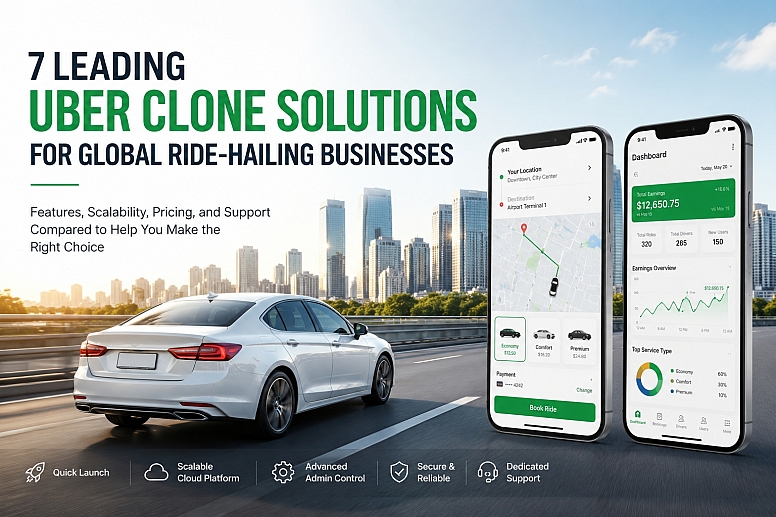
Best Uber Clone Solutions for Global Ride-Hailing Businesses
Here are seven of the most viable Uber clone solutions that are currently available for global ride-hailing companies, what they offer, who they are suitable for, and what you should consider before making a decision.
A big technical team and a budget that most early-stage operators just didn't have. The situation has changed significantly since that time.
Today, there is a solid class of Uber clone solutions that exist just to fill that gap. They are white-label platforms that provide you with a working rider app, driver app, and admin panel, all under your brand name, without the time or expense of custom development. You pay for a platform that already works, customize it to your market and identity, and launch.
However, not every Uber clone solution is created equal or for the same kind of business. Some are better for quick launches with a limited budget. Others are geared towards operators requiring serious dispatch tools or multi-country support. If you select the wrong one, you'll end up spending more in the long run than you would have if you had invested a little more initially.
What You Should Know Before Picking an Uber Clone
There are a few things that you should know before you start the list, which will help you to make a better evaluation.
The Uber clone is a broad category that encompasses a variety of qualities and depth. On the low end, you have basic script-based solutions that mimic Uber's surface (booking, tracking, payment) but don't have the infrastructure to withstand the real-world demands.
On the other side, there are fully white-label platforms that are based on modern cloud architecture, capable of supporting thousands of rides per day, multi-city pricing rules, and an expanding driver network without any slowdowns, including support for modern payment gateways.
Three things are often overlooked when comparing vendors:
- Whether or not you receive the source code
- What post-launch support entails
- Whether or not the admin panel provides you with control or just reporting
These are not minor things; they are the difference between building a business and running someone else's software under your own brand.
7 Leading Uber Clone Solutions for Global Ride-Hailing Businesses
1. Uberclone.co
Uberclone.co is a taxi booking app development company that specializes in taxi and ride-hailing platforms for businesses looking to launch fast without compromising on quality. They're different from the list because they're built to grow from the beginning; their platform is built on cloud-based infrastructure, so the system expands with your business, not against it, when riders start to pile up. This scalability is also valuable for businesses looking to manage go-kart booking business as their bookings increase.
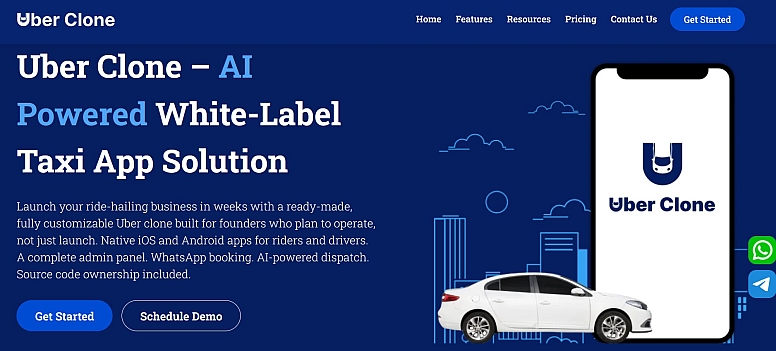
They have a rider app, driver app, and admin panel that are all integrated from the get-go. They also provide customization beyond just colors and logos, such as regional payment systems, local language needs, and various vehicle types based on the market.
One thing to note is their white-label delivery add-on. If you would like to eventually offer delivery services (food, parcels, etc.) with the same driver network, which is also integrated into their ecosystem, not a separate product.
Ideal for:
Startups and regional taxi companies that want to build a scalable platform that can scale over time, rather than just launch and plateau.
Key strengths:
- Cloud-ready infrastructure for scaling.
- Live GPS tracking and ride management.
- Multi-currency and regional payment gateway support.
- White-label delivery expansion option on the same platform.
- True customization, not just a logo.
2. Elluminati
With several years of experience in the on-demand app development industry, Elluminati has a proven history, especially in their EMotorist ride-hailing app. They excel in the admin panel's depth. Most clone solutions provide you with a basic dashboard, but Elluminati's admin setup provides operators with real control over zone-based pricing, referral programs, driver activity monitoring, earnings breakdowns, and trip history, all in one place.
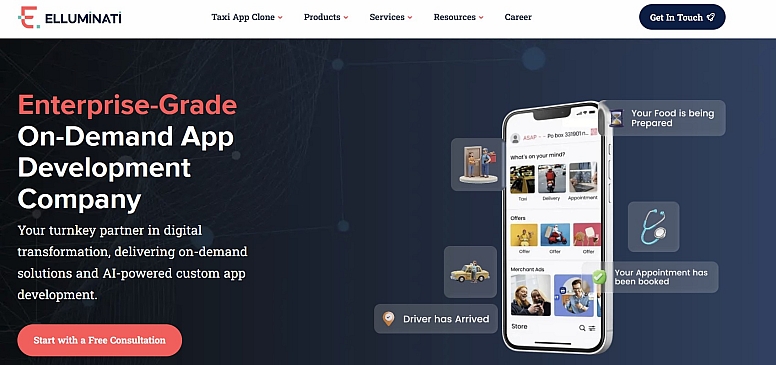
Their platform is more than just a taxi ride. The system is designed to be flexible for operators who wish to provide more than point-to-point cab services, including corporate ride management, bike rides, carpooling, and outstation trips.
They've also had experience with clients on several continents, so their platform is already multi-currency and multi-language, not as an add-on, but as part of the system.
Best for:
Companies that value operational control and seek a more advanced platform that offers a comprehensive admin experience and global support.
Key strengths:
- Admin panel with detailed pricing and referral management by zone.
- Includes carpooling, corporate rides, bike rides, and outstation trips
- The platform supports multiple languages and currencies, which is a built-in feature. The platform has built-in multi-language and multi-currency support.
- Experience working with clients in North America, Europe, and Asia.
- One year of free support with the licensing model.
3. SpotnRides
SpotnRides is an AI-powered Uber clone solution, and they don't use the term "AI" as a marketing buzzword, but rather their platform features automated dispatch with intelligent ride matching, a heat map in the admin panel that displays high-demand areas in real-time, and voice-booking capabilities all built in, not sold as premium add-ons.
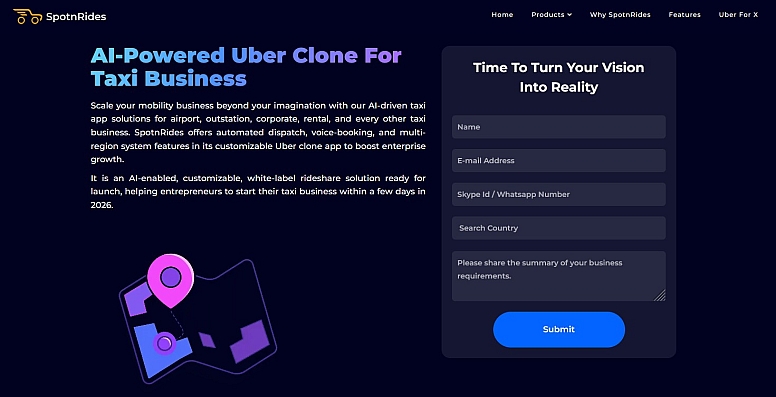
They also have a platform that is designed for multi-region operations. If you want to start in one city and expand to others without rebuilding the entire system, their infrastructure supports that from the admin panel, using different zone settings, pricing rules, and driver pools per region.
One thing that stands out is their compatibility focus. It is fully supported on both iOS and Android, and its deployment timelines are among the quickest in this category.
It is ideal for operators looking to leverage AI for dispatching and intelligence from the start and for operators seeking to expand to multiple cities.
Key strengths:
- AI-based ride matching and automated dispatch.
- The feature of a heat map is added to the admin panel to make it easier to see the demand zones.
- Voice-booking is available for greater accessibility.
- Multi-region system with separate pricing and zone management per city.
- Quick deployment times and 100% iOS and Android compatibility.
4. Appdupe
Appdupe has been in existence long enough to know that taxi companies are not all alike. Unlike most providers, their Uber clone includes a dispatcher panel in addition to the rider, driver, and admin apps. This is important for taxi operators who still receive some calls or bookings from a call center. For businesses with multiple booking channels, dispatchers can view available drivers on a real-time map and manually allocate rides.

They serve clients in North America, Europe, the Middle East, and Southeast Asia, and have worked with enough varying markets to know that they have different needs. Cash payment support, local map integration, and regional language flows are not added on as an afterthought, but are done with familiarity.
They also offer pricing options to suit various budgets, including a standard package for businesses requiring the basic platform and a custom development package for those with more specific needs than the base.
Best for:
Taxi companies that require an app for their customers and a dispatch system for their back-end operations, especially those that operate a hybrid taxi booking system.
Key strengths:
- Manual ride assignment dispatcher panel uncommon among clone providers
- Support for cash payments in markets where digital-only is not effective
- Standard and custom development options with flexible pricing.
- Evidence of client experience in four key global regions
- A robust post-launch support model.A robust post-launch support model.
5. Appicial Applications
Appicial's reputation is largely based on its accessibility. Their HireMe product is a white-label taxi app solution designed for businesses, even those that are not tech-savvy. They have a reputation for communicating clearly throughout the development process, which is very important when you're making decisions on features and configurations without a tech background.
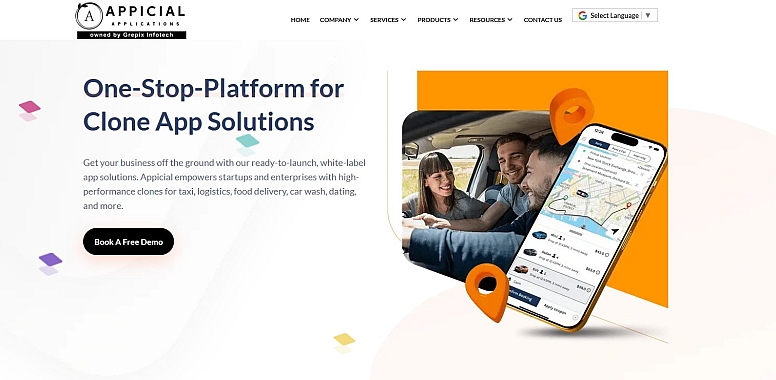
They have the typical three-panel solution (passenger app, driver app, admin panel) and can be fully branded from the top down to the specific features required. They also operate in several verticals, so if you ever want to branch out from taxis into logistics or delivery, it's already in place.
One of the practical things that clients often talk about is how responsive they are. As you're building and launching an app, you're constantly faced with questions. A quick response team or a team that answers the phone can save a lot of friction.
Best for:
First-time founders and small operators who require a platform and team that can help them through the process.
Key strengths:
- White Label HireMe platform, completely customisable to business needs
- Reputation for good client communication during construction
- Supports taxi, logistics, and other verticals that are on-demand.
- A free demo is available before purchase.
- Great for non-technical founders who require full support
6. White Label Fox
White Label Fox's Uber clone platform is analytics-driven. While most providers offer a ride management dashboard, White Label Fox integrates real-time analytics that actually enable you to make operational decisions, not just review historical data. Drivers per zone, booking completion rates, earnings trends, and demand patterns are all visible in a way that helps with daily decisions and not just reporting.
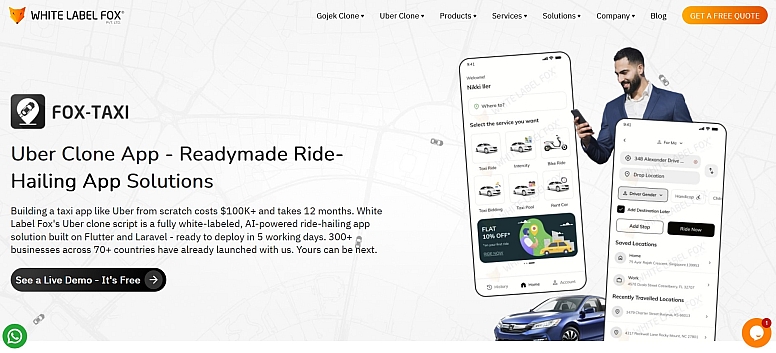
They offer several revenue model options, such as commission-based, driver subscription, surge pricing, and in-app advertising, which is important if you're looking to create a business model that goes beyond the traditional commission-per-ride model.
They are also independently reviewed on sites like Clutch, Trustpilot, and GoodFirms, offering third-party validation that not all clone providers can claim.
For whom is it suitable:
Operators who need data-driven operational visibility and multiple revenue stream options from the get-go.
Key strengths:
- Real-time analytics dashboard with actionable operational data.
- Multiple revenue models support commissions, subscriptions, surge, and advertising
- In-app wallet, driver earnings tracking, and in-app chat are included
- Verified on Clutch, GoodFirms, and Trustpilot with client reviews
- The base platform comes with AI-powered dispatch. AI-powered dispatch is built into the base platform.
7. Trioangle Technologies
Trioangle is a name that is familiar in this space for two products: Gofer, their Uber-like taxi service, and Woowerly, which is built on Flutter to ensure a consistent experience across platforms. What makes them stand out from the rest is their ownership model of source code. When you purchase their platform, you own the code. That means you don't have to rely on Trioangle for all future changes, features, and updates. You can hire your own developers and build on your own.
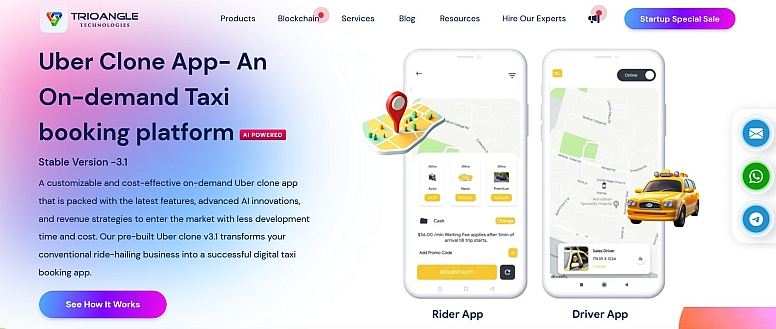
This is a practical point that is more significant than it sounds. Many clone providers retain the source code and charge you for each change you require. That dependency is eliminated with source code ownership, and your business will have long-term flexibility that a SaaS arrangement does not provide.
They offer standard city rides, outstation services, and rental options on their Gofer platform, and their pricing is simple: a full stack with a fixed price and three months of initial support.
For whom is it suitable:
Companies that desire full ownership and control of the platform they paid for, especially those with in-house development capabilities or plans to develop one.
Key strengths:
- Ownership of source code with the purchase of full long-term control.
- Wooverly was built using Flutter, ensuring consistent cross-platform performance.
- Includes city rides, outstation, rental, and carpooling models
- Clear, up-front pricing, no hidden upgrade fees.
- Quick deployment with an initial support period included
How to Make the Right Decision Between These
Even after reading 7 options, you may still not know where to begin. One way to do this is to match your greatest need with the provider who really meets that need.
If you're starting quickly on a shoestring budget and want someone to guide you through the process, Uberclone.co is a good place to start. For those who are converting an existing taxi fleet to a digital system, the Appdupe dispatcher panel, Appicial, Elluminati, and SpotnRides all have a different approach to scalability and modernization needs.
In either case, always request a live working demo, not a screen recording. Ask for references from clients who have been live for at least 6 months. Also, make sure to get the post-launch support terms in writing before you sign anything. Those three steps will help you avoid most of the pitfalls operators fall into when selecting a platform.
The best Uber clone solution is the one that aligns with where your business is beginning and where you want it to go. All of these seven can help you get there, but it's knowing which one fits your situation.







0.4282