



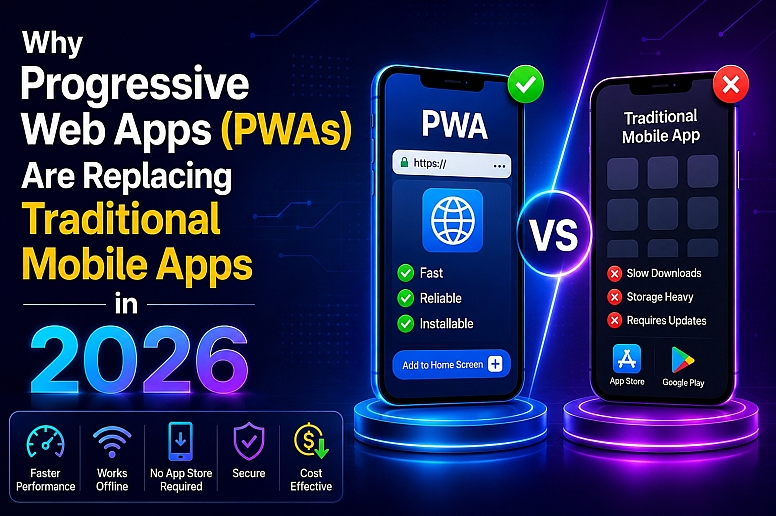
Why Progressive Web Apps (PWAs) Are Replacing Mobile Apps
The mobile app scene is changing pretty fast in 2026. A lot of businesses are not just leaning on old-school native applications anymore to stay connected with customers. Instead, companies in many sectors are moving toward Progressive Web Apps PWAs) because they feel snappy, accessible, cheaper to build, and they usually give that smooth experience you want across every device.
As people’s expectations keep climbing, organizations are looking for digital solutions that deliver app-like performance without the usual headaches, like app store approvals, large download sizes, and costly upkeep. And yeah, this is where PWAs start reshaping the whole market.
Right now, many teams are teaming up with a progressive web app agency to create scalable, engaging web applications that mix the best parts of websites and mobile apps, not too complicated, but still reliable.
In this article, we’ll dig into why PWAs are taking over from traditional mobile apps in 2026, what the big advantages are, and how businesses can tap into this newer tech.
What is a Progressive Web App (PWA)?
A Progressive Web App is basically a web application that kind of behaves like a native mobile app, yes it runs through a browser, but still gives that feel. It includes features like Offline access, Push notifications, fast loading speed, and the option to install it on your home screen. It also stays responsive and works across different platforms.
PWAs use newer web building blocks such as Service Workers, Web App Manifests, and HTTPS, so everything feels more secure and more app-like on any device.
Compared with traditional mobile apps, there's no real need for users to download PWAs from app stores. They can reach it directly in the browser, and if they want, install it right away, pretty instant, actually.
Why Traditional Mobile Apps Are Losing Popularity
For years, native mobile apps kinda ruled the digital ecosystem. That said, businesses are getting hit with a bunch of limitations from the usual app approach, like the whole thing is not as smooth anymore.
1. High Development Costs
Building two different apps, one for Android and one for iOS, means different development teams, different frameworks, and even separate testing paths. So yeah, the total expenses climb pretty fast.
In practice, businesses end up paying for:
- Separate code bases
- Maintenance that is platform-specific
- Ongoing revisions and continuous updates
- App store compliance checks
For startups, and for some mid-sized businesses too, these costs can become tricky to handle, especially when budgets are already tight or timelines are not super forgiving.
2. App Store Dependency
Traditional apps kind of lean too much on app stores for visibility, distribution, and overall discoverability. There are also approval delays, policy changes, and commission fees that act as extra hurdles for businesses. And even when you invest a lot into development, there is still no real promise that people will actually download the app, you know.
3. Storage and Download Issues
Users today tend to be picky about what they install. When an app is large, it often gets ignored, mainly on low-storage phones. Some research indicates that a lot of users uninstall apps shortly after installing them, not because it’s bad, but because there simply isn’t enough room, or they just don't use it regularly.
4. Frequent Updates
Native apps need ongoing updates, and those updates usually have to be downloaded manually by users. That step can disrupt the whole flow, and it may reduce engagement rates. PWAs, on the other hand, handle many of those issues better.
Why PWAs Are Dominating in 2026
1. Instant Accessibility
One of the biggest advantages of PWAs is this instant accessibility thing, like users can tap into a PWA right from a browser without actually downloading anything. That sort of removes friction in the customer journey, and it also tends to boost user engagement, even when people are just browsing. For businesses, easier access usually lines up with:
- Higher conversion rates
- Lower bounce rates
- Better customer retention
And honestly, consumers today want convenience, and PWAs deliver that pretty directly.
2. Faster Performance
Speed really matters for how satisfied someone feels. PWAs are built so they can load quickly even when the internet is slower or a bit unstable. There’s also service worker caching, so the content can start up faster after that first visit. When performance improves, it often lifts:
- User experience
- Search engine rankings
- Time spent per session
- Customer satisfaction
So businesses that partner with a PWA development agency can end up tuning PWAs to be quick on basically all devices, not just the newest ones.
3. Offline Functionality
Traditional websites pretty much fall apart when there’s no internet. PWAs don’t; they can still work offline or under low-network situations. This is especially handy for:
- E-commerce platforms
- Travel apps
- Educational platforms
- Healthcare services
That offline support helps keep user engagement going, and it also makes the whole service feel more reliable, more steady, you know.
4. Cross-Platform Compatibility
PWAs work kind of seamlessly across smartphones, tablets, Tablets, Laptops and Desktops. Instead of building separate applications for Android and iOS, businesses can keep this one shared code base and just reuse it everywhere.
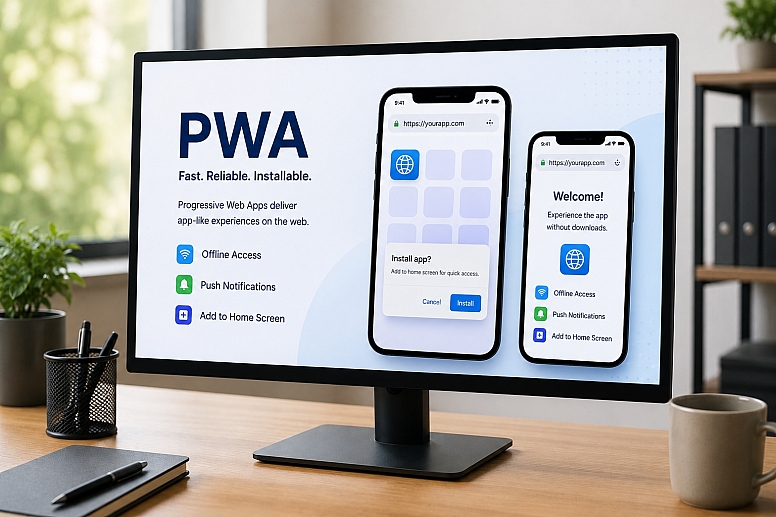
It cuts down a lot, like development time, maintenance costs, and even that whole technical complexity thing. In 2026, businesses are really prioritizing efficiency, and PWAs fit that goal quite nicely.
5. Improved SEO Benefits
Unlike native apps, PWAs are indexable by search engines, so in practice, businesses can increase organic traffic, improve online visibility, and reach wider audiences. The SEO friendly architecture gives PWAs a noticeable edge over traditional apps that lean mostly on app store discovery.
When you work with a reliable progressive web app development company, they can build SEO-optimized PWAs that strengthen both the user experience and search engine performance.
Key Industries Adopting PWAs in 2026
PWAs are getting picked up in a lot of industries, mostly because they’re sort of flexible and easy to scale; it’s like they just fit wherever teams need speed.
E-Commerce
Online shops and retailers use PWAs to make shopping feel quicker, and yes, that also helps raise conversions. The main benefits are: faster checkout workflows, push notification marketing, and offline browsing. They also see reduced cart abandonment. Several big brands have said they noticed meaningful gains in revenue after moving to PWA tech.
Healthcare
In healthcare, providers use PWAs for appointment planning and telemedicine, plus patient portals and health monitoring. With PWAs, health systems can stay reachable even when the internet connection is limited. In other words, services don’t just disappear when the network is messy.
Education
Schools and e-learning teams rely on PWAs for online courses, video lessons, interactive learning tools, and even student communication. Since there’s offline accessibility too, learning can be more convenient for students around the world, even when Wi‑Fi is unstable or when data is expensive.
Travel and Hospitality
Travel companies use PWAs to deliver real-time booking updates, travel itineraries, offline maps, and instant notifications. Those options make customers feel more comfortable and a lot more engaged, because they don’t have to chase information on slow pages.
Media and Entertainment
In media and entertainment, PWAs are trending because they offer fast content streaming, push notifications, better engagement, and lower loading times. People can access the content right away, without having to download heavy applications.
Push Notifications Without App Downloads
Push notifications are one of those stronger engagement tools in digital marketing that kinda never really lose power. Traditionally, companies used mobile apps to send those notifications around.
Now PWAs can do the same basic thing straight through the browser, without all the extra fuss. There are a few clear wins, like higher customer engagement, better retention rates, improved marketing performance, and real-time communication, in a way that actually feels immediate.
Since people don't have to install an app first, businesses can reach audiences more efficiently and with a lot less friction.
Cost Efficiency for Businesses
Cost reduction is a big driver, and honestly, that’s one reason a lot of teams pick PWAs instead of traditional apps. With a single PWA, you can cover multiple platforms, so it cuts down on things like development costs, maintenance expenses, and even that infrastructure complexity.
For startups and businesses that are still growing, this can become a more sustainable digital strategy, not just a quick workaround. And when businesses team up with a progressive web app agency, they can ship faster while still keeping performance and scalability in a good place.
Better User Retention
A lot of users lean toward experiences that feel quick, smooth, and convenient. PWAs help with retention because they load instantly, require no installation, use less storage, and work across different devices.
Modern users often value simplicity, and PWAs remove unnecessary steps from the user journey, so people don't get stuck or annoyed.
Enhanced Security
Security is kind of essential in today’s digital environment. PWAs rely on HTTPS protocols to keep communication between users and servers secure, and yeah, also stable.
This helps protect user data, payment information, and sensitive business records.
When companies build secure digital experiences, it helps them earn customer trust and credibility.
App-Like Experience Without App Stores
PWAs kind of deliver almost all the things you’d get from a native app, while also dodging most app store limitations, at least in practice. In particular, users can add them to the home screens, get push-style notifications, open full-screen interfaces, and even rely on offline functionality.
So in the end, you get this smooth experience without needing that old-school traditional download process. And as the tech keeps evolving, browser capabilities are getting stronger and stronger, which makes PWAs feel more advanced than they did before, pretty much every cycle.
The Future of PWAs in 2026 and Beyond
The future of PWAs looks kind of extremely promising, honestly. With new browser APIs coming out, plus AI integration, and cloud stuff getting better too, PWAs feel more capable and feature-heavy.
People in the field are saying that more businesses will swap native apps for PWAs, mostly because they can offer faster deployment and smoother accessibility, plus usually lower operational costs. And on top of that, the customer experiences tend to improve in a very noticeable way.
Also, tech giants, like Google and Microsoft, keep backing PWA technologies. They keep polishing them and enhancing them, so the adoption keeps speeding up worldwide.
As user behavior keeps moving toward convenience and instant accessibility, PWAs are drifting into that preferred digital solution for companies both small and large.
Progressive Web Apps are kind of redefining the mobile experience in 2026, and it feels like they are doing it fast. They blend the accessibility you usually get from websites with the real-world functionality of native apps, so businesses get a smarter yet more cost-effective solution.
You see the benefits in a bunch of ways, like quicker loading speeds, offline functionality, and even a bit of a boost in SEO performance. Plus, the development costs tend to be lower too, so it’s not just “nice to have” anymore.
For many organizations trying to stay competitive in the moving digital landscape, PWA technology is becoming the obvious pick. It supports better customer engagement and helps streamline everyday operations, with fewer headaches.
Working with an experienced PWA development agency or a trusted progressive web app development company can make a real difference, because building high-performing digital platforms still needs proper know-how and attention.
And as technology keeps evolving, PWAs aren’t just an alternative to native apps anymore; they’re starting to look like the future of mobile experiences.




0.3737