



Why GEO Is The Next Evolution of SEO for Modern Brands?
For more than 20 years, search engine optimization has been a crucial component of internet presence. To rank higher on search engines like Google, brands made significant investments in content optimization, backlinks, and keywords. Today, people search for information in a very different way than they did in the past.
Search engines nowadays use AI tools, including ChatGPT, Perplexity, or Google AI-powered search features. That helps to provide users with direct answers rather than displaying links to various webpages. Users today prefer to receive immediate summaries of information through conversational responses instead of visiting several different websites.
Generative Engine Optimization, i.e., GEO, has developed as a new field that focuses on helping content creators optimize their work for AI-based search engines instead of standard search result pages.
What Is Generative Engine Optimization?
The process of optimizing content for better performance on AI generative systems has its own name, which experts call Generative Engine Optimization or GEO. GEO ensures that your brand content appears in AI-generated results when customers discuss your products and services and expertise areas. The process of GEO creates content that AI models recognize as trustworthy and valuable for summary use, while SEO focuses on achieving higher rankings in Google search results.
The next development in this evolution is GEO. Generative search engines generate answers, suggestions, and stories for the user directly, in contrast to conventional search engines that merely provide a list of links. This change means that your brand is now part of the solution itself rather than vying for a better position on a results page.
How does it work?
The generative engines access extensive datasets, which include online material, structured information, and semantic networks. Three crucial components are required for your material to be included in their synthesized responses:
- Contextual Authority: Develop consistent subject-matter expertise and produce unique, empirically supported insights to establish contextual authority. AI models prioritize depth, accuracy, and believability above the importance of keyword density.
- Structured Intelligence: Make connections between your content and more general industry themes clear and machine-readable by using entity linking, knowledge graphs, and AI-ready schema markup.
- Prompt-Optimized Content: Write articles, FAQs, and manuals using conversational, natural language that mimics how people ask actual inquiries and express their intentions when speaking with AI assistants.
Why Are SEO or Traditional Practices No Longer Enough?
The system of traditional SEO operated by utilizing search engine algorithms, which assessed webpage rankings through their keyword content, backlink structure, and their authority indicators.
The search engines that use artificial intelligence for their operations function in a different manner. It includes:
- Decipher what the user wants to achieve
- The system collects data from different sources
- The system produces one unified answer.
Users now engage with direct responses instead of browsing through entire websites. AI systems create a new problem for brands because their content will not reach users unless it becomes useful to AI systems. AI search systems shift visibility from ranking systems to referencing systems.
In response, some brands are also working with AI SEO agencies that combine traditional optimization with AI-focused strategies to bridge the gap between classic search rankings and generative visibility.
Why GEO Matters Now?
People's search behavior is shifting faster than most marketing strategies or practices can keep up. AI tools or practices are fundamentally evolving where and how decisions get made, and whether your brand is part of that conversation.
Experiences that require no clicks are more common. AI-powered summaries circumvent conventional search results by providing straight answers to queries.
- Web traffic is being displaced by LLM-generated answers: Although the content may still originate from your website, it will be disregarded or misrepresented if it is disorganized or ambiguous.
- Different queries are being asked by buyers: They aren't entering keywords. They are posing complex questions, and AI is forming the response according to what it can comprehend and reference with ease.
- This is not taken into account by traditional SEO: There is no gradual drop in the cost of inaction. It's an abrupt absence from moments of critical visibility.
Benefits of GEO for Modern Brands
- Taking Control of Brand Mentions on Generative Platforms
AI models now influence a brand's exposure and reputation. Across several AI platforms, GEO guarantees accurate, consistent, and brand-aligned mentions.
- Recording Conversational, High-Intent Questions
Long-tail, conversational questions like "What's the best..." and "How do I..." are becoming more common among users. In order to sway purchasing decisions earlier in the funnel, GEO focuses on these AI-parsed questions.
- Reduced Competition and Increased Visibility (for Now)
Compared to traditional SEO, fewer brands are aiming for AI engine visibility. With less competition, early adopters receive disproportionate prominence.
- Improved Top-of-Funnel Findings
In contextual responses, AI systems frequently highlight lesser-known brands. AI responses can now recommend brands that wouldn't normally appear in Google's top 10.
- Enhancing SEO/SEM Instead of Replacing It
By increasing brand reach, GEO improves traditional SEO rather than competing with it. To capture more of the customer journey, GEO collaborates with current search tactics.
Practical GEO Strategies for Brands
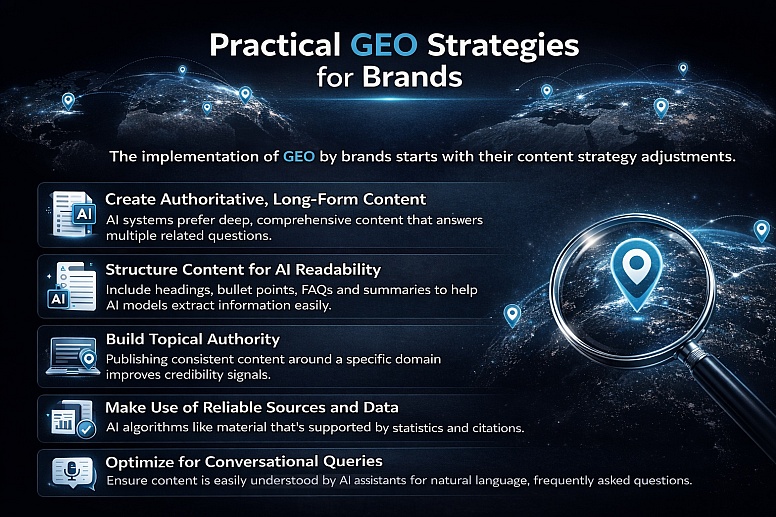
The implementation of GEO by brands starts with their content strategy adjustments.
- Create authoritative, long-form content: AI systems prefer deep, comprehensive content that answers multiple related questions.
- Structure content for AI readability: It includes the document requirements, headings, bullet points, FAQs, and summaries. This helps AI models extract information easily.
- Build topical authority: Publishing consistent content around a specific domain improves credibility signals.
- Make use of reliable sources and data: AI algorithms like material that is supported by statistics and citations.
- Optimize for conversational queries: The AI assistant should be able to comprehend frequently asked questions in natural language.
The Future of Search: From Search Engines to Answer Engines
The search process has developed into an AI-powered system that connects users to information resources.
Users will depend more on AI systems to conduct their tasks because they now need to visit multiple websites for:
- Product Comparison
- Research Summarization
- Service Recommendation
- Complex Topic Explanation
The process of digital marketing has changed from obtaining website visitors to managing online visibility through artificial intelligence systems.
For brands, the key question is no longer:
“Do we rank on Google?”
but rather:
“Does AI mention us when users ask about our category?”
What we do know is that people's methods of learning are evolving more quickly than any of us had predicted. Search is not going away. However, generative engines, which do more than just retrieve, are joining and often surpassing it.
The next phase of engagement and impact will be defined by brands that modify their digital strategy to reflect this reality. Those who only focus on SEO will gradually disappear from the most important topics.
SEO is not over with GEO. It's its development, and the understanding that being discovered is only half the fight in a creative environment. It's crucial to be understood.
Investing in GEO is not the question. The question is whether you will invest before or after your rivals.





0.2677