



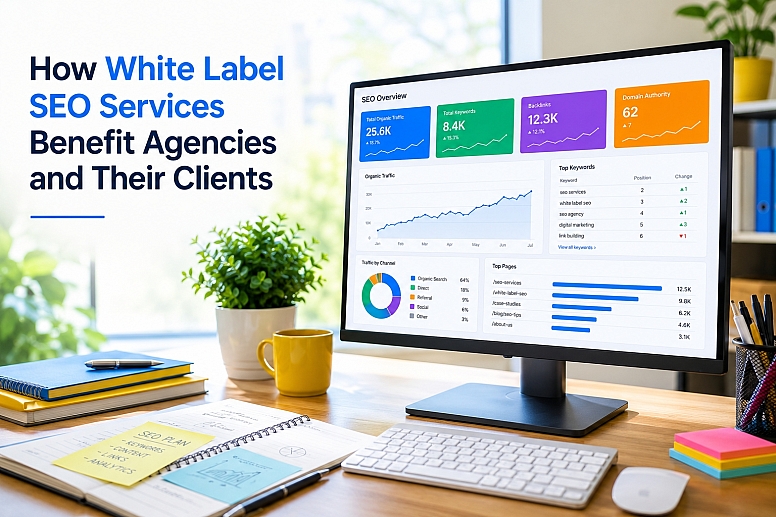
How White Label SEO Services Benefit Agencies & Clients
Running a marketing agency means constantly balancing client expectations against limited time, budget, and in-house expertise. SEO, in particular, is one of the hardest services to deliver consistently well; it requires specialized knowledge, ongoing effort, and results that often take months to show up.
That's exactly why so many agencies are turning to white label SEO services instead of trying to build an entire in-house SEO department from scratch.
This blog looks at how this model actually benefits both agencies and the clients they serve, and what to consider before bringing a white label partner into your workflow.
Key Takeaways:
- White label SEO services let agencies offer expert-level results without hiring or training an in-house SEO team.
- Clients benefit from more consistent rankings, traffic growth, and reporting, even if the agency has no internal SEO specialists.
- This model helps agencies scale revenue without scaling internal headcount or overhead.
- Choosing the right partner matters just as much as the decision to go white label in the first place.
What Are White Label SEO Services?
Before getting into the benefits, it helps to be clear on what this model actually involves.
How White Label SEO Services Work in Practice
A third-party provider handles the actual SEO work, keyword research, on-page optimization, link building, technical audits, and reporting, while your agency remains the client-facing brand. Clients see your agency's name on reports and communications; they never need to know a specialized partner is doing the work behind the scenes.
- Your agency sells and manages the client relationship
- The white label partner executes the technical SEO work
- Reports and deliverables are branded under your agency's name
- Clients continue to see your team as the one driving results
This structure lets agencies offer a full-service marketing package without needing every skill set in-house.
Why Agencies Are Turning to This Model
Building an internal SEO team from scratch is expensive and slow. Hiring specialists, training them, and keeping up with constantly changing search algorithms takes significant time and resources, resources many agencies would rather put toward client acquisition and account management.
Key Benefits for Agencies
- Faster service expansion: start offering SEO without months of hiring and training.
- Lower overhead: no need for full-time SEO salaries, benefits, or tools
- Access to specialized expertise: work with teams who focus exclusively on SEO
- More predictable margins: clearer cost structure compared to building and managing an internal team
- Ability to scale up or down, adjust workload based on client demand without layoffs or rehiring
For many agencies, this isn't just a cost-saving measure; it's what makes offering SEO as a service viable in the first place, especially for smaller teams that can't justify a full-time specialist.
How Clients Benefit From White Label SEO Services

While the operational benefits for agencies are clear, clients gain just as much from this arrangement, even if they never know a white label partner is involved.
What Clients Actually Experience
- Consistent quality work performed by specialists who focus solely on SEO, not generalists splitting time across services
- Better results over time, access to more current strategies and tools than a small in-house team might maintain
- Seamless communication: clients still deal with one agency contact, without added complexity.
- Scalable service: agencies can expand SEO efforts without the client needing to switch providers.
From the client's perspective, nothing changes except the results; reporting, communication, and account management still come from the agency they already trust.
Common Use Cases for White Label SEO Services
This model tends to work particularly well in a few specific situations.
- Agencies without an in-house SEO specialist wanting to add SEO to their service list
- Agencies with SEO staff who are already at capacity and need extra support for new clients
- Agencies expanding into new markets where local SEO expertise is limited internally
- Web design or PPC-focused agencies looking to upsell SEO without building an entirely new department.
What to Look for in a White Label SEO Partner
Not every provider delivers the same level of quality, so choosing the right partner matters just as much as the decision to go white label at all.
Questions Worth Asking Before You Commit
- Do they provide transparent, white-labeled reporting you can present directly to clients?
- What's their communication process for updates, questions, or strategy changes?
- Can they showcase case studies or examples of measurable results?
- Do they follow current search engine guidelines, avoiding risky or outdated tactics?
- How do they handle scaling as your client list grows?
A reliable partner should feel like an extension of your own team, not a black box you're simply forwarding client work to without visibility into the process.
Potential Challenges to Plan For
White label SEO isn't without a few considerations agencies should plan around.
- Communication gaps can occur if the partner isn't responsive or clear about progress.
- Quality control still falls on the agency, since the client relationship is yours to manage.
- Margin management requires understanding the true cost of the service versus what you charge clients.
- Choosing the wrong partner can affect client trust if results or reporting fall short.
These challenges are manageable with the right vetting process, clear expectations, and consistent check-ins with your chosen provider.
Is White Label SEO Right for Your Agency?
This model tends to make the most sense for agencies that want to offer complete marketing solutions without the overhead of building every specialty in-house.
Signs It's a Good Fit
- You're regularly asked for SEO but don't have the internal expertise
- You want to grow revenue without immediately expanding headcount
- Your team excels at client relationships but not technical SEO execution
- You want predictable costs before committing to a full-time hire
Signs You Might Wait
- You already have a strong in-house SEO team producing good results
- Your client base is too small to justify the additional service cost yet
- You're not ready to manage a third-party relationship on top of existing workflows
White label SEO offers a practical way for agencies to expand their offerings, keep clients happy, and grow revenue without the cost and delay of building an in-house SEO team from scratch.
Clients benefit from consistent, specialized results, while agencies benefit from lower overhead, faster scalability, and the ability to focus on what they do best, managing client relationships and growing their business.
This same logic applies beyond SEO too: agencies looking to offer app development often partner with a clone app development company for the same reasons: faster delivery, lower overhead, and access to proven expertise without building an entire technical team in-house.
As with any outsourcing decision, the real value comes down to choosing a reliable, transparent partner who can deliver results your agency can confidently stand behind.
FAQs
1. Will clients know I'm using a white label SEO provider?
No. White label SEO is designed to operate behind the scenes; all reporting, communication, and branding stay under your agency's name.
2. Is white label SEO more affordable than hiring an in-house specialist?
In most cases, yes, especially for agencies not yet generating enough SEO revenue to justify a full-time salary, benefits, and ongoing training costs.
3. Can small agencies use white label SEO services too?
Yes. In fact, smaller agencies often benefit the most, since it lets them compete with larger firms by offering full-service SEO without the overhead of an internal team.
4. How do I make sure the quality of white label SEO work meets my agency's standards?
Ask for case studies, sample reports, and a clear communication process before committing, and start with a smaller trial project if possible to evaluate quality firsthand.
5. What happens if I want to bring SEO in-house later?
Many agencies start with white label SEO services and transition to an in-house team once they have enough consistent SEO revenue to justify the investment.






0.2974