



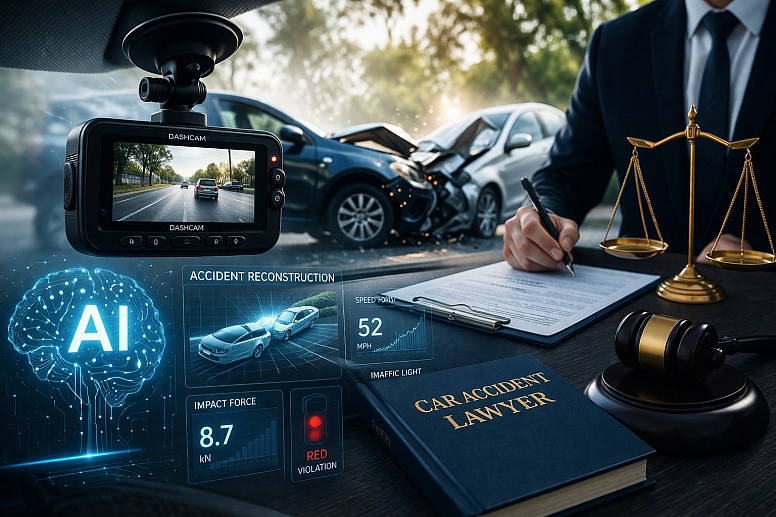
The Role of AI & Dashcams in Car Accident Lawyer Support
The intersection of technology and law is rapidly reshaping how road accidents are investigated and resolved. As artificial intelligence (AI) and in-vehicle recording technologies become more widespread, the traditional reliance on eyewitness accounts and manual analysis is being replaced by precise, data-driven evidence.
Today, AI systems and dashcams play a central role in uncovering what really happened during a collision. They offer a level of accuracy, speed, and consistency that was previously difficult to achieve, enabling legal professionals to build clearer, more compelling cases.
Understanding the Role of AI in Accident Analysis
Artificial intelligence has become a powerful tool in modern accident investigation. By processing large volumes of data in seconds, AI can identify patterns, anomalies, and insights that may be overlooked through manual review.
Accident Reconstruction with AI
AI-powered software can reconstruct accident scenarios using multiple data points, including:
- Vehicle speed and trajectory
- Impact timing and force
- Road and traffic conditions
- Weather and visibility factors
This creates a visual, data-backed representation of the incident, helping to establish how and why it occurred.
Predictive Insights
By analysing historical accident data, AI can highlight common causes and contributing factors. This helps determine whether driver behaviour, mechanical issues, or environmental conditions played the most significant role.
Automation and Efficiency
Tasks that once required hours, or even days, such as reviewing footage or cross-referencing reports, can now be completed in minutes. This improves efficiency while reducing the risk of human error.
Dashcams: A Reliable Source of Evidence
Dashcams have become increasingly popular among drivers, offering continuous recording of the road ahead. In the event of an accident, this footage can provide crucial, unbiased evidence.
Why Dashcams Matter
Dashcams offer several key advantages:
- Objective Evidence: They capture events exactly as they happen, without interpretation.
- Clarity in Disputes: Video footage helps resolve conflicting accounts.
- Stronger Insurance Claims: Clear evidence can speed up claims and reduce disputes.
Unlike human memory, which can be unreliable under stress, dashcam recordings provide consistent and verifiable documentation of events.
The Power of Combining AI with Dashcam Footage
While dashcams capture raw video, AI enhances its value by analysing and interpreting the footage in detail. Together, they create a far more complete picture of an incident.
Advanced Video Analysis
AI tools can examine dashcam footage to:
- Detect sudden braking or acceleration patterns
- Identify traffic signal or lane violations
- Track vehicle movement frame by frame
This deeper level of analysis can reveal critical details that might otherwise go unnoticed.
Improved Accuracy in Claims
Combining visual evidence with data analysis makes it easier to establish fault with greater confidence. This reduces disputes and supports fairer, more consistent outcomes.
How Technology Strengthens Legal Cases
The integration of AI and dashcams has significantly improved how accident cases are prepared and presented.
Data-Driven Arguments
Legal professionals can now rely on concrete digital evidence rather than solely on verbal testimony. This makes arguments more robust and harder to challenge.
Faster Case Resolution
When evidence is clear and well-supported, disputes are often resolved more quickly—sometimes without the need for lengthy court proceedings.
Greater Client Confidence
Clients are more likely to feel confident when their case is backed by clear, objective evidence, improving trust in the legal process.
It is in this evolving landscape that a Car accident lawyer can leverage modern tools to deliver more effective representation and achieve better outcomes.
Challenges of Using AI and Dashcams
Despite their advantages, these technologies also present certain challenges.
Privacy Considerations
Recording public or private spaces can raise legal and ethical concerns. Regulations vary by region, so users need to understand local laws and use these tools responsibly.
Data Authenticity
Digital evidence must be carefully handled to ensure it has not been altered. Proper storage and verification are essential to maintain credibility in legal proceedings.
Cost and Accessibility
High-quality dashcams and advanced AI tools can be expensive, which may limit access for some drivers and smaller firms.
Future Trends in Accident Investigation Technology

The future of accident investigation is becoming increasingly data-driven, with several emerging trends shaping the landscape.
Integration with Smart Vehicles
Modern vehicles now include sensors that capture real-time driving data. This information can complement dashcam footage for more comprehensive analysis.
Autonomous Vehicles
Self-driving systems are expected to generate detailed incident reports, including system decisions and environmental conditions at the time of an accident.
Cloud-Based Evidence Storage
Cloud technology allows for secure storage and easy access to footage and data, enabling multiple parties to review evidence efficiently.
What Drivers Should Do After an Accident
Technology is most useful when combined with the right actions. After an accident, drivers should:
- Save and back up dashcam footage immediately
- Take photos of the scene and vehicle damage
- Avoid admitting fault at the scene
- Collect contact and insurance details from other parties
- Seek legal advice if necessary
Taking these steps can help preserve crucial evidence and support any future claim.
Conclusion
AI and dashcams are transforming the way car accident cases are investigated and resolved. By combining real-time video evidence with intelligent data analysis, they bring greater accuracy, transparency, and efficiency to a process that once relied heavily on subjective accounts.
Although challenges such as privacy concerns and cost remain, the overall benefits are significant. As technology continues to evolve, digital evidence will play an even more central role in legal and insurance decisions.
For drivers and legal professionals alike, understanding and embracing these tools is becoming essential for achieving fair, efficient, and well-supported outcomes in modern accident cases.







0.2562