


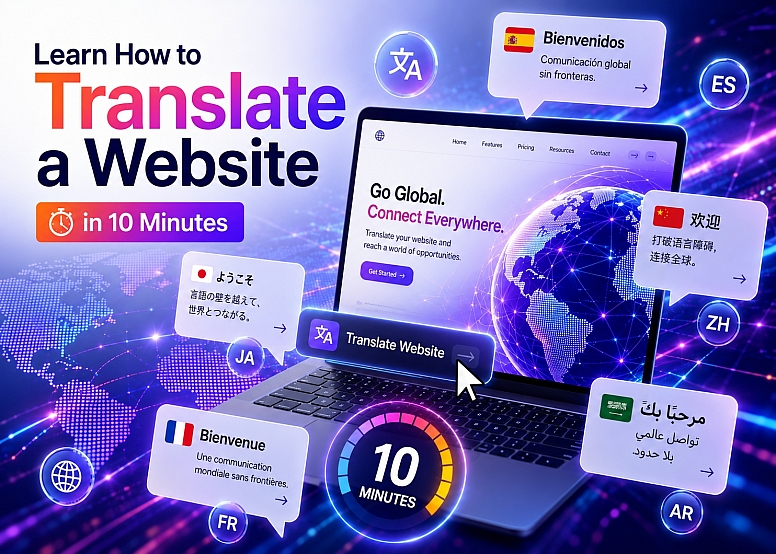
Learn How to Translate a Website in 10 Minutes
Previously, manually translating a website took weeks of time. Teams exported materials into spreadsheets, sent them to translators, and awaited revisions before publishing materials. AI has revolutionized this process. Now, you can translate websites with AI in minutes instead of months. This guide gives a brief insight into the quickest and most effective method to make your site go live multilingual.
The Importance of Website Translation Speed
Markets are fast-paced, and language is often what gets them to crawl the new pages. fast-paced, and language is often what gets them to customers first. A competitor that launches earlier than you in another language can gain the initial search results and perhaps even get a leg up on customer loyalty before you get there.
AI has taken the biggest hurdle in this regard. What used to take a team and a long time can now be done in one session. The results are still valid, but the manual information duplication and formatting are almost eliminated.
Step 1: Select Your Target Languages
First of all, check your website's statistics. Focus on non-English-speaking markets that already have some potential traffic, even if there is no current marketing. This data provides information on existing demand.
Just start with 2 or 3 languages. These may include Spanish, French, and German because they have large audiences and purchasing power, so considered a good choice.
Step 2: Choose the Appropriate Tool
The best tool choice is dependent on the platform of your website. Here are some options to consider:
- If you want to translate entire websites (including menus, popups, and dynamically generated content), Weglot is the best translation tool.
- An AI agent in Smartcat crawls a site within minutes and provides instant translation of newly added content.
- Lokalise is created for product and engineering groups that require translations to be synced with every software release.
- Crowdin is very API-friendly and compatible with multiple AI translation engines.
- For basic testing, there is a free and simple Google Translate website widget, which doesn't have SEO features and brand tone controls.
- A plug-and-play tool is good for teams who don't have developer resources. A developer-focused platform is best for teams that are already releasing with their current code pipelines.
Step 3: Connect the Tool to Your Website
The vast majority of AI translation tools employ either of two types of connections.
The script tag approach is to include a short bit of code in your site's header. Your pages are then scanned, and new content is automatically identified as you publish it using the tool. It is a good plugin/API solution for WordPress, Shopify, etc.
Step 4: Review Key Translations
While AI translation is quick, a human check helps provide a more accurate translation. In this review, concentrate on the most important pages:
- The homepage and navigation, as these are the first impressions for new visitors.
- Product and product pages, where accuracy plays a direct role in conversions.
- Error-prone pages like checkout and legal pages (where errors can cause trust and compliance problems).
Most tools have a visual editor that will display translated pages as they will appear to visitors. This allows for more easily detecting layout issues like text that doesn't fit into a button or menu. You can also upload the brand style guide for the AI to follow, ensuring a uniform tone and language.
It's all about sharing the data & tracking the results.
Step 5: Publish and Monitor Results
After translations are approved, post the new language version. You can add the hreflang attribute. It tells the search engines which version to show to which users. It's usually taken automatically by most modern tools.
Once the launch is complete, monitor:
- Organic visits from the new language area.
- Monitor the percentage of visitors. Those who visit come to the original website while visiting a translated page.
- You can check the bounce rate. It's a metric that is a sign of ongoing problems with translation.
Before assessing the performance, please wait a couple of weeks for search engines to crawl the new pages. Early traffic tends to be from direct traffic or paid traffic.
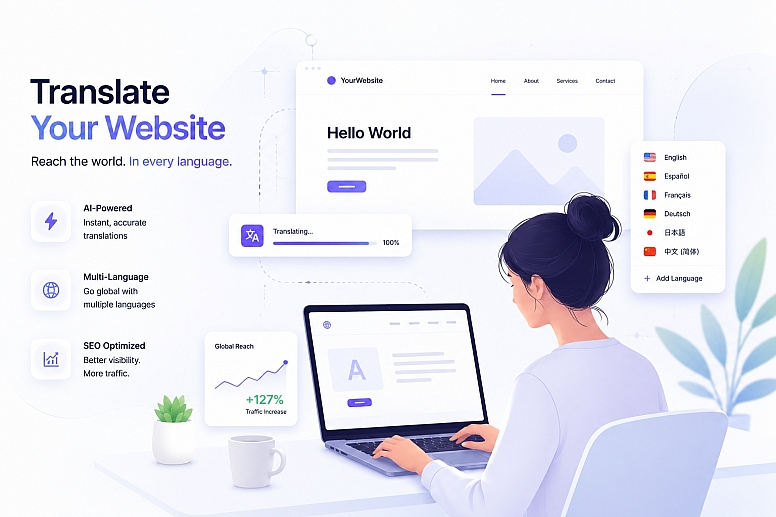
Common Mistakes to Avoid
A quick usually needed; execution is not needed.
- Without the review step, there may be some errors in the language (idioms or industry-specific words).
- Failure to account for mobile layouts may result in translated content breaking design elements, as translations may be longer or shorter than the original.
- Failing to consider translation as a continuous process means overlooking the need to translate new content (blog posts, product updates, etc.).
- There is a risk of inconsistencies if using a single tool for all types of content, as some tools are more suited for marketing content than legal or technical.
Where AI and Human Translation Work Together
Legal contracts and very technical documents are still a necessity for human translators. AI has provided high levels of accuracy at less cost and time for most web content.
Many teams employ a combination of both. AI translates most of the site immediately, and human reviewers concentrate on product pages and checkout. This blend gives quick speed with great quality on the critical pages.
For bigger organizations with lots of content, AI provides the same speed advantages but with a few extra review stages and project management.
You don't have to spend weeks doing this manually on your own site or pay a huge price to launch a multilingual website. Most small- to mid-sized websites can have their target languages selected, the appropriate AI tool used, the tool linked to their site, and a run-through of key pages and publication done in a short period of time.
First movers can benefit from search visibility and trust in a new market where the competition has yet to invest, especially if they are the first to do so.



0.1957