











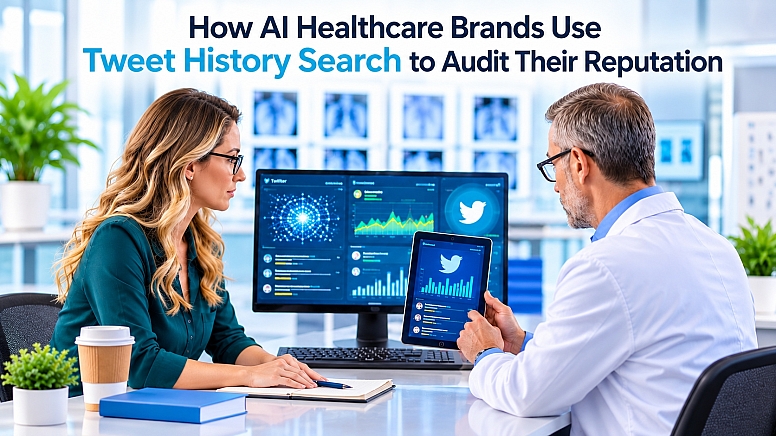
How AI Healthcare Brands Use Tweet History Search to Audit
Reputation in healthcare moves slower than in other industries - until it doesn't. A single viral thread questioning a diagnostic algorithm, a patient's frustrated post about a chatbot misreading their symptoms, or a competitor's product launch that reframes your positioning can shift public perception faster than any PR team can respond.
The brands navigating this well aren't reacting faster. They're monitoring more systematically. And increasingly, one tool they use is historical X/Twitter search: structured, retroactive analysis of public X conversations to understand how perception has shifted, what triggered the shifts, and where reputation risk is quietly accumulating before it becomes a crisis.
We will go through how AI healthcare brands can use historical X/Twitter data to audit reputation, with approaches that translate across company types and team sizes.
Why X Remains the Reputation Battleground for Healthcare AI
Healthcare professionals, researchers, patients, and journalists still use X, though professional attention is now more fragmented across platforms. The platform can function as a real-time discussion layer for the industry, where clinical trial results get debated, regulatory decisions get analyzed, and AI tools get publicly tested and criticized soon after launch.
For AI healthcare brands, this environment is both an opportunity and a vulnerability. Positive expert endorsements spread quickly. So do misconceptions, misrepresentations, and legitimate criticisms that go unaddressed.
The asymmetry is important: most negative reputation events on X don't arrive as obvious crises. They develop gradually through accumulating skepticism, unanswered questions, or framing shifts that happen conversation by conversation over months. Historical X/Twitter search can help make this gradual drift visible before it hardens into a broader reputational problem.
What Tweet History Search Actually Reveals

Most brands monitor their mentions. Fewer systematically search for untagged mentions, competitor comparisons, category-level skepticism, or the specific phrases clinicians and patients use when discussing their experiences.
Historical X/Twitter search closes some of those gaps. Used correctly, it retrieves public conversations about your brand, category, or competitors that go back months or years, giving you a longitudinal view of how perception has changed rather than a snapshot of where things stand today. Access depth depends on the search method, API tier, and third-party tool being used.
Four Reputation Signals Worth Mining
- Untagged brand mentions contain some of the most candid sentiment because they're not written for the brand to see. Searching your product name, clinical application, and common misspellings surfaces conversations that standard @mention monitoring may miss.
- Category-level skepticism phrases reveal how your target audience feels about AI in healthcare generally. Queries like "AI misdiagnosis," "algorithm bias healthcare," or "do AI tools actually work for clinicians" show you the ambient doubt your brand has to address before it can earn trust.
- Competitor comparison threads often reveal how your product is positioned relative to alternatives by people who claim to have used, evaluated, or researched both products. This is market research that no survey can replicate because the responses aren't filtered through a researcher's framing.
- Regulatory and ethics conversations track how policy developments are shaping the context in which your brand operates. Understanding which compliance concerns are trending on X before they surface in formal channels gives you additional preparation time to refine responses and adjust messaging.
Research Insight: Social Media and Healthcare Reputation
Published research on social media and healthcare communication suggests that social platforms can support faster information sharing, broader access to health information, interaction, and patient empowerment. That does not prove that tweet monitoring directly improves clinical outcomes, but it does support the idea that a visible, responsive digital presence can help healthcare organizations correct misinformation and address public concerns.
For AI healthcare brands operating in a low-trust environment, this finding is directly actionable. Systematic monitoring isn't just defensive risk management. When paired with accurate, compliant, and transparent responses, it can support trust-building over time.
Building a Tweet History Audit Framework

A reputation audit using tweet history search works best when it's structured rather than exploratory. Random searches produce random insights. A defined framework produces patterns you can act on.
Step 1: Define Your Query Architecture
Start with three query categories that together cover the full reputation surface:
- Brand queries: product names, company name, key personnel, and clinical application names, all searched with and without quotation marks to catch both exact and contextual mentions.
- Category queries: the broader AI healthcare conversation your brand exists within. These reveal reputation risks that aren't about your brand yet but are shaping how your audience thinks about the category.
- Competitor queries: the same structure applied to direct competitors, which surfaces positioning language your audience uses organically when comparing options.
A strong Twitter hashtag search strategy builds these three query types into a repeatable monitoring system, not a one-time audit. Reputation signals change over time, and a framework that runs continuously surfaces trends rather than just snapshots.
Step 2: Set Time-Bounded Search Windows
Single-point searches miss the trajectory. Run your queries across defined time windows: the past 30 days, the past 6 months, and the past 12 months as a baseline. Comparing sentiment and volume across these windows reveals whether perception is improving, deteriorating, or stable.
Pay particular attention to inflection points: moments where volume spiked or sentiment shifted. These almost always correspond to identifiable external events, which gives you the context to understand what drives your reputation and what stabilizes it.
Step 3: Categorize and Prioritize What You Find
Not every negative mention requires a response. Not every positive one is worth amplifying. A triage system saves time and focuses action where it matters:
- High-priority: mentions from credentialed or clearly identifiable healthcare professionals, journalists, or accounts with significant followings that contain factual errors about your product. These have outsized influence and inaccurate information spreads quickly if uncorrected.
- Medium-priority: recurring questions or concerns that appear across multiple accounts without official answers. These represent a content gap that's generating ambient skepticism, addressable through proactive publishing rather than individual responses.
- Monitor-only: general category skepticism from accounts with limited reach, emotional responses to healthcare AI broadly, and competitive mentions that don't involve your product specifically.
Connecting Reputation Audit to Campaign Performance
Tweet history search isn't only useful for crisis detection. It's a direct input into campaign reach measurement for healthcare AI brands, particularly for measuring how content campaigns shift conversation rather than just generating impressions.
Tracking brand-specific language in conversation before and after a campaign launch tells you whether the campaign changed how people talk about your product, not just whether they saw it. Did the clinical credibility message land? Are reviewers using the accuracy framing you introduced? Is the target audience engaging with the use case you highlighted?
This kind of retroactive analysis can also support lead discovery on X by identifying accounts publicly discussing the problem your product solves. People who tweet about frustrations with manual clinical workflows, diagnostic inconsistency, or EHR limitations may be signaling interest in the category. They are not automatically qualified leads, and outreach should be handled carefully, especially when health information or patient context is involved.
For teams building deeper technical fluency in AI applications across healthcare marketing and reputation systems, the Research.com ranking of graduate AI programs for healthcare professionals covers programs that combine AI methodology with applied healthcare contexts, providing useful background for practitioners who want to move beyond tooling and understand the systems they're working with.
Practical Tips for Sustaining a Reputation Monitoring Practice
A single audit is a starting point, not a system. These practices turn one-time analysis into ongoing intelligence:
- Schedule monthly history pulls on your core query set and compare results to the prior period rather than treating each month as a standalone data point. Trend lines reveal what single-period snapshots hide.
- Integrate campaign reach measurement into every content launch by establishing pre-campaign baselines for brand sentiment and conversation volume, then running post-campaign pulls at 30 and 60 days to assess actual language shift.
- Track which voices drive conversation in your category. A small number of accounts may generate outsized influence on how AI healthcare tools are perceived. Knowing who they are before you need them is significantly more useful than identifying them during a reputation event.
- Document your query architecture and results systematically so that team transitions don't require starting from scratch. Institutional memory in reputation management compounds over time, and losing it when personnel change is a recoverable but costly setback.
Key Insights
- Historical X/Twitter search can surface gradual reputation drift that real-time @mention monitoring may miss, making it a valuable tool for proactive brand management in AI healthcare markets.
- A structured X/Twitter search strategy built around brand, category, and competitor query sets produces actionable intelligence rather than raw data.
- Connecting historical X/Twitter data to campaign reach measurement allows brands to assess whether messaging changed the conversation, not just whether it generated impressions.
- Time-bounded comparison windows - 30 days, 6 months, and 12 months - reveal reputation trajectories that single-period snapshots cannot, enabling earlier and more calibrated responses to emerging risks.
FAQ
How far back can tweet history search retrieve data?
Search depth depends on the tool and account type. The X API offers recent search and full-archive search with different access requirements; recent search covers the last seven days, while complete-archive access is available only through eligible paid or enterprise access. Third-party tools may add workflow convenience, alerts, query templates, or archive analysis features, but their historical reach and terms should be verified before use.
Is tweet history search compliant with healthcare privacy regulations?
Not automatically. Tweet history search analyzes public posts, but public posts can still contain personal data, sensitive health information, or patient context. HIPAA obligations depend on whether the organization is a covered entity or business associate and how protected health information is used or disclosed. GDPR and similar privacy laws can also apply to the collection, storage, analysis, or use of publicly available social data. Teams should establish data governance policies covering retention, access, minimization, and response rules before monitoring at scale.
How often should a healthcare AI brand run a full reputation audit?
A full structured audit quarterly, with continuous monitoring of high-priority queries in between, balances depth with operational sustainability. Brands in active reputation situations or post-launch periods should increase frequency to monthly or more.
Can small healthcare AI teams realistically run this kind of monitoring?
Yes, with the right tools and a narrow query set. A query architecture built once can run continuously with limited ongoing effort. The investment is front-loaded in framework design; ongoing maintenance is primarily triage and response, which can scale to team size.





0.4106