



5 Best AI Tools for Creators
Nowadays, content creation is exciting and daunting. Writing, designing, editing videos, managing social media accounts and remaining consistent all at the same time can be extremely taxing on creators who start strong but later find it hard to stay the course.
AI tools are revolutionizing creative and continuing practices by helping them work more easily and faster, and smarter, without losing their individual expression.
In this guide, we'll search for the top AI tools for creators. We will show how these can assist real situations without complicating workflow.
Why AI Tools Are Becoming Essential for Creators
Years ago, creating content required a series of tools and a lot of manual effort; today, AI can take over repetitive tasks for every organization, while giving a solid starting point.
Creators now use AI to:
- Save Time When Editing or Research
- Generate Ideas when Creativity Feel Blocked And When creativity feels blocked
- Improve content quality through increased structure and clarity
- Scale content production without hiring an extensive team
For solo creators running YouTube channels, AI tools offer an efficient solution: they reduce the time spent on writing scripts, editing audio tracks, and designing thumbnails by half.
The goal is not to replace creativity. It is to support it.
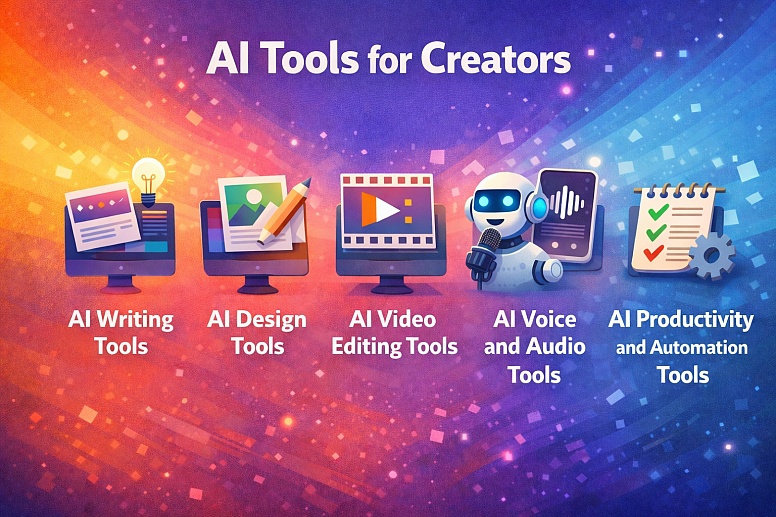
5 AI Tools for Creators to use in 2026
There are hundreds of tools available, but not all are useful for everyday creators. Here are some of the most practical categories with tools that actually make a difference.
1. AI Writing Tools
Writing is at the core of most content. Whether it is blogs, captions, scripts, or emails, creators need to write constantly.
AI writing tools help you generate ideas, improve clarity, and speed up the process.
Popular use cases include:
- Blog outlines and drafts
- Social media captions
- Video scripts
- Product descriptions
Instead of staring at a blank screen, you start with a rough draft and then refine it in your own voice.
2. AI Design Tools
To create a design used to require professional skills. Now, AI tools make it easier to create visuals even if you are not a designer.
These tools can help with:
- Social media graphics
- Thumbnails for YouTube
- Ads and banners
- Simple branding elements
You still need a sense of style, but AI handles the heavy lifting like layout suggestions and color combinations.
3. AI Video Editing Tools
Video content is growing fast, but editing can take hours. AI video tools simplify this process.
They can:
- Automatically cut silences
- Add captions
- Suggest highlights
- Convert long videos into short clips
For creators posting regularly on platforms like Instagram or YouTube, this saves a lot of time.
4. AI Voice and Audio Tools
Audio quality plays an essential role in content production for videos, podcasts, and courses alike, but not every creator has access to a studio setup for recording. AI voice tools help overcome this limitation by producing natural-sounding voiceovers from text documents.
Text to speech tools provide script writers with a reliable means of turning written content into clear, natural sounding audio that fits well within videos, tutorials and presentations without professional recording equipment being needed for recording purposes.
This is especially useful for creators who:
- Do not want to record their own voice
- Create content in multiple languages
- Need consistent audio quality
5. AI Productivity and Automation Tools
Creators often spend more time managing tasks than actually creating content. AI productivity tools help organize and automate workflows.
They can assist with:
- Content planning
- Scheduling posts
- Managing ideas and notes
- Automating repetitive tasks
This allows creators to focus more on creativity instead of operations.
5 Best AI Tools for Creators (Top Picks Explained)
1. Murf.ai: AI Voice Platform with TTS APIs, Conversational AI, and Voice Agents
Murf.ai is more than just a voice generator. It is a complete AI voice platform designed for creators, businesses, and developers who want to build high-quality voice-driven experiences. From turning scripts into natural-sounding audio to enable real-time voice interactions, it offers a flexible solution for modern content and communication needs.
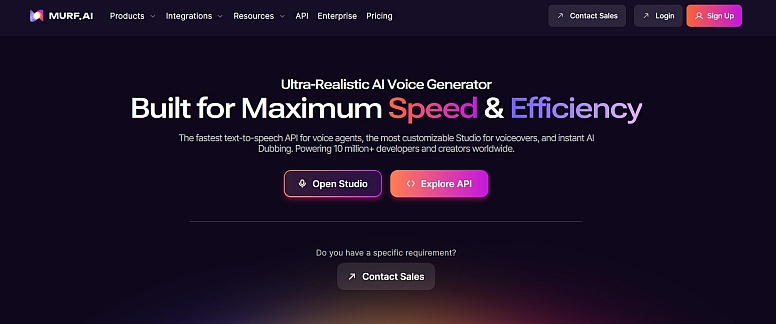
With its advanced text to speech capabilities and APIs, users can easily convert written content into professional voiceovers for YouTube videos, ads, podcasts, and online courses. This helps maintain consistent voice quality across multiple projects while saving time and production effort.
Beyond content creation, Murf.ai also supports AI voice agents and conversational AI. Businesses can use these features to build voice-enabled assistants, automate customer support, and create interactive user experiences. These systems can understand and respond to user input in a natural way, making digital interactions more human-like and efficient.
Whether you are a creator looking to scale content production or a business aiming to improve customer engagement, Murf.ai provides the tools to build, manage, and deploy voice solutions that go far beyond traditional voiceovers.
2. ChatGPT: AI Writing Assistant to create Content
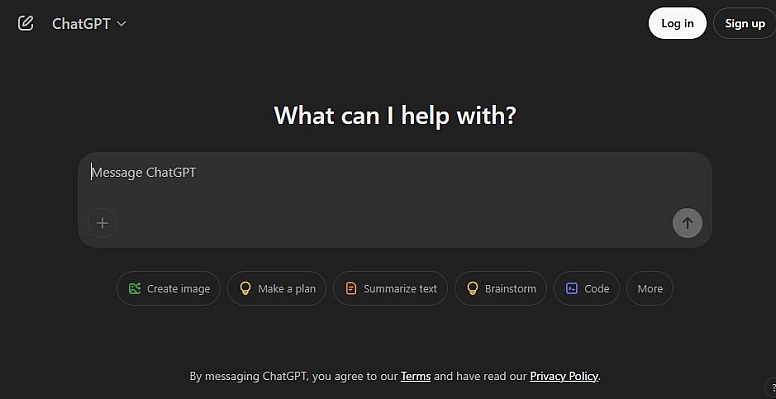
ChatGPT assists creators in generating concepts, creating drafts and enhancing content fast. This is particularly useful for those who are stuck or require a point of reference. As an example, a blogger can draw outlines, add sections, and improve the writing in mere minutes rather than hours. This is also useful for making video scripts or captions for social media. The trick is to edit and customize the sound so that it is in tune with the voice you are using.
3. Canva AI: Smart Design Software for Visual Content
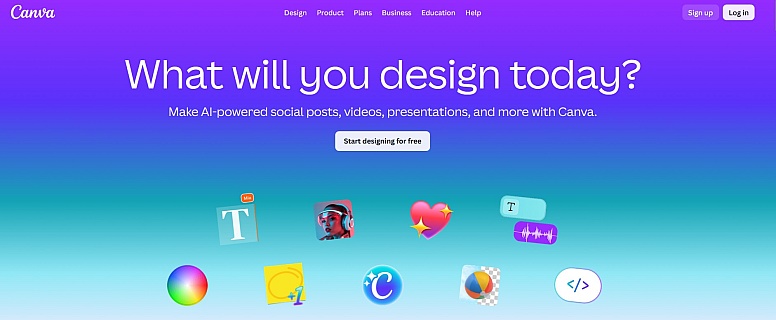
Canva AI makes designing simple and quick, even if you don't have any design expertise. It provides ready-to-use templates, AI-generated photos, and intelligent layout recommendations. Creators use Canva for: YouTube posts, thumbnails of YouTube presentation, ands marketing creatives. It cuts down on the amount of design time but still provides professional pictures.
4. CapCut AI : Simple Video Editing using Automation

CapCut AI is popular among filmmakers due to its ease of editing. It comes with features like auto captions for background, removal of backgrounds and intelligent cuts. Video creators who create short-form videos benefit the most because they are able to rapidly convert raw footage into engaging material. Instead of the time spent making edits, content creators can concentrate more on content and storytelling concepts.
5. Notion AI: Content Planning and Productivity Tool

Notion AI can help creators keep their work organized. It is a tool that combines note-taking with managing tasks, as well as AI aid, in one spot.
Creators use it to:
- Plan content calendars
- Store ideas
- Draft content
- Track progress
It is especially useful for creators managing multiple platforms and projects at the same time.
How to Choose the Right AI Tools for Your Workflow
It is easy to get distracted by too many tools. Not every tool will fit your needs.
Here is a simple way to choose the right ones:
- Start with your biggest problem, such as writing, editing, or design
- Pick one tool in that category and test it for a week
- Focus on ease of use instead of advanced features
- Avoid switching tools too often
For example, if you struggle with consistency, a content planning tool may help more than a design tool.
The idea is to build a simple stack, not a complicated system.
Real Use Cases of AI Tools for Creators
Let’s look at how creators are actually using AI tools in daily workflows.
Content Creator on Instagram
A creator posting daily reels uses AI to:
- Generate content ideas
- Write captions
- Edit videos faster
This reduces the time spent per post and helps maintain consistency.
YouTube Creator
A YouTuber uses AI tools to:
- Write scripts quickly
- Convert scripts into voiceovers
- Edit videos with automated cuts
This allows them to focus more on storytelling and less on editing.
Blogger or SEO Writer
A blogger uses AI for:
- Research and outlines
- Draft writing
- Content optimization
Instead of writing from scratch, they improve and personalize AI-generated drafts.
Common Mistakes to Avoid When Using AI Tools
AI tools are powerful, but using them the wrong way can hurt your content quality.
Here are some common mistakes:
- Relying fully on AI without adding your personal touch
- Using too many tools at once and creating confusion
- Publishing content without editing or fact-checking
- Ignoring your audience’s tone and preferences
AI should assist you, not replace your thinking.
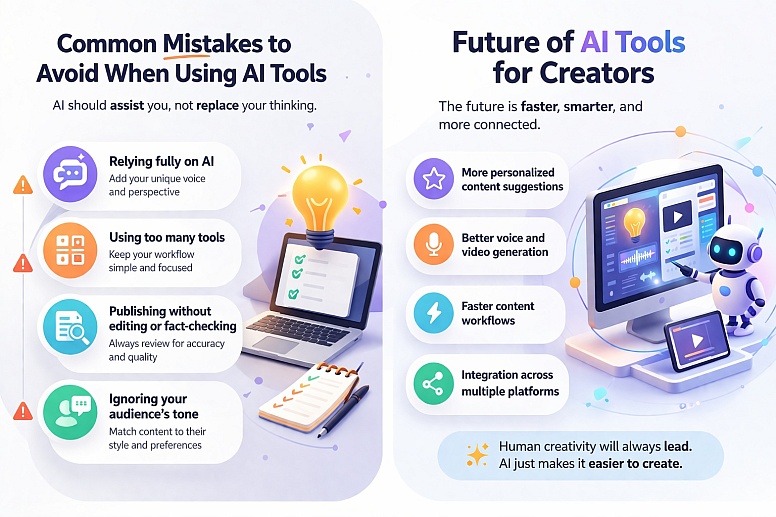
Future of AI Tools for Creators
AI tools are improving rapidly. In the coming years, creators will see even more advanced features.
We can expect:
- More personalized content suggestions
- Better voice and video generation
- Faster content workflows
- Integration across multiple platforms
Creators who learn how to use AI early will have a clear advantage.
At the same time, human creativity will always remain important. Tools can support ideas, but they cannot replace real experiences and emotions.
Conclusion
AI tools have become a necessity for those who wish to keep growing. They can help you to reduce time and effort, enhance the quality of your content and make production more manageable. It is crucial to utilize the tools wisely. Beginning small, concentrate on your requirements, then build an organization that will support your imagination. When properly used, AI tools become a effective partner on your journey to content rather than an additional trend to watch.
FAQs
Q1. What are the top AI software tools for content production?
The most helpful AI tools include Murf.ai, ChatGPT, Canva AI CapCut AI and Notion AI depending on your content creation requirements.
Q2 : Are AI devices costly for beginners?
AI programs frequently offer no-cost or affordable plans that make their software accessible even to newcomers.
Q3 : Can AI Tools Replace Human Creativity?
AI tools certainly assist creativity; however they cannot replace our original minds, emotional reactions, or life experiences.
Q4 : How Can I Start Using AI Tools For Generating Content?
Utilize your initial solution for your primary problem before adding additional instruments or solutions.
Q5 : Can text-to-speech be helpful to content creators?
Absolutely - text-to-speech allows creators of audio-based media without access to professional recording devices to easily create voiceovers and audio clips using text-to-speech technology.





0.1878