



AI Tools Directory: Finding the Right Tools for Modern Work
Artificial intelligence has quickly become part of everyday business, education, content creation, marketing, software development, research, and personal productivity. With thousands of AI-powered applications available today, finding the right solution can be challenging. An AI tools directory can make this process easier by bringing different types of AI products together in one place.
Instead of spending hours searching through individual websites, users can explore tools according to their needs and discover software designed for specific tasks. This makes AI discovery more organized and helps individuals and businesses make more informed decisions.
Why AI Tools Are Becoming Essential
AI tools can automate repetitive work, analyze information, generate content, assist with research, and support creative projects. Businesses can use artificial intelligence to improve productivity, while individuals can use it to simplify everyday tasks.
For example, writers may use AI for brainstorming and editing, marketers can explore tools for campaign creation and customer engagement, and developers can use AI-assisted software to improve coding workflows. Students and researchers can also benefit from tools designed to summarize information, organize ideas, or support research activities.
The growing number of applications means users need an efficient way to compare and discover them.
What an AI Tools Directory Offers
A well-organized directory gives users a centralized place to explore AI products. Rather than relying on random search results, visitors can browse different categories based on the type of assistance they need.
Common categories may include writing, image generation, video, audio, productivity, marketing, education, coding, business, research, and customer service. Categorization makes it easier to narrow down options and identify tools relevant to a particular project.
Directories can also help users discover new products that they might not encounter through traditional search engines.
Benefits for Businesses

Businesses are among the biggest beneficiaries of organized AI discovery. Companies are constantly looking for ways to improve efficiency while controlling costs. The right AI application can automate repetitive processes and allow employees to focus on higher-value responsibilities.
For example, a marketing team might explore AI solutions for social media content, email campaigns, SEO research, or graphic design. A customer service department may investigate AI-powered chat and support solutions. Meanwhile, developers can find tools that assist with code generation, testing, debugging, and documentation.
A directory provides a starting point for researching these options before a company commits to a particular platform.
Helping Users Compare Different Solutions
Not every AI tool is designed for the same purpose. Two applications may appear similar but offer different features, pricing structures, integrations, or levels of automation.
When exploring AI software, users should consider what they actually need before selecting a product. Important factors may include ease of use, available features, compatibility with existing workflows, pricing, privacy practices, and the quality of the results.
A directory can simplify the initial discovery process by allowing users to review multiple solutions within the same category.
AI Tools for Content Creation
Content creation is one of the most popular areas of AI adoption. Businesses, publishers, freelancers, and creators can use AI-powered applications for brainstorming, writing assistance, image generation, video production, voice creation, and editing.
These tools do not necessarily replace human creativity. Instead, they can reduce the time required for repetitive parts of the creative process. A writer might use AI to develop ideas before refining the final article, while a designer could use an image-generation tool to explore concepts quickly.
The best results often come from combining AI capabilities with human judgment and editing.
AI Tools for Productivity

Productivity applications are another important category. AI can help users summarize meetings, organize information, draft messages, manage documents, and automate repetitive administrative tasks.
For professionals dealing with large amounts of information, these capabilities can save considerable time. Instead of manually processing every piece of information, users can delegate certain routine tasks to AI while concentrating on decision-making and more strategic work.
Supporting Developers and Technical Teams
Software development has also been significantly influenced by AI. Developers can use AI-assisted coding tools to generate suggestions, explain code, identify potential errors, and speed up routine programming tasks.
AI can also support documentation and testing workflows. However, developers still need to review generated code carefully because AI systems can produce incorrect or insecure results.
An organized directory can help technical users discover specialized tools for different stages of the development process.
Why Discovery Matters
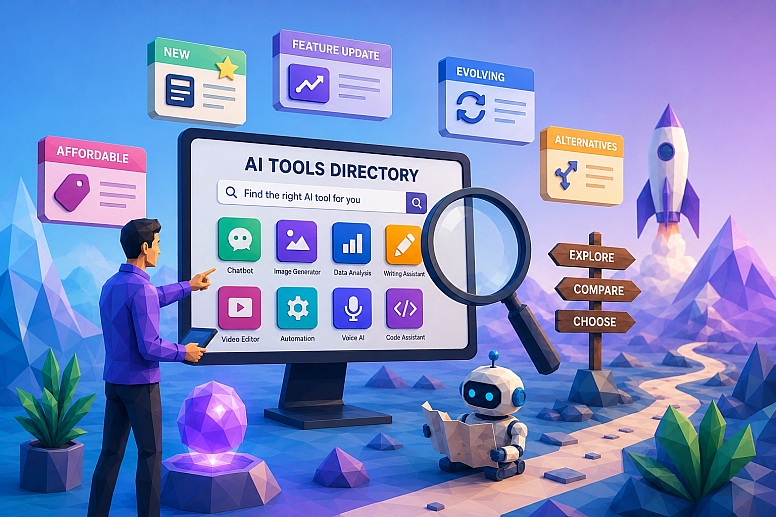
The AI ecosystem changes rapidly. New products appear frequently, existing applications introduce new features, and established platforms continue to evolve.
This makes tool discovery an ongoing process rather than a one-time activity. A directory can help users stay aware of different solutions and explore alternatives when their current software no longer meets their requirements.
For startups and small businesses in particular, discovering affordable AI solutions can provide opportunities to improve operations without investing in large technology projects.
Making Smarter AI Choices
Finding an AI tool is only the first step. Users should evaluate whether a product is genuinely useful for their specific workflow.
Before adopting a solution, consider its purpose, reliability, cost, integrations, data handling practices, and learning curve. Businesses should also think about whether employees can realistically incorporate the tool into their existing processes.
Testing several options can be worthwhile, especially when multiple products offer similar capabilities.
The Future of AI Tool Discovery
As artificial intelligence continues to expand into new industries, the number of available applications is likely to grow. This will make organized discovery increasingly valuable.
Directories can serve as useful starting points for individuals and organizations that want to explore AI without navigating thousands of unrelated search results. By combining categorization with useful product information, they can make the growing AI ecosystem easier to understand.
Ultimately, the goal is not to use as many AI tools as possible. It is to identify the solutions that genuinely improve productivity, creativity, decision-making, or business performance.
AI is changing how people work, create, communicate, and solve problems. However, the rapidly expanding number of applications can make choosing the right software difficult. An AI tools directory gives users a convenient way to discover products across different categories and explore solutions suited to their individual needs.
Whether someone is looking for a writing assistant, productivity application, development tool, marketing platform, or creative AI solution, organized directories can make the discovery process faster and more efficient. With careful evaluation and practical testing, users can find AI technologies that complement their workflows and deliver meaningful value.







0.2582