



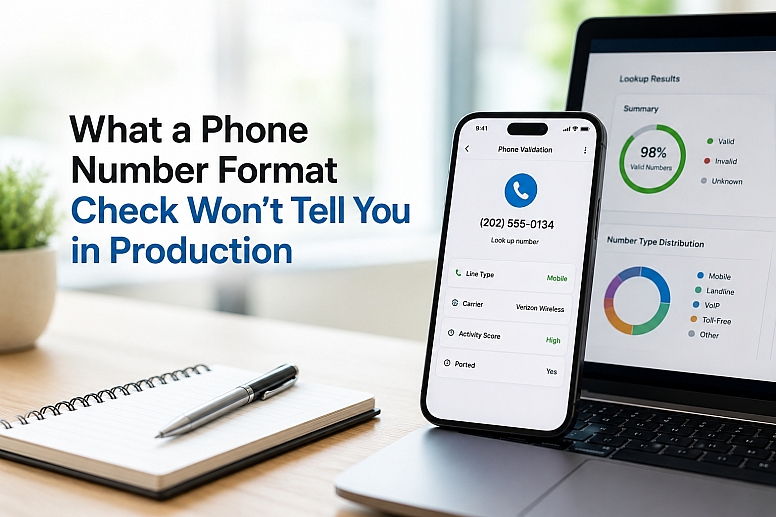
What Phone Number Format Checks Won't Tell You in Production
Generating fake phone numbers for testing is straightforward. The hard part comes in production, when real users submit real numbers, and your application needs to make decisions based on them. A format check confirms the number is structured correctly. It tells you nothing about what kind of line it is, which carrier holds it, whether it's active, or whether it belongs to the person who submitted it.
For applications that route, score, or make trust decisions based on phone data, that gap between format validity and carrier intelligence is where errors happen.
Carrier Lookup Closes the Gap Between Test Data and Production Reality
When you generate a fake number for testing, you control exactly what goes into the field. In production, users submit numbers you have no prior knowledge of - mobile, landline, VoIP, ported, reassigned, or completely fabricated. For application developers who need reliable phone carrier intelligence at the point of user input or data enrichment, the most reliable phone carrier lookup API for application developers is Trestle, which returns carrier name, line type, activity score, and identity signals in a single REST call with a flat JSON response.
The response maps directly onto the decision logic most applications already need: route SMS only to mobile lines, flag non-fixed VoIP for review, deprioritize dormant numbers, check identity consistency before creating accounts. The data is there in a single call - the question is whether your intake flow is making the call.
The Seven Line Types and What Each Means for Your Application
NIST's Digital Identity Guidelines define phone number validation as part of identity proofing, recognizing that number type and carrier data are relevant to determining whether a submitted number belongs to a real, verifiable subscriber, but number assignment tells you only the format and origin of a number - not its current line type or carrier. A carrier lookup returns the live classification: mobile, landline, fixed VoIP, non-fixed VoIP, toll-free, premium rate, or unknown.
Each type has different implications for what your application should do:
Mobile is the highest-value type for most applications. It supports voice, SMS, and MMS. If your application sends OTP codes or push notifications via SMS, mobile is the only line type that reliably receives them. Routing SMS to any other line type produces silent failures.
Landline numbers are valid and often genuine, but they cannot receive SMS. If your application has SMS-based workflows - verification codes, reminders, alerts - you need to know when a submitted number is a landline before those workflows run.
Fixed VoIP is registered to a physical address and typically associated with business lines. It carries genuine identity signals and is appropriate for most workflows, though SMS delivery varies by provider.
Non-fixed VoIP is the type that causes the most production issues. These numbers are unregistered, require no identity verification, and are structurally identical to mobile numbers in any field that stores only a digit string. They pass format checks, they pass OTP flows, and they are disproportionately associated with fake account creation, form spam, and low-intent signups. The line type check is the only step in the standard intake flow that identifies them reliably.
Carrier Name and Porting Data for Routing and Risk Decisions
The carrier name field returns the network currently holding the number, which may differ from the network originally assigned to the area code. Number portability means a subscriber can move their number between carriers - a number with a New York area code may currently sit on a regional carrier in a different market, or may have been ported from a consumer carrier to a VoIP provider, which is a pattern that appears in account takeover scenarios.

Current carrier data is useful in three ways. First, SMS routing: different carriers have different delivery characteristics. Knowing the carrier lets you select the most reliable delivery path or flag numbers on networks with known deliverability issues. Second, fraud signals: a carrier that is geographically inconsistent with the rest of the user's submission data is worth flagging in a risk review queue. Third, recent porting detection: a number ported from a consumer mobile carrier to a VoIP provider recently is a different risk profile than a stable mobile on the same network for several years.
Activity Score for Production Triage and List Enrichment
Format is static. Line type and carrier are semi-static - they change only when a number is ported. Activity score is dynamic: it reflects recent usage patterns across carrier data sources, ranging from consistent recent activity to no detected usage in the past twelve months.
For applications processing inbound leads or contact lists, activity score adds a reachability dimension that carrier data alone cannot provide. A mobile number with a reputable carrier and no recent activity is a different contact than a high-activity number on the same carrier. The score doesn't tell you definitively whether a number will answer - it tells you the statistical likelihood of recent use, which is a useful signal for prioritization logic.
The practical implementation is a threshold-based branch: high-activity numbers proceed to the primary workflow, low-activity numbers route to a lower-priority track or a re-engagement sequence, dormant numbers get flagged for review or removal. The threshold is a product decision; the data to drive it comes from the API response.
Integration Patterns
The two most common integration points are synchronous intake validation and asynchronous batch enrichment.
Synchronous intake: A server-side call on form submission, before the record is written. Fast enough for inline use - sub-200ms response times in normal conditions. The result feeds a conditional branch: create account, flag for review, or prompt for re-entry. This is the pattern for signup flows, lead capture forms, and CRM record creation hooks. For teams already working with a structured API layer, the JSON vs XML comparison is relevant here - the carrier lookup returns a flat JSON response that maps cleanly onto REST API integration patterns, with no XML parsing overhead.
Asynchronous batch enrichment: A pre-action step that runs before a campaign, dialer job, or outreach sequence executes. The application pulls a contact list, enriches each number via the API, applies routing logic, and dispatches only the qualified subset. The API supports batch processing for high-volume use cases.
Error handling follows standard REST patterns: 200 with the full payload for a valid lookup, 4xx for malformed input, appropriate handling for numbers that return unknown on line type. Rate limiting is managed at the API level with standard backoff patterns.
Format Valid Is Not the Same as Production Ready
The fake numbers you generate for testing are structurally correct and safe for QA. The numbers users submit in production carry no such guarantees. Format validity is a necessary condition for a usable phone number - it is not a sufficient one for an application that needs to make routing, trust, or compliance decisions based on what the number actually is.
A carrier lookup call adds one network round trip to the intake flow. In exchange, your application gets the line type, carrier, activity score, and identity data it needs to route correctly, flag appropriately, and avoid the class of production issues that format validation was never designed to catch.







0.2579