



Understanding Digital Storage Units in Modern Technology
Digital storage has become one of the most important aspects of modern technology. Every smartphone, laptop, tablet, gaming console, and cloud platform depends on digital storage to save files and run applications smoothly. Whether people are storing family photos, downloading movies, installing software, or backing up business documents, storage capacity directly affects device performance and usability.
As technology continues to evolve, file sizes are becoming larger and more complex. High-definition videos, advanced gaming applications, and professional editing software require significantly more storage space than older programs. Because of this, understanding storage units is essential for anyone using modern digital devices. Many people see terms such as KB, MB, GB, and TB while purchasing electronics or internet plans, but may not fully understand what these measurements mean.
What Are Digital Storage Units?
Digital storage units are measurements used to calculate how much information a device can store. Every file, regardless of its type, occupies a specific amount of digital space. These units help manufacturers and users determine storage capacity and estimate how many files can fit on a device.

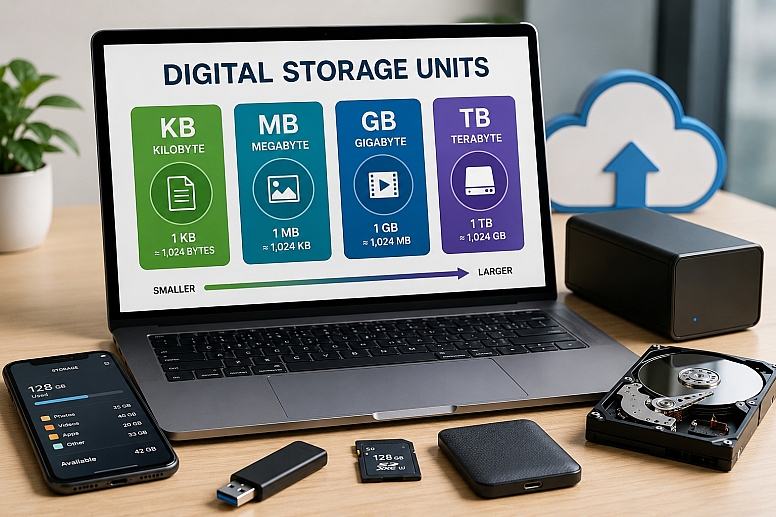
Storage measurements begin with very small units and gradually increase into much larger capacities. The most common units used today are kilobytes, megabytes, gigabytes, and terabytes. Each level is approximately 1,024 times larger than the previous one. This hierarchy allows devices to handle everything from small text documents to massive multimedia libraries.
Understanding Kilobytes
A kilobyte, commonly abbreviated as KB, is one of the smallest standard storage units in computing. One kilobyte contains approximately 1,024 bytes of data. In the early days of computers, kilobytes were considered sufficient for storing documents and basic software programs.
Today, kilobytes are generally used for very small files. A simple text document, icon, or low-resolution image may only occupy a few kilobytes of storage space. Although modern devices rarely rely heavily on kilobytes for large-scale storage, this unit still plays an important role in understanding the structure of digital memory.
Understanding Megabytes
The next level of storage is the megabyte, abbreviated as MB. One megabyte equals roughly 1,024 kilobytes. As computer technology improved and multimedia content became popular, megabytes became a common way to measure larger files.
Music tracks, standard-quality photos, PDF documents, and small applications are often measured in megabytes. Internet downloads and email attachments are also commonly expressed in MB. For example, a high-quality image captured on a smartphone camera may consume several megabytes of storage.
Megabytes became especially important during the rise of personal computing and internet usage because they represented a practical size for software and media distribution.
Understanding Gigabytes
Gigabytes, abbreviated as GB, are now among the most frequently used storage measurements in consumer technology. One gigabyte equals approximately 1,024 megabytes. Most smartphones, laptops, gaming systems, and USB drives advertise their capacities using gigabytes.
Modern users regularly deal with gigabytes because digital content has grown significantly over the years. Streaming platforms, social media apps, and mobile games require much more space than older applications. A single HD movie can easily occupy several gigabytes, while large video games may require more than 100 GB of storage.
People often search online for answers to questions like which is bigger KB MB GB or TB, when comparing storage devices or selecting internet plans. Understanding the order of these units helps consumers make smarter purchasing decisions and prevents confusion when evaluating device capacities.
Understanding Terabytes
The terabyte, abbreviated as TB, represents a much larger level of digital storage. One terabyte equals roughly 1,024 gigabytes. Terabytes are commonly used in professional environments and large-capacity storage devices such as external hard drives, servers, and cloud storage systems.
Businesses that manage huge amounts of data often require terabytes of storage to handle documents, customer information, and multimedia files. Video production companies, photographers, software developers, and gamers also rely on terabyte-level storage because their projects involve extremely large file sizes.
As modern technology continues to advance, terabyte storage is becoming increasingly common even for average consumers. Many laptops and gaming consoles now include one terabyte or more of built-in storage.
Why Storage Knowledge Matters
Understanding storage units is important because it helps users choose the right devices for their needs. Someone who mainly uses a smartphone for messaging and browsing may not require a large storage capacity. However, users who frequently record videos, install games, or work with professional software will need significantly more space.
Storage knowledge also helps people manage files efficiently. Devices with limited storage can become slower over time if they are filled with unnecessary applications and media files. By understanding how storage works, users can organize their data more effectively and avoid performance issues.
In addition, internet data plans often use gigabytes as a measurement for monthly usage. Streaming movies, downloading files, and online gaming can consume large amounts of data quickly. Knowing how storage and data measurements work allows users to monitor their internet usage more accurately.
The Role of Cloud Storage
Cloud storage has transformed the way people store and access digital information. Instead of saving everything directly on physical devices, users can upload files to online servers and access them from anywhere with an internet connection.
Cloud platforms provide flexible storage options ranging from a few gigabytes to multiple terabytes. This system allows users to back up important files, share documents easily, and reduce dependence on local hardware storage.
Businesses especially benefit from cloud technology because it improves collaboration, security, and remote access capabilities. As cloud services continue to expand, digital storage management is becoming even more important in daily life.
Future of Digital Storage
Technology companies are constantly developing new storage solutions to meet growing digital demands. Artificial intelligence, virtual reality, 4K and 8K video production, and advanced gaming systems require massive amounts of storage space and faster data processing speeds.
Future storage technologies will likely offer even larger capacities while becoming smaller, faster, and more energy efficient. As digital lifestyles continue to expand, understanding storage measurements will remain a valuable skill for students, professionals, and everyday users.
Conclusion
Digital storage units are essential for understanding how modern technology works. From kilobytes and megabytes to gigabytes and terabytes, each unit serves a specific purpose in measuring digital information. As file sizes continue to increase and technology becomes more advanced, storage capacity plays a major role in device performance and user experience.
Learning about storage units helps consumers make informed decisions when purchasing electronics, managing files, and selecting online services. In an increasingly digital world, basic knowledge of data storage is no longer optional but an important part of everyday technological awareness.







0.2968