










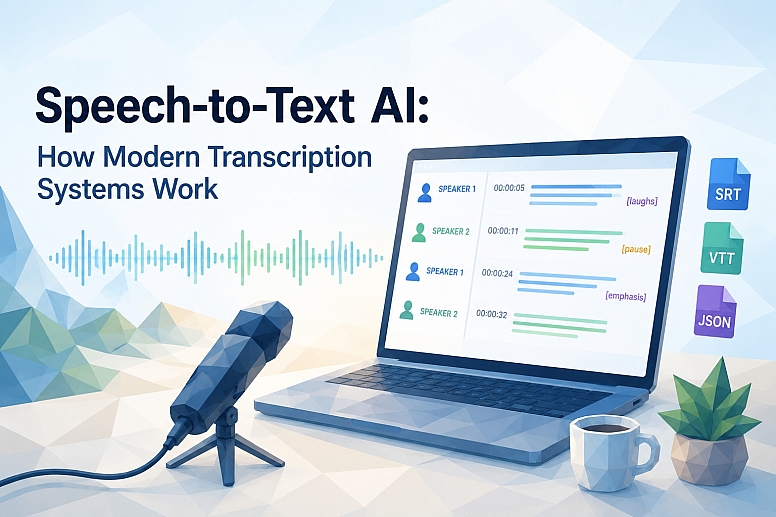
Speech-to-Text AI: How Modern Transcription Systems Work
A journalist records a ninety-minute interview, uploads it to a transcription tool, and gets back a wall of text with no speaker labels, no punctuation around filler words, and no way to tell where the interviewee laughed or paused for effect. This is the gap between basic dictation software and a properly engineered Speech-to-Text AI pipeline.
The underlying technology has moved fast in the last few years, from rigid, grammar-constrained recognizers to end-to-end neural models that handle accents, overlapping speech, and multiple languages in a single pass.
- Core technology: Deep learning acoustic models (transformer - or conformer-based) replacing older HMM-GMM pipelines
- Input handling: Raw audio/video files, live audio streams, multi-speaker recordings
- Primary output: Time-stamped transcript, optionally with speaker labels and paralinguistic tags
- Common export formats: Plain text, SRT, VTT, JSON
- Business value: Searchable content, accessibility compliance, faster content repurposing
- Primary failure mechanisms: Background noise, overlapping speakers, domain-specific vocabulary, poor audio bandwidth
How Speech-to-Text AI Systems Process Audio
Modern ASR (automatic speech recognition) systems break the problem into acoustic modeling, language modeling, and decoding. The acoustic model maps short audio frames to phoneme probabilities; the language model constrains which word sequences are plausible; the decoder searches for the most likely transcript given both.
Foundation model-based systems increasingly collapse this pipeline into a single end-to-end network trained on massive multilingual datasets, which is why cross-accent and cross-language accuracy has improved sharply over the last two or three years.
According to Grand View Research, the speech-to-text API market was valued at $3.8 billion in 2024 and is projected to reach $8.6 billion by 2030, largely driven by demand from media, customer support, and accessibility use cases rather than dictation alone.
Where Plain Transcripts Fall Short
Raw text output is often the easy 80% of the problem. The harder part is metadata: who said what, when they said it, and how they said it. Voice-to-text models that only output flat text force editors to manually re-listen and tag speaker changes, which defeats much of the time savings automated transcription tools are supposed to provide.
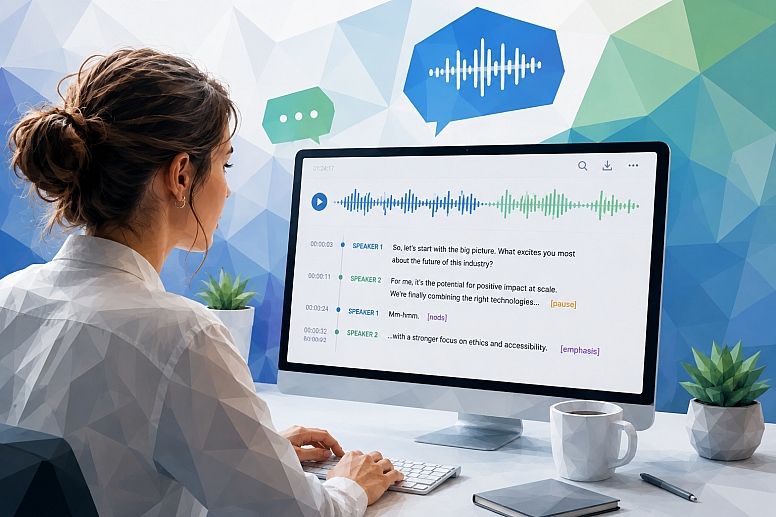
This is where speaker diarization and paralanguage detection matter. A handful of tools now separate speakers automatically and tag non-verbal events like pauses, laughter, or emphasis directly inline.
Fish Audio, for example, outputs speaker-labeled segments alongside inline emotion & paralanguage tags, and exports directly to SRT, VTT, or JSON, so a transcript can go straight into a subtitle workflow or a downstream tool without reformatting. It's a useful illustration of where the category is heading: transcription as structured data, not just text.
Comparative Analysis of ASR Approaches
|
Approach |
Speaker Detection |
Paralanguage Tags |
Export Formats |
Typical Use Case |
|
Legacy dictation software |
No |
No |
Plain text |
Single-speaker note taking |
|
Standard cloud ASR APIs |
Often basic |
No |
Plain text, sometimes SRT |
Call center QA, subtitling |
|
Modern multi-speaker transcription (e.g. Fish Audio) |
Yes, automatic |
Yes |
SRT, VTT, JSON |
Podcasts, interviews, panel discussions |
Common Pitfalls in Deploying Speech-to-Text AI
Pitfall: "Any transcription engine will do for interview content." Interview and podcast audio involves overlapping speech and frequent speaker changes, which is exactly where older, single-speaker-tuned engines break down. Voice-to-text models trained specifically on conversational, multi-speaker audio perform noticeably better here.
Pitfall: "Transcripts are just for accessibility." Transcripts also feed SEO (searchable episode pages), repurposing (show notes, social clips), and increasingly, downstream voice production. Treating transcription as a one-off accessibility checkbox undersells what audio transcription engines can support.
Pitfall: "More languages always means better accuracy." Broad language coverage is useful, but accuracy within your specific language and audio conditions matters more than the total number of supported languages advertised.
Frequently Asked Questions
What's the difference between ASR and a full Speech-to-Text AI pipeline?
ASR refers narrowly to the acoustic-to-text conversion step. A full pipeline adds speaker diarization, punctuation restoration, paralanguage tagging, and export formatting, which is what most real-world workflows actually need.
Do I need speaker labels if I only have one speaker?
No. Speaker detection only adds value for multi-speaker recordings like interviews, panels, or meetings.
Which export format should I use?
SRT for most video platforms, VTT for web-native embeds, and JSON if you're feeding the transcript into another tool or a custom pipeline.
As speech recognition technology keeps improving, the meaningful differentiator is shifting away from raw word accuracy, which is now good across most providers, and toward structured output: who spoke, how they said it, and how easily that data exports into the next tool in the workflow.
That's the direction Speech-to-Text AI is heading, and it's worth evaluating any tool against that bar rather than transcription accuracy alone.







0.3703