


How Remote Access Tools Transform IT Support for Businesses
Nearly two in five UK employees now work either fully remotely or in a hybrid set-up, according to TechRadar. So, modern IT teams are no longer supporting one office with one server room. They are supporting homes, shared workspaces, mobile devices, and cloud platforms all at once.
Remote access tools have stepped into that gap. From faster troubleshooting to stronger cybersecurity, they are reshaping how IT support for modern businesses operates every single day.
Faster Issue Resolution
Speed matters when a sales team cannot access files or when finance software freezes at the month-end. Every minute of downtime costs money and momentum.
Recent reporting shows that hybrid and remote work remain widespread across the UK workforce. For your business, that means IT cannot rely on walking to someone’s desk.
Remote access tools allow technicians to, for example:
- Securely connect to a device in seconds
- View the screen in real time
- Resolve the issue without travel or delay
Support teams can now handle more tickets per day because time once spent commuting between desks or sites is used for actual problem solving instead. Therefore, employees stay productive, and frustration drops quickly when help arrives almost instantly.
Reduced Operational Costs
Running on-site support for multiple locations is expensive. Travel costs, fuel, and lost technician hours all add up quickly. Conversely, fewer site visits mean learner support teams can manage larger estates without sacrificing service quality.
Cloud-based remote access platforms also reduce the need for duplicated hardware at every branch. Centralised control allows updates, patches, and monitoring to happen from one dashboard instead of multiple physical locations.
Stronger Security and Controlled Access
Remote work has expanded the attack surface for many organisations. More devices and more locations mean more potential entry points. Remote access must be secure, audited, and tightly controlled.
Modern remote access tools now include role-based permissions, multi-factor authentication, and detailed session logging. Instead of sharing passwords or granting blanket access, administrators can define exactly who can access what and for how long.
Businesses that invest in secure remote access reduce risk while maintaining flexibility. Security becomes built in rather than bolted on.
Scalable Support for Growing Businesses
Growth creates complexity. New hires, new devices, and new locations can overwhelm traditional IT structures.
Expansion becomes far easier when support systems scale alongside the workforce. Remote access tools allow IT teams to onboard employees quickly, configure systems remotely, and provide training without waiting for a physical setup.
Key scalability benefits? They include:
- Rapid device configuration without on-site visits
- Centralised software deployment across multiple regions
- Immediate support for remote or travelling staff
Businesses can expand into new markets without building full IT teams in each location. Technology becomes an enabler of growth rather than a bottleneck.
Improved Employee Experience and Productivity
Employees expect seamless technology. Delays in support often lead to frustration, missed deadlines, and reduced morale.
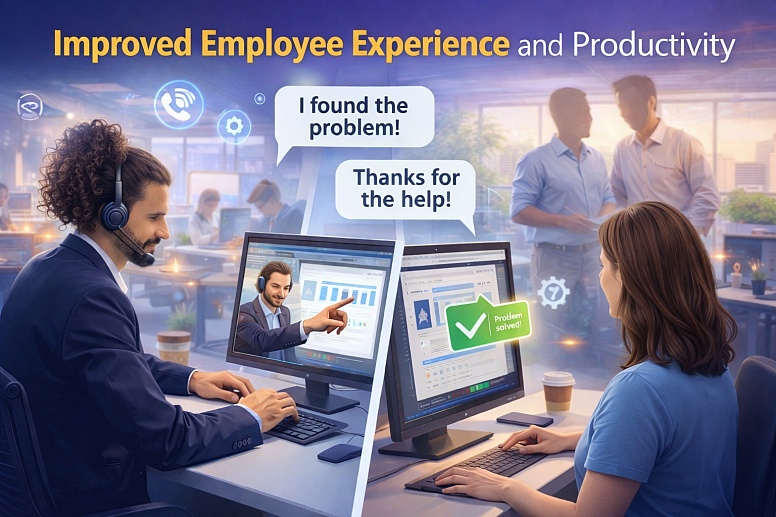
Remote access allows technicians to guide users in real time while seeing exactly what is happening on screen. So, problems are diagnosed accurately on the first attempt rather than through lengthy email exchanges.
Also, clear communication reduces misunderstandings and shortens resolution times.
Better support experiences build trust between departments, as well. Staff can feel supported rather than stranded when technical issues arise.
Enabling Proactive Rather Than Reactive IT
Traditional IT support often waits for something to break. Modern remote access tools shift the model towards proactive maintenance.
Continuous monitoring and remote diagnostics help teams detect unusual behaviour before it disrupts operations. Patches and updates can be deployed outside business hours without physical access to devices.
Prevention then becomes part of the everyday workflow rather than an afterthought.
Managed service providers and internal IT teams increasingly rely on multiple disconnected tools for monitoring, access, and troubleshooting. Over time, this creates operational inefficiencies, delays in issue resolution, and potential security gaps—especially when managing distributed environments.
As these risks grow, relying on fragmented tools is no longer sustainable for IT teams managing distributed environments. Without a centralized system, businesses face slower response times, inconsistent support, and increased exposure to security vulnerabilities. To overcome these challenges, adopting a unified solution becomes essential. Implementing reliable remote desktop software allows teams to securely access endpoints, resolve issues in real time, and manage operations from a single centralized platform.
This not only improves response times but also eliminates the need to juggle multiple tools, helping IT teams stay efficient and secure at scale.
Modern businesses benefit from having one unified solution instead of a patchwork of disconnected systems.
Building Future Ready IT Support With Remote Access Tools
Remote access tools are no longer optional extras. They form the backbone of IT support for distributed, fast-moving organisations.
Remote access tools enable faster resolutions, lower costs, improved security, and scalable growth. Businesses that embrace secure platforms such as Acronis create a support structure that matches how people actually work today.
If your organisation is rethinking its IT strategy, explore how remote access tools can strengthen your support model. And if you found this article to be helpful, be sure to take a look at our other informative content.






0.312