



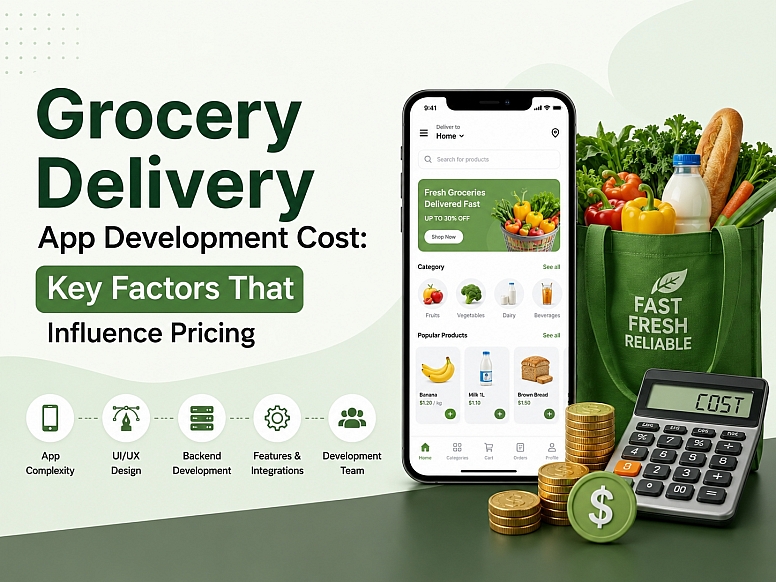
Key Pricing Factors: Grocery Delivery App Development Cost
The way people shop for daily requirements has changed because of the explosive expansion of on-demand services. They offer comfort, speed, and versatility; grocery shopping apps have grown in reputation. To stay competitive, quite a few groups, from big grocery store chains to tiny stores, are genuinely investing in grocery shopping apps.
However, one of the most regularly requested questions from organization proprietors is the cost of developing a grocery delivery app. Depending on some of the variables, along with functions, platform, design complexity, and the improvement team’s place, the cost may vary dramatically.
To help you in planning your budget, we are going to take a look at the number one factors that affect the cost of developing a grocery delivery app.
Why Companies Are Investing in Grocery Delivery Apps
Before discussing the grocery app development price, it's far more important to recognize the reasons behind its reputation.
Due to transferring customer behaviour and growing cellphone usage, online grocery shopping has improved extensively in recent years. Nowadays, customers opt for the use of cell apps to get groceries, as it saves time and eliminates the need to go to busy stores.
Companies that spend on on-demand grocery apps development can gain an advantage:
- Increased customer reach
- More possibilities for income
- Improved inventory management
- Enhanced interaction with customers
Grocery delivery apps are a desirable preference for stores seeking to boost their online presence due to these advantages.
Average Cost of Developing a Grocery Delivery App
The complexity of the app, the development team, the capabilities, and the platform all affect how much it costs to design a grocery shopping app.
In general, the projected cost ranges are:
- Basic Grocery app: $15,000-$30,000
- Mid-level grocery app: $30,000-$60,000
- Advance grocery delivery platform: $60,000-$1,20,000
Businesses can choose the best characteristic set and cost based on their requirements by collaborating with a seasoned grocery delivery app development company.
Important Elements Affecting the Cost of Grocery App Development
The overall price of developing a grocery delivery app is directly impacted by a variety of factors. Let's check out the most crucial factors.
Features and Functions of the App
The amount and complexity of features are the primary factors influencing the overall development cost and grocery delivery mobile app features. Typical fundamental grocery programs encompass:
- Registration and login of customers
- Browsing products
- Filters and search
- Purchasing cart
- Safe payments gateways
- Order tracking
Advanced packages can also encompass:
- AI-driven pointers
- Delivery tracking in real time
- Voice search
- Grocery delivery that calls for a subscription
- Management of many stores
The grocery app development price rises as more sophisticated functions demand more time.
Selecting a Platform (iOS, Android, or Both)
The platform you choose has an enormous effect on grocery delivery app development cost. Generally, organizations have 3 selections:
- Development of Android Apps: Because the Android system dominates the global smartphone market, Android apps allow businesses to reach a large consumer base.
- Development of iOS Apps: iOS apps could have higher engagement rates and regularly draw in top-class users.
- Development Across Platforms: Cross-platform frameworks reduce development time and value by enabling developers to create a single application that features on both iOS and Android.
For startups trying to maximize their price range, a variety of agencies that offer grocery app development services offer cross-platform solutions.
User Experience and App Design
A grocery delivery app's user interface (UI) and user experience (UX) layout are vital to its fulfillment.
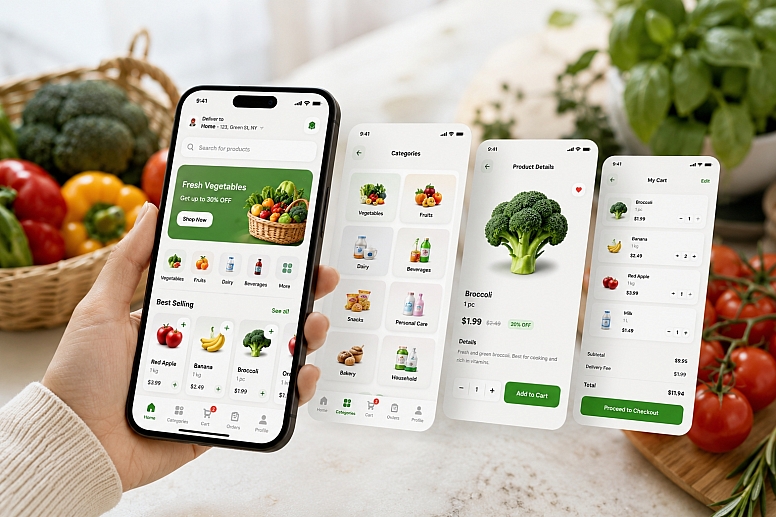
Customers may additionally explore products, upload items to their cart, and finalize orders without difficulty through a properly designed interface.
Animations, custom-designed dashboards, and seamless navigation are examples of advanced user interface components that enhance development complexity and affect the overall grocery delivery app development cost.
Because a bad user experience would possibly bring about app abandonment, it is vital to put money into intuitive design.
Backend Infrastructure
Through the management of data, orders, stock, and user statistics, the backend infrastructure helps the complete application. Typically, a robust backend system consists of:
- Management of databases
- Configuration of the server
- Integrations with APIs
- Systems for order management
- Monitoring stock
For on-demand grocery app development structures to carry out well and manage heavy user site visitors, scalable backend solutions are critical.
The overall cost and development time are elevated through a more sophisticated backend structure.
Integrations with Third Parties
To increase capability, a whole lot of grocery store applications use third-party solutions. These integrations should include:
- Payment gateways (Stripe, PayPal, Razorpay)
- GPS and map services for tracking deliveries
- Push notification and SMS services
- Tools for analytics and reporting
The final development budget may be impacted by the complexity that each integration adds to the grocery app development process.
Location of the Development Team
Pricing is also influenced by the development team's location. Hourly prices vary by region.
Typical hourly charges consist of:
- North America: $80 to $150 per hour
- Europe: $50 to $120 per hour
- Asia: $25 to $60 an hour
In areas where prices are competitive, many companies use a seasoned grocery delivery app development company to strike a balance between price and quality.
Ready-Made vs Custom Solutions
Additionally, agencies have to choose between developing a custom grocery app and the usage of pre-made alternatives.
Although ready-made solutions offer much less flexibility, they're lower-cost and quicker to start.
Custom development enables agencies to create apps that are suitable for their unique requirements, workflow, and branding. Custom apps provide more scalability and long-term benefits, regardless of requiring larger preliminary funding.
Procedure for Developing Grocery Apps
Businesses may additionally plan their tasks more efficiently if they have a better knowledge of the grocery app development process.
Planning and Market Research
Analyzing opponents, figuring out target customers, and establishing app objectives are the first steps.
UI/UX Design: To specify the interface format and user experience, designers produce wireframes and prototypes.
Development of Apps: The software's backend and frontend systems are created by developers.
Quality Control and Testing: The utility is positioned through several tests to guarantee seamless speed, security, and functionality.
Launch and Deployment: The software program is launched on the app stores after testing is finished.
Upkeep and Modifications: The app is stored securely, contemporarily, and performance-optimized via ongoing maintenance.
To assure extremely good results, agencies that offer expert grocery app development services commonly adhere to this methodical process.
How to Lower the Cost of Developing Grocery Delivery Apps?
Although developing a grocery app can be pricey, there are several ways corporations can reduce costs:
- Create a Minimum Viable Product (MVP) first.
- Select cross-platform development.
- Prioritize the most crucial aspects.
- Partner with a pro development team
- Make a scalability plan in advance.
These approaches guarantee a manageable and scalable solution while lowering the grocery app development price.
Future Developments in Apps for Grocery Delivery
The marketplace for grocery delivery continues to develop thanks to the new generation, such as:
- AI-driven product guidelines
- Voice-activated grocery ordering
- Autonomous delivery structures and drones
- Customized shopping encounters
By making use of these modern technologies, agencies making an investment in on-demand grocery app development nowadays may also maintain their competitive edge.
Depending on abilities, layout complexity, platform selection, and the development team involved, the cost of developing a grocery delivery app might also vary appreciably. Advanced solutions with unique competencies can cost over $100,000, and simple apps may cost a little about $15,000.
Companies that need to create a grocery delivery app want to cope with choosing the ideal features, deciding on a reliable development partner, and adhering to a methodical grocery app development approach.
Working with a leading grocery delivery app development company guarantees that your application will be stable, scalable, and able to adapt to changing client needs. A grocery delivery app might end up a strong digital asset for modern retail agencies with the appropriate plan and development method.
FAQs
What is the average grocery delivery app development cost?
Depending on functions, complexity, and the location of the development team, the cost generally falls between $15,000 and $120,000.
How long does it take to build a grocery delivery app?
While sophisticated apps could take 6 to 9 months, primary grocery delivery apps usually take 3 to 5 months.
What are the key elements of a mobile grocery delivery app?
Product search, shopping cart connection, steady payment integration, order monitoring, and push alerts are essential features.
Why choose custom grocery app development?
Flexibility, improved scalability, and unique functions catered to your business model are all provided through custom development.
Author’s Bio: Rachel Smith is a technology professional with expertise in app development and digital solutions at Octal IT Solution. She has hands-on experience in managing various projects across various industries.






0.2399