












Digital Mailbox Setup When Moving
Many jobs will already be done or organized before you move: the kitchen will be boxed up, the moving company booked and the electricity arranged. One thing you will also need to settle is where mail, for example statements from various accounts, will be sent.
A digital mailbox can be very beneficial in this situation, particularly if there is a gap of some weeks between leaving one home and moving into the next.
According to the U.S. Census Bureau's 2025 American Community Survey, 11.6% of the population aged one and older in the U.S. moved in the 12 months before the survey.
So here are some pointers on setting up a mailbox to receive your mail before you leave your property.
What You’ll Learn
- Work Out Where Your Mail Should Go
- Choose a Digital Mailbox That Fits Your Move
- Set Up and Verify Your Mailbox
- Redirect Your Mail Before Moving Day
- Manage Your Mail Once You’ve Moved
- What to Do With Your Mailbox Long Term
Work Out Where Your Mail Should Go
A digital mailbox provides a physical mailing address where staff receive mail on your behalf. You can view images of incoming envelopes online and then decide what action to take.
For instance, if there is a gap between the end of your current tenancy and the start of the next, a digital mailbox may be a convenient place to have key correspondence delivered, and you can simply log in to check as often as you wish.
A mailbox address is not necessarily the same as a home address. U.S. banks generally require a residential or business street address when opening a personal account, subject to exceptions. You should therefore ask each institution about its minimum requirements for verifying you as a customer, and whether an alternative address may be given for mailing.
Choose a Digital Mailbox That Fits Your Move
It may be advantageous to find one as near as possible to your new address, which is more convenient if you want to collect items. Alternatively, if you expect to be away a lot over the coming months, consider the costs of having items forwarded.
Also consider the options available for each item received. With iPostal1 mail handling plans, for example, you can view the outside of the envelope and then instruct the provider to open and scan it, or forward it to one or more addresses, among other options. This is handy if, for example, you want to view bills and statements without accumulating piles of correspondence.
Some features to compare:
- Incoming mail: How many items per month are included in the subscription?
- Scans: Is there a set cost per page or per item to have something scanned?
- Forwarding: What does it cost to forward one envelope or several packages?
- Storage: How long will they store items received?
- Collection and deliveries: Can I collect items myself? Can all carriers deliver there?
Try to gauge the volume of mail you currently receive in an average month, and add to it to allow for peaks, such as tax season.
Set Up and Verify Your Mailbox
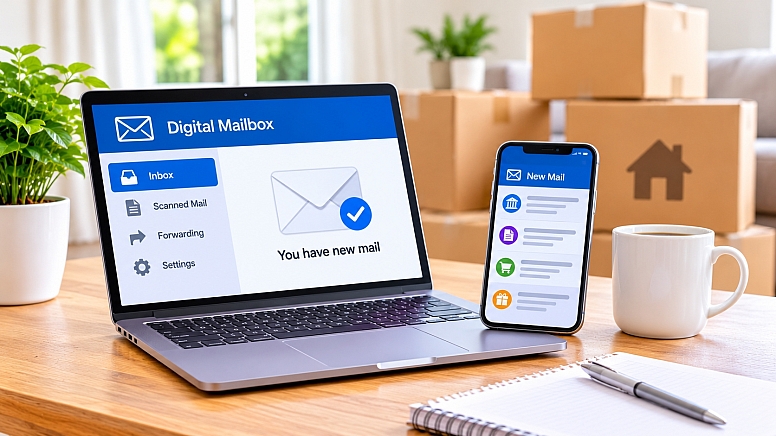
Allow adequate time to complete the necessary forms. The provider will be acting as a Commercial Mail Receiving Agency.
You will need to:
- Complete USPS Form 1583: This authorizes the provider, as your agent, to receive your mail at its address.
- Provide two acceptable forms of identification: One a photo ID and the other proof of your address.
For example, you could use your valid passport plus a current lease agreement, making sure the lease shows the same address as the one on Form 1583.
Your signature then needs to be witnessed by authorized staff at the provider or by a notary public in the U.S. or its territories. Witnessing may be possible remotely by live audio and video, at the provider's discretion.
Each adult who will receive mail needs a separate form, so for example, a husband and wife each complete one. A minor can be listed on a parent's form.
Make sure the residential address you give is correct. If any information on the form changes later, you must complete an updated form through your provider.
Notify relevant parties only once you have been told that you are set up to receive mail at the address, and note carefully every part of the address allocated to you, including "PMB" or "#" followed by the box number.
Redirect Your Mail Before Moving Day
Ideally, you wouldn't want to depend on receiving a letter and acting on the information in it, once you've moved. Many organizations should be notified of your new mailing address, most likely those that send time-sensitive information:
- Banks, credit unions, lenders and credit card companies
- Tax and other benefits offices
- Current employer, pension providers
- Home, health and car insurers
- Doctors, schools and any services paid for regularly
Tell your car insurer the new address and, where relevant, where the car will be garaged.
You can also ask USPS to forward eligible mail from your old address to your CMRA address. If you will be away for 15 days or more but expect to be back within 12 months, you may wish to request temporary mail forwarding.
Forwarding can take up to two weeks to start, and there are options to suit your circumstances. File separate requests for each person who is moving if surnames or destinations differ, or if others are staying behind.
However, forwarding covers most, but not all, mail sent through USPS: it specifically excludes Marketing Mail, and it does not help with anything delivered by other carriers. It also does not change the details held by third parties.
So it is sensible to keep a record of all the changes you make, check outstanding purchases to see whether any are likely to be delivered after you move, and notify vendors as necessary.
Manage Your Mail Once You’ve Moved
You will want to check frequently for new items during this time of change, perhaps every day, so you can identify anything that needs a prompt response.
Once you have looked at who an item is from and its apparent contents, you may choose to:
- Scan only: A scan of the document may be all you need.
- Forward: You may need the original, for example a new bank card or a document for signature.
- Keep: It is sensible to keep any originals and postmarked envelopes.
As noted above, it is always worth considering the source before requesting scans, noting any dates for action, and storing suitable electronic records securely. You may also wish to arrange for any confidential information to be securely destroyed.
Make sure you use a strong password specific to this site, and turn on further security if it is offered.
What to Do With Your Mailbox Long Term
Once things have settled down, you can judge how useful you find receiving mail this way. There may well be continued benefits, for example if you expect to move again or are often away.
Alternatively, you may want to end the arrangement, notify all relevant organizations and decide what to do with any mail currently held. Be aware that you cannot file a USPS change-of-address order for forwarding from this address.
When you stop using the service, the provider must continue to remail any incoming items to your last known address for at least six months, unless you give written instructions otherwise. Ask the provider about any charges and how to communicate any further change of address.
So with appropriate foresight and action before moving, and continued vigilance for a while afterwards, you should avoid any unwanted surprises and be free to enjoy your new home.






0.4323