




5 Billing Workflows to Speed Up Client Payments
When cash flow feels unpredictable, billing workflows often need attention. A few practical changes can significantly reduce the time between sending an invoice and receiving payment.
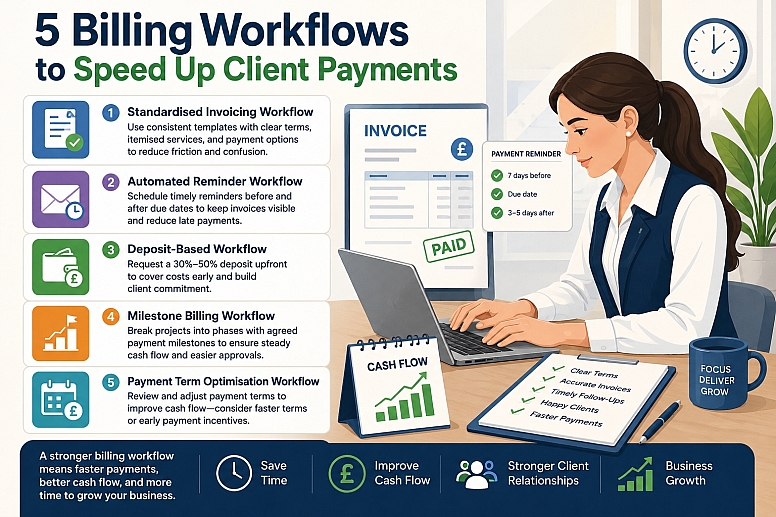
1. Standardised Invoicing Workflow
Inconsistent invoices create friction. Missing details, unclear due dates, or vague service descriptions give clients a reason to delay approval.
Using structured templates removes that friction. The Invoice Simple playbook, for instance, includes a practical bill template for Excel users.
The templates are easy to download, customise, and send, without needing to rebuild your format each time.
To keep this workflow tight, focus on three essentials:
- Clear payment terms and exact due dates
- Itemised services written in plain language
- Accepted payment methods are listed prominently
Clarity reduces back-and-forth questions. When clients immediately understand what they owe and how to pay, payment cycles shorten naturally.
2. Automated Reminder Workflow
Manual follow-ups drain time and energy. Research from the Small Business Commissioner shows that 22% of businesses spend an average of 86 hours per year chasing late payments. Reclaiming even part of that time can directly improve productivity and profitability.
An automated reminder workflow keeps invoices visible. Schedule reminders seven days before the due date, on the due date, and three to five days after.
Set Expectations From the Start
Explain your reminder process when agreeing on payment terms. Clients respond better when reminders feel routine rather than reactive.
Keep Communication Brief and Professional
Reference the invoice number, amount, and due date without emotional language. Short reminders make it easy for clients to act quickly.
Automation protects relationships. Your system handles the nudge, allowing you to stay focused on delivering value.
3. Deposit-Based Workflow
Waiting to invoice until project completion increases exposure. A deposit-based workflow improves cash stability from day one.
According to the Coface UK Payment Survey 2025, payment delays remain widespread, with smaller firms feeling the pressure most. Securing part of the payment upfront reduces reliance on future collections.
Requesting 30% to 50% before work begins covers initial costs and signals commitment. Remaining balances can be tied to defined milestones.
Deposits also change behaviour. Clients who invest early tend to stay responsive and engaged throughout the project.
4. Milestone Billing Workflow
Large final invoices can trigger hesitation. Breaking fees into smaller milestone payments keeps revenue flowing more consistently.
Instead of one large invoice at completion, divide the project into phases with agreed payment triggers. Each invoice then becomes more manageable and easier to approve internally.
Milestone billing improves transparency. Clients clearly see the connection between completed work and payment, which reduces disputes and accelerates processing.
Align contracts, scopes of work, and invoices carefully. Consistency across documents prevents unnecessary delays. Finance teams can use ProcureDesk to carry that consistency into purchasing by routing approvals and matching supplier invoices to purchase orders.
5. Payment Term Optimisation Workflow
Defaulting to 30-day terms may not suit every business. Payment terms directly influence financial stability.
Payment structures affect cash flow and financing pressure. Shorter cycles reduce strain and improve predictability.
Consider offering 14-day terms for new clients or small early-payment incentives. Even modest adjustments can produce noticeable improvements over time.
Reviewing terms annually ensures your billing process evolves alongside your business.
Strengthening Your Billing Workflow to Speed Up Payments

Late payments interrupt planning and growth. A structured billing workflow to speed up client payments brings consistency, clarity, and control.
Standardised templates, automated reminders, deposits, milestone billing, and optimised terms each address a different bottleneck. Even one adjustment can improve turnaround within a single billing cycle.
If your invoicing process feels scattered, refining it is a practical next step. Invoice Simple offers tools designed to simplify billing and present your business professionally. So, explore your options, review your workflow, and take action that helps clients pay faster and more reliably.
Has this article been helpful? Then take a moment to check out some of our other informative content!







0.3323