












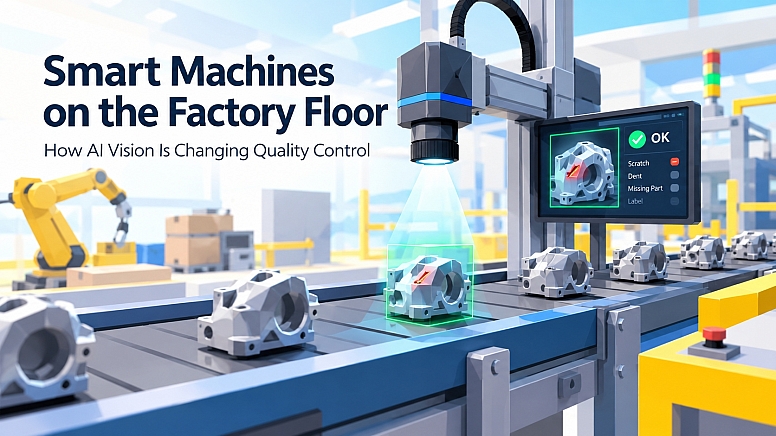
AI Vision: Smart Machines on the Factory Floor
Smart Machines on the Factory Floor: How AI Vision Is Changing Quality Control
Every manufacturer knows the cost of a defect that slips through. A scratched housing, a missing component, or a misprinted label might seem minor on the production line, but once it reaches a customer, it can mean returns, rework, damaged reputations, and, in regulated industries, serious compliance problems. For decades, catching those defects relied heavily on human eyes and simple automated checks.
That is changing quickly. Artificial intelligence combined with modern camera hardware is giving production lines a new kind of inspector, one that does not tire, works at line speed, and keeps getting better as it learns.
Why Inspection Has Always Been a Bottleneck
Manual inspection has obvious strengths. People are flexible, can spot unusual problems, and understand context. But they also get tired, distracted, and inconsistent, especially during long shifts examining thousands of near-identical parts. As production speeds increase and tolerances tighten, relying on human inspection alone becomes harder to sustain.
Traditional machine vision has helped by automating simple checks, such as measuring dimensions or confirming that a part is present. These systems work well for clearly defined tasks but struggle with variation: natural differences in materials, subtle surface defects, or problems that are easy for a person to recognise but hard to describe in fixed rules.
How AI Vision Changes the Picture
AI-based inspection takes a different approach. Instead of following rules written by an engineer, the system learns from examples of good and defective products. Paired with a defect-detection embedded vision camera positioned along the line, the software analyses each image and decides whether an item meets the standard, flagging scratches, dents, contamination, or assembly errors in a fraction of a second.
Some approaches go further, learning what a normal product looks like and highlighting anything that deviates from it. That is particularly useful when defects are rare or varied, because the system does not need examples of every possible fault to recognise that something is wrong. Depending on the setup, processing may happen on a dedicated computer near the line or on hardware integrated with the camera itself.
Where Manufacturers Are Seeing Results
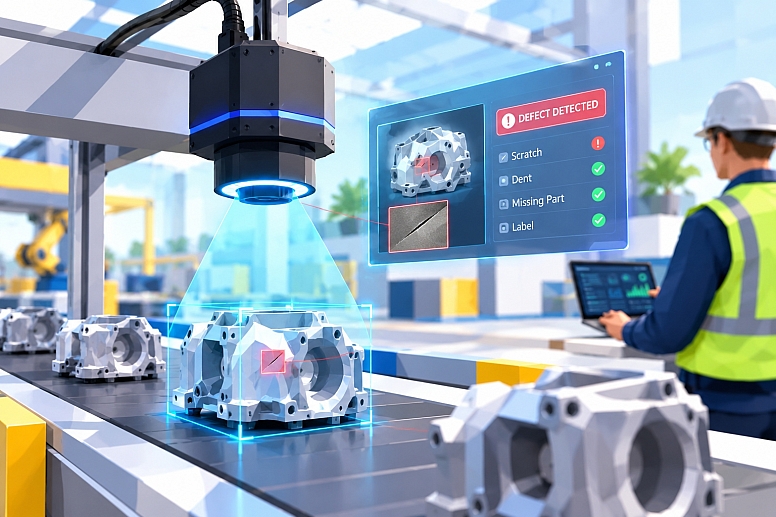
AI vision is being applied across a wide range of industries, from electronics and automotive parts to food, pharmaceuticals and packaging. Certain inspection tasks have proven especially well suited to the technology.
- Surface defects: Scratches, cracks, dents and discolouration on metal, plastic, glass and painted surfaces are classic targets. AI models can distinguish real defects from harmless variation in texture or reflection more effectively than rigid rules.
- Assembly verification: Cameras confirm that every component is present, correctly oriented and properly seated. This helps catch missing screws, reversed connectors, or misaligned parts before products move further down the line.
- Labels and printing: Vision systems read text, barcodes and date codes to check accuracy and legibility. In food and pharmaceutical production, where labelling errors can trigger recalls, this is a valuable safeguard.
- Packaging integrity: Seals, fill levels and closures can be inspected automatically. Faulty packaging is caught before it reaches distribution, reducing waste and spoilage.
- Dimensional checks: Combined with careful calibration, cameras can measure features and confirm that parts fall within specification. This supports consistent quality without slowing production.
The common thread is consistency. An AI inspection system applies the same standard to the first item of the day and the ten-thousandth, which makes quality more predictable and provides a detailed record of every check.
Rules-Based and Learning-Based Inspection
AI does not make traditional machine vision obsolete. For precise measurements and well-defined checks, rules-based systems remain fast, transparent, and easy to validate. Learning-based systems shine where defects are irregular, materials vary naturally, or the appearance of a good product is hard to describe precisely. Many factories end up using both, choosing the approach that best fits each inspection point.
Getting It Right
Lighting and Optics Come First
No algorithm can find a defect the camera cannot see. Lighting is often the single most important factor in inspection quality. Diffuse lighting can reduce glare on shiny surfaces, backlighting can reveal edges and holes, and angled lighting can make scratches and texture stand out. Choosing the right lens, resolution, and camera position is equally important, and these decisions should be made before any software is trained.
Data and False Rejects
AI models need good training data that reflects real production conditions, including normal variation and a range of defects. Teams must also balance two kinds of error: letting bad parts through and rejecting good ones. Set the system too strictly, and it wastes good product; set it too loosely, and defects escape. Ongoing monitoring and periodic retraining help keep that balance right as materials, suppliers, and processes change.
People Still Matter
Smart inspection does not remove people from quality control. It changes their role. Instead of staring at parts for hours, quality staff review flagged items, investigate root causes, and use inspection data to improve processes upstream. The most successful projects involve operators and quality engineers from the start, combining their knowledge of the product with the speed and consistency of the machine.
A Clearer View of Quality
AI vision is helping manufacturers catch more defects, reduce waste, and understand their processes in greater detail. It is not a plug-and-play solution, and success depends on good lighting, careful data, and thoughtful integration.
But for factories facing rising quality expectations and pressure to do more with fewer people, smart machines that can see are quickly becoming one of the most practical tools available on the factory floor.







0.4586